'Empty Confirmation Hearings' Continue After Prime Minister Kim Minseok
Witness Adoption Fails Due to Ruling Party's Overwhelming Majority
Possibility of Linkage with Amendment to the Confirmation Hearing Act
After the confirmation hearing for Prime Minister Kim Minseok, confirmation hearings without witnesses or reference persons have become the 'new normal.' During the so-called 'super week' of confirmation hearings for the new government's ministers, several hearings proceeded without the adoption of any witnesses or reference persons. As a result, the issues of adopting witnesses and reference persons, as well as the discussion of conducting morality verification behind closed doors, are increasingly likely to be addressed together in discussions to amend the Confirmation Hearing Act.
Of the four confirmation hearings held at the National Assembly on July 14, there are no agreed-upon witnesses for the hearings of Baek Kyunghoon, candidate for Minister of Science and ICT; Chung Dongyoung, candidate for Minister of Unification; and Jun Jaesoo, candidate for Minister of Oceans and Fisheries. For the confirmation hearing of Kang Sunwoo, candidate for Minister of Gender Equality and Family, only two witnesses unrelated to the controversial 'abuse of aides' allegations were adopted.
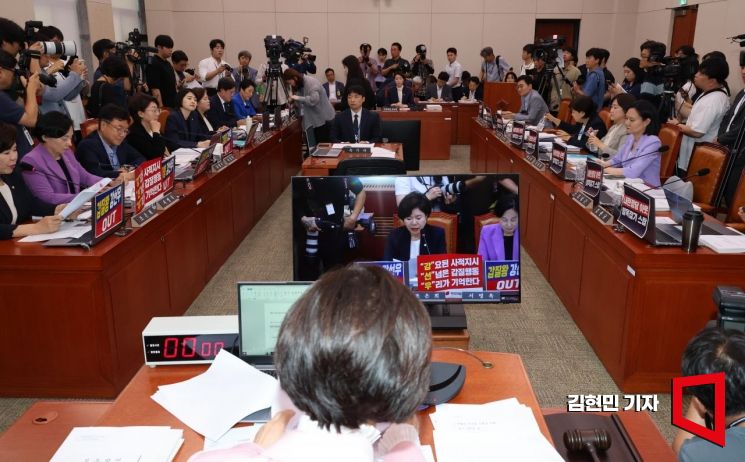 On July 14, at the National Assembly's Gender Equality and Family Committee hearing for Kang Sungwoo, Minister of Gender Equality and Family, placards were attached to the seats of ruling and opposition party lawmakers. 2025.7.14 Photo by Kim Hyunmin
Regarding this, Song Eonseok, interim leader and floor leader of the People Power Party, criticized at an emergency party meeting held at the National Assembly, saying, "They are creating empty confirmation hearings without document submissions or witness adoptions by the candidates, employing Kim Minseok's so-called 'bed soccer' tactic, where they just need to endure for a day." Previously, during Prime Minister Kim's confirmation hearing, an unprecedented hearing was held without any witnesses or reference persons.
Ruling and opposition parties decide on witnesses either by agreement or by vote, but if the opposition requests the adoption of a specific witness, the ruling party often rejects it, causing the process to fall through. Especially since the Democratic Party holds a majority in all standing committees, the opposition has few means to force the adoption of witnesses other than public pressure. As a result, disputes over the adoption of witnesses and submission of materials have arisen at every hearing.
The Democratic Party is considering linking the move to hold morality verification sessions behind closed doors to an amendment of the Confirmation Hearing Act, using the current situation of confirmation hearings proceeding without witnesses as an opportunity. Kim Sanghyuk, chief spokesperson for the Democratic Party, said on YTN Radio that day, "Regarding confirmation hearings, it is appropriate for matters related to morality to be conducted privately, with materials provided accordingly," adding, "In public hearings, it seems right to focus questions on policy matters."
Previously, Democratic Party lawmaker Kwon Chilsung proposed an amendment to the Confirmation Hearing Act that would require morality verification to be conducted privately while strengthening regulations on the submission of materials.
© The Asia Business Daily(www.asiae.co.kr). All rights reserved.
![Clutching a Stolen Dior Bag, Saying "I Hate Being Poor but Real"... The Grotesque Con of a "Human Knockoff" [Slate]](https://cwcontent.asiae.co.kr/asiaresize/183/2026021902243444107_1771435474.jpg)
















