Frequent Flooding Since Sayeon Dam Construction... Average of 42 Days Submerged Each Year
Need for Drinking Water Solutions if Floodgates Are Installed at Spillway
Ulsan Plans to Develop the Site as a Historical and Tourist Attraction Despite Water Issues
The UNESCO World Heritage Committee inscribed the 'Banguchon Petroglyphs' on the World Heritage List on July 12 (local time) and recommended that progress reports on the Sayeon Dam construction be submitted. The Sayeon Dam is a natural overflow-type dam built in December 1965 at the downstream point of the Daegokcheon stream to secure industrial and domestic water supplies. When heavy rain fills the dam reservoir, the upstream petroglyphs inevitably become submerged.
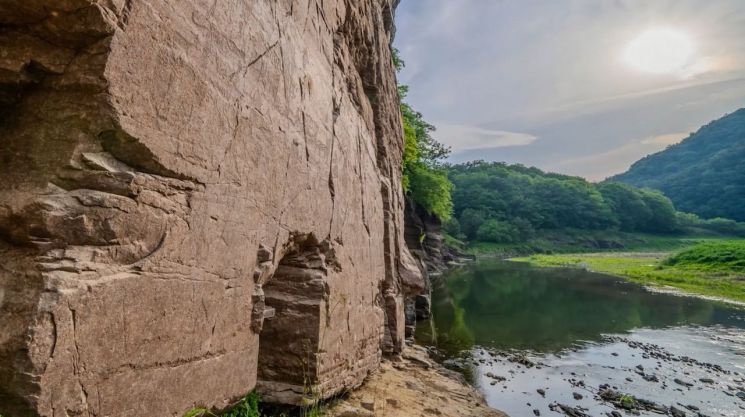
The Bangudae Petroglyphs in Daegok-ri, Ulju, were discovered in December 1971 by a team of professors from Dongguk University, six years after the Sayeon Dam was constructed. At the time, most of the engravings on the lower part of the rock were already underwater. Water flowing from the upper Daegokcheon could no longer pass downstream and pooled in front of the Bangudae rock. As the water accumulated, it gradually rose up the rock, covering the petroglyphs engraved at lower elevations one by one.
The images of whales, deer, and tigers at Bangudae had to spend several months each year underwater. Only in late autumn or winter, when the water receded, could the petroglyphs, covered in mud and pollutants, dry in the sunlight. However, stagnant water that could not flow emitted a characteristic fishy odor, and at times, algal blooms made the water appear murky.
If this vicious cycle continues, the images of the petroglyphs lose their form. The engraved outlines become so blurred that they are no longer recognizable. In fact, the human face once visible on the Bangudae rock from the hill across the Daegokcheon is now impossible to see with the naked eye.
There have been efforts to rescue the petroglyphs from the water. Attempts included installing cutoff walls, building ecological embankments, redirecting the watercourse through a tunnel, and installing a kinetic dam (a movable temporary barrier). However, all of these were abandoned due to concerns about low feasibility or potential damage to the surrounding landscape.
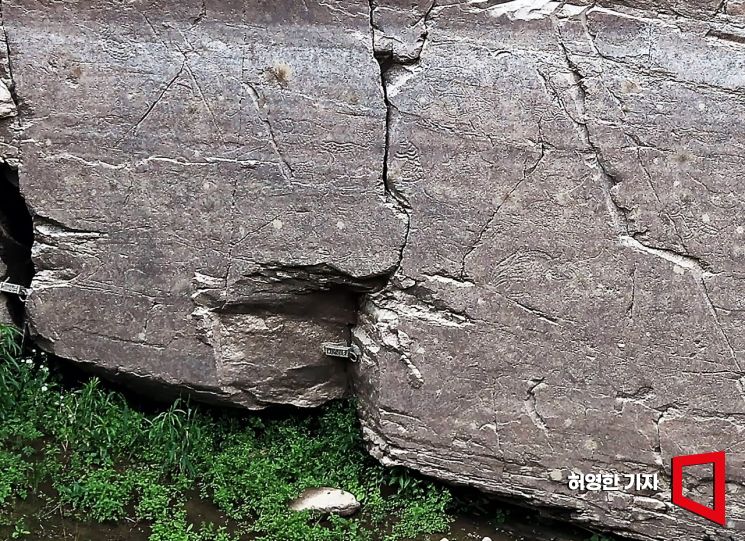 A part of the Bangudae Petroglyphs in Eonyang-eup, Ulju-gun, Ulsan Metropolitan City. Photo by Heo Younghan
Currently, the water level of the Sayeon Dam is being adjusted to prevent flooding, but this is only a temporary solution. The dam's full reservoir level is at an elevation of 60 meters above sea level, while the petroglyphs are located between 53 and 57 meters. If the dam level reaches 53 meters, parts of the petroglyphs become submerged, and if it exceeds 57 meters, they are completely underwater.
According to Korea Water Resources Corporation, which operates the Sayeon Dam, the petroglyphs have been submerged an average of 42 days per year over the past ten years, from 2014 to 2023. However, as of early this month, there has been no submersion damage this year. This is because there has not been enough rainfall for the petroglyphs to be submerged.
The National Heritage Administration and Ulsan City established a plan in 2021 to install floodgates at the dam spillway in order to keep the Sayeon Dam's water level low. Currently, basic and detailed designs are underway. If all procedures proceed smoothly and construction begins in the second half of next year, completion is expected around 2030.
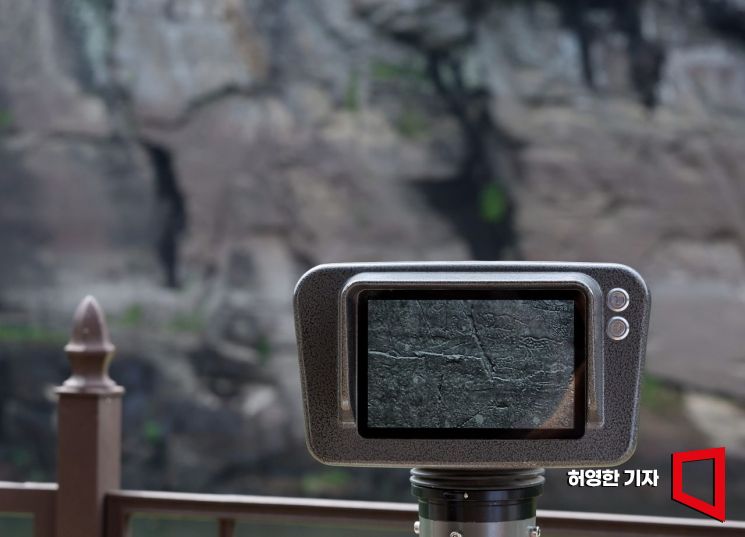 A magnified view of the Bangudae Petroglyphs in Eonyang-eup, Ulju-gun, Ulsan Metropolitan City, through an electronic telescope
The key issue is how to address the resulting shortage of drinking water as the water level decreases. Ulsan City stated, "If the Sayeon Dam's water level is lowered, Ulsan will face a daily shortage of about 49,000 tons of drinking water compared to before," and added, "Considering future demand, even more water will need to be secured."
The government is pursuing a plan to make up for the shortfall by bringing in water from the Unmun Dam in Cheongdo-gun, North Gyeongsang Province. However, neither the specific volume nor the supply timeline has been determined. Separately, as Daegu City is implementing the 'Clean Water Highway' project to receive water from the Andong Dam, there is a high possibility that water from the Unmun Dam will be supplied to Ulsan. However, since the Lee Jaemyung administration plans to conduct a full review, it is too early to be optimistic.
Even if inter-regional water supply agreements are smoothly reached, the problem does not end there. A 44-kilometer water conduit must be installed from Unmun Dam to Ulsan. It will require additional waiting for this multi-billion-won project to become a reality.
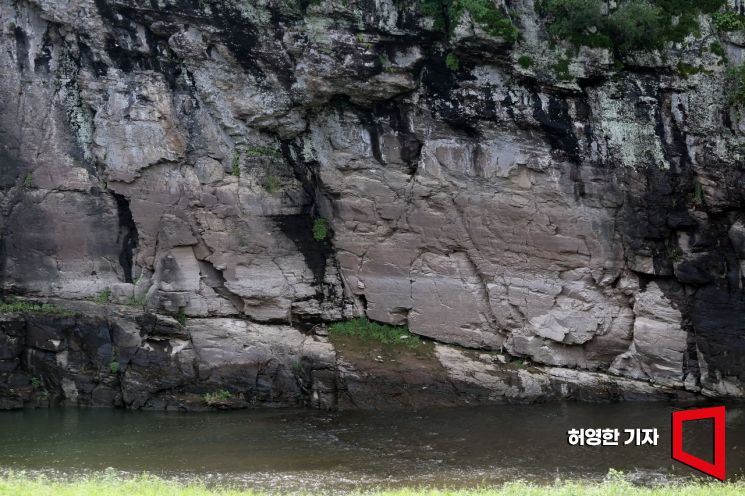
Despite the unresolved water issue, Ulsan City is actively cooperating in the preservation of the Banguchon Petroglyphs. Recently, the city has also launched a comprehensive maintenance planning project for the area surrounding the petroglyphs. Once the maintenance plan is established, the area will be managed with a focus on preservation and utilized as a sustainable tourism resource. The city also plans to build a World Petroglyph Center and develop trails to turn the site into a historical and tourist attraction.
Ulsan Mayor Kim Dukyum said, "Through the establishment of a comprehensive maintenance plan, we aim to promote domestic and international academic research, apply preservation technologies, and revitalize the local economy," adding, "We will spare no effort to ensure that Ulsan is recognized as a world-leading prehistoric heritage site."
© The Asia Business Daily(www.asiae.co.kr). All rights reserved.



















