It has been found that the concentration of heavy metals in the air in the Gyeonggi region is decreasing.
The Gyeonggi-do Institute of Health and Environment announced on July 13 that, after operating an air heavy metal monitoring network in seven areas of the province last year, it confirmed an average decrease of 16% in concentrations compared to 2023.
The monitoring of heavy metals in the air is conducted annually to regularly assess the air quality status in the province and to protect the health of residents living near industrial areas.
The Institute installed monitoring networks in seven areas?Suwon, Ansan, Pyeongtaek, Uijeongbu, Anseong, Gapyeong, and Pocheon. It collected samples of airborne particulate matter (PM-10) at least once a month and analyzed the concentrations of 12 types of heavy metals.
The results showed that the overall concentration of heavy metals decreased by 16.3%, from 1.82672 ㎍/㎥ in 2023 to 1.52893 ㎍/㎥ in 2024.
Among these, cadmium (Cd) saw the largest reduction, dropping by 71.2% from 0.00292 ㎍/㎥ to 0.00084 ㎍/㎥. Nickel (Ni) decreased by 20.6% (from 0.00339 ㎍/㎥ to 0.00269 ㎍/㎥), and chromium (Cr) decreased by 12.3% (from 0.00373 ㎍/㎥ to 0.00327 ㎍/㎥).
These heavy metals are well-known hazardous substances that can increase the risk of impaired kidney function, lung damage, and cancer. They are mainly emitted from industrial processes.
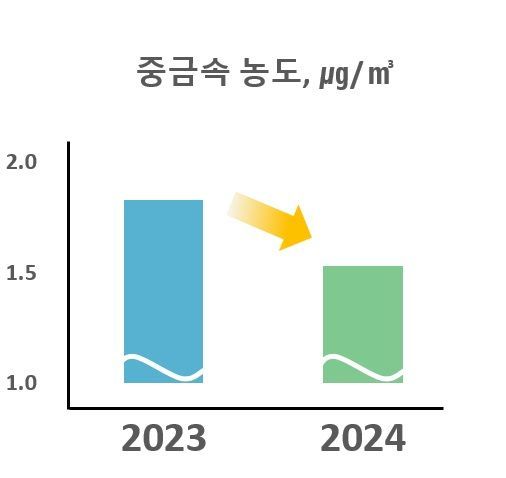 Comparison Table of Heavy Metal Concentrations Recently Released by Gyeonggi-do Institute of Health and Environment
In particular, the annual average concentration of lead (Pb) was found to be 0.02942 ㎍/㎥, which is 5.9% of the domestic air quality standard of 0.5 ㎍/㎥ per year.
Lead is a hazardous substance that, when accumulated in the human body, can cause damage to the central nervous system, increase blood pressure, and delay cognitive development in children. It is especially dangerous for children and the elderly. The low level compared to the standard indicates that the region's air quality is relatively safe.
The Institute posts its reports on the Air Environment Information Service and the Gyeonggi-do Institute of Health and Environment website, so that all residents can access the monitoring results.
Hwang Chanwon, Director of the Climate and Air Research Division at the Institute, said, "We are striving to establish a scientific foundation for protecting residents' health and improving air quality based on accurate measurements," adding, "We expect that these results will serve as essential baseline data for developing future policies to reduce particulate matter and hazardous heavy metals."
© The Asia Business Daily(www.asiae.co.kr). All rights reserved.

















