Deputy Mayor Kwangwan Ko Inspects Jjokbangchon in Gyelim-dong
Everyday Measures: Cooling Shelters, Coupons, and Health Kits
Convenience Store Vouchers Introduced for Delivery Workers and Substitute Drivers
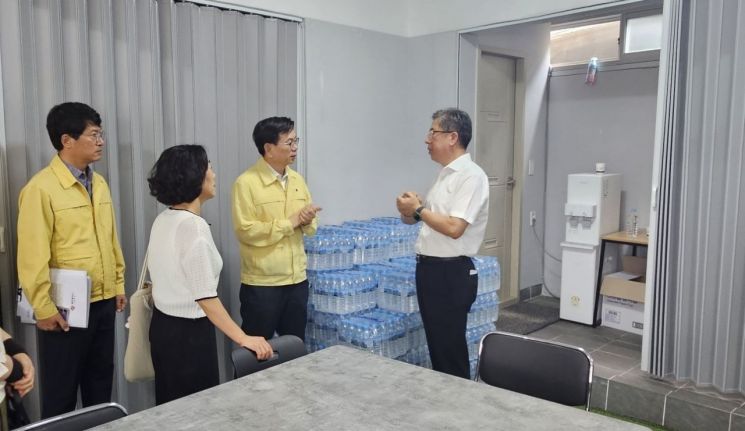 Kwangwan Ko, Deputy Mayor of Gwangju, visited Jjokbit Counseling Center located in the densely populated area of small rooms in Gyelim-dong, Dong-gu, on the 11th to listen to difficulties in operating the heat relief shelter. Photo by Gwangju City
As the recent heatwave continues, Gwangju City is closely monitoring the health and safety of vulnerable groups such as residents of jjokbangchon (small room communities), delivery workers, construction workers, and the homeless.
According to the city on July 12, Deputy Mayor Kwangwan Ko personally inspected the heatwave response system in the densely populated area of jjokbang residents in Gyelim-dong, Dong-gu, on July 11. This on-site visit was arranged to enhance the effectiveness of the city's 'Comprehensive Protection Measures for the Homeless in Response to Heatwaves' and 'Protection Measures for Sensitive Groups such as Jjokbang Residents.'
Deputy Mayor Ko checked the status of emergency shelters and cooling supplies prepared in the jjokbangchon area and instructed, "During heatwave advisories, prioritize the safety of heat-sensitive groups such as the elderly and the homeless, and flexibly operate on-site response personnel to enable a swift response in case of emergencies."
The city is actively supporting home health care services, cooling supplies, and emergency shelters to prevent health deterioration caused by the heatwave among economically vulnerable groups such as recipients of basic livelihood benefits, the homeless, and jjokbang residents.
Heat relief shelters are being operated at facilities such as Jjokbit Counseling Center, Deullangnallang Community Center, and the Temporary Shelter for the Homeless (Dasiseogi Comprehensive Support Center), where emergency accommodations and cooling supplies are provided so that these groups can use them with peace of mind. In addition, the city is meticulously providing on-site support, including deploying personnel to protect the homeless and strengthening patrols both during the day and at night.
Last month, with support from the Hope Bridge Korea Disaster Relief Association, heatwave response kits were provided to 40 jjokbang residents. During the summer, the city plans to use 66 million won from the disaster relief fund to supply cooling items to residents of small-scale facilities in the five autonomous districts.
The city has classified 15 types of heat-sensitive groups into physical, social, occupational, and economic categories and is implementing customized protection measures. In particular, about 1,000 life support workers are checking in daily by phone or in person on approximately 15,000 people, including the elderly and those with chronic illnesses. For about 8,000 single elderly households, an emergency safety and reassurance service utilizing ICT (Information and Communication Technology) equipment is being provided. In addition to home visits by health care professionals, health items such as fans and cool masks are also being distributed.
Preventive activities are also being carried out for people occupationally exposed to heatwaves, such as farmers, construction workers, and mobile workers. At construction sites, a "2 hours of work, 20 minutes of rest" guideline is recommended, and cooling facilities, cold water, and cooling products are provided.
For the first time this year, the city implemented the "Safe Shelter Coupon Program" to protect the health of mobile workers working outdoors during the heatwave. This program is jointly conducted by the Gwangju Economic Promotion and Job Foundation and the Gwangju Labor Rights Center, and its core is to provide practical support for shelter use to workers who frequently work outdoors, such as delivery workers and substitute drivers.
The city is providing convenience store coupons worth 25,000 won each to a total of 650 people, including 150 delivery workers and 500 substitute drivers. The coupons are given after completing safety education and a labor environment survey, encouraging mobile workers to temporarily escape the heat in indoor spaces such as convenience stores.
For elderly waste collectors, the city will operate a "Resource Recycling Activity Group" throughout August, allowing them to sort recyclables indoors or in the shade, thereby providing low-intensity jobs during the heatwave period and supporting both their health and safety.
In addition, the city is continuously operating 681 shade canopies, 24 cooling fog systems, and 2 clean roads installed throughout the city. Cooling costs are supported at more than 1,500 heat relief shelters. On top of these existing measures, the city has expanded its heatwave response by operating water-spraying vehicles and conducting bottled water sharing campaigns. An additional 500 million won from the disaster management fund was urgently allocated and immediately distributed to the autonomous districts.
Gwangju City has established a cooperative system with autonomous districts, homeless facilities, fire, police, and medical institutions to strengthen daytime patrols and is also carrying out practical protection activities such as emergency medical and food support, fire prevention education, and hygiene inspections.
© The Asia Business Daily(www.asiae.co.kr). All rights reserved.

















