Over 60% in North Jeolla, South Jeolla, and Jeju
Gwangju is the only region with a 10 percentage point drop
Proportion supporting "family-only responsibility" declines across all regions
Consensus on shared responsibility becomes clearer
Seven out of ten middle-aged adults in the Honam and Jeju regions believe that the responsibility for supporting elderly parents should not rest solely with families, but should be shared by the government and society as well. The notion that only families are responsible is declining, while support for shared responsibility is spreading.
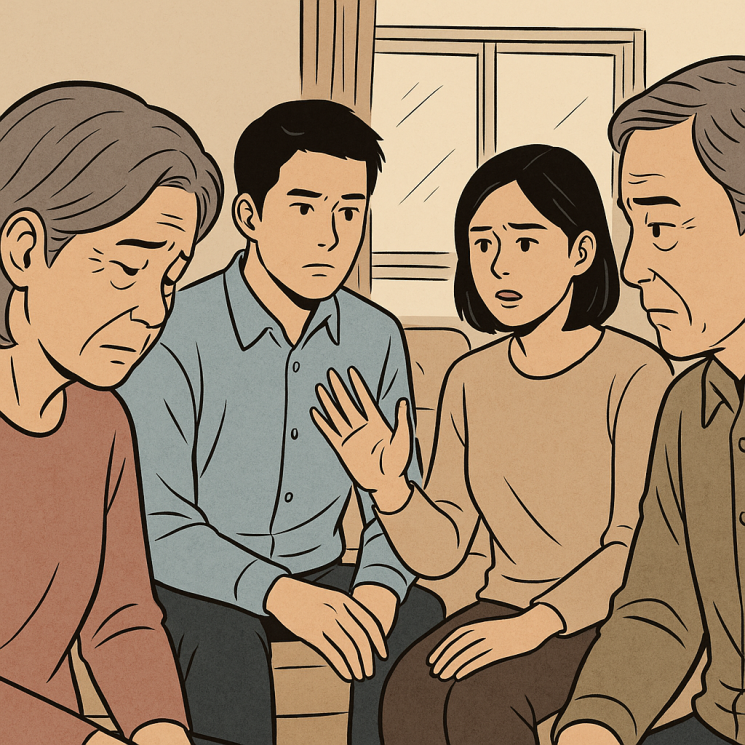
According to the recently released "Honam and Jeju Region Middle-aged Adults in Statistics" by the Honam Regional Statistics Office, a survey conducted in 2024 among residents aged 40 to 64 in Honam and Jeju found that the proportion who answered "families, government, and society should share responsibility" was 70.4% in North Jeolla, 69.7% in South Jeolla, 64.5% in Jeju, and 59.3% in Gwangju.
Compared to 2020, the figures increased by 7.7 percentage points in North Jeolla, 8.2 percentage points in South Jeolla, and 5.0 percentage points in Jeju, but decreased by 10.5 percentage points in Gwangju. Responses indicating that only one party?family, the parents themselves, or government and society?should be responsible generally showed a declining trend.
In Gwangju, the highest proportion of respondents (17.2%) said "parents themselves should be responsible," followed by "family" at 15.6%, and "government and society" at 8.0%. In South Jeolla, "family" accounted for 15.1%, "parents themselves" 10.4%, and "government and society" 4.8%. In North Jeolla, "family" was 15.4%, "parents themselves" 9.7%, and "government and society" 4.5%. In Jeju, the figures were "family" 20.3%, "parents themselves" 10.4%, and "government and society" 4.9%.
The proportion of respondents who said "family should be responsible" decreased in all regions. The decline was greatest in Jeju (down 6.5 percentage points), followed by South Jeolla (down 4.8 percentage points), North Jeolla (down 3.5 percentage points), and Gwangju (down 3.1 percentage points).
When asked about preparations for old age, a relatively high proportion answered "I am preparing": 82.7% in Gwangju, 80.6% in North Jeolla, 79.3% in South Jeolla, and 78.0% in Jeju. The most common method of preparation was public pensions, followed by savings accounts and savings-type insurance, private pensions, and real estate, stocks, and bonds.
The home ownership rate was highest in Gwangju at 46.8%, followed by Jeju (44.8%), North Jeolla (44.5%), and South Jeolla (44.4%). Gwangju slightly exceeded the national average of 44.9%.
In 2023, the leading cause of death among middle-aged adults was cancer (malignant neoplasms). The proportion of cancer deaths was 35.9% in Gwangju, 33.4% in Jeju, 32.3% in North Jeolla, and 31.2% in South Jeolla, followed by suicide, heart disease, cerebrovascular disease, and liver disease.
At age 40, the expected remaining years of life were 44.8 years in Jeju, 44.2 years in Gwangju, 44.0 years in North Jeolla, and 43.7 years in South Jeolla. The life expectancy for people in their 50s and 60s was also found to be in the upper 80s.
By occupation, among wage workers, those in Gwangju and North Jeolla were most likely to work in manufacturing, while those in South Jeolla and Jeju were more likely to work in construction. Among non-wage workers, wholesale and retail trade was the most common occupation in Gwangju, North Jeolla, and South Jeolla, while in Jeju, accommodation and food services were most common.
© The Asia Business Daily(www.asiae.co.kr). All rights reserved.
![Clutching a Stolen Dior Bag, Saying "I Hate Being Poor but Real"... The Grotesque Con of a "Human Knockoff" [Slate]](https://cwcontent.asiae.co.kr/asiaresize/183/2026021902243444107_1771435474.jpg)
















