Reliance on REC Raises Concerns Over KEPCO's Burden and Potential Electricity Rate Hikes
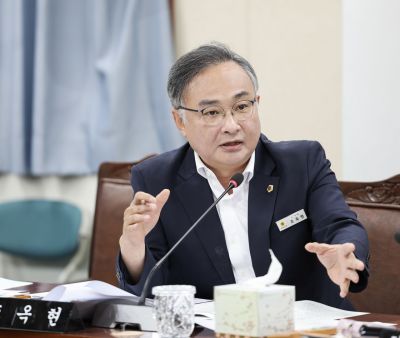
Jo Okhyun, a member of the Jeonnam Provincial Council (Democratic Party of Korea, Mokpo 2), expressed serious concerns regarding the sustainability and fairness of the province's ongoing "Energy Basic Income" policy during the Energy Industry Bureau's business report on July 10. He urged the development of fundamental measures to ensure financial stability.
Jo stated, "The Energy Basic Income is presented as a vision to generate income of about 1 trillion won annually for residents, but in reality, it relies on the 'REC (Renewable Energy Certificate)' weighting system." He warned, "This creates a structure where Korea Electric Power Corporation (KEPCO) must purchase electricity at high prices, and ultimately, that burden will inevitably be passed on to either increased electricity rates or the national budget."
'REC' refers to certificates issued for electricity produced from renewable energy sources, which power generation companies can sell for profit. However, this structure requires KEPCO to purchase renewable energy at higher prices, and the resulting burden can lead to KEPCO's financial difficulties or increases in electricity rates, raising concerns about the system.
Jo further criticized, "Although it is claimed that profits are being shared, in reality, this is not about distributing the profits of power generation companies, but rather about sharing artificially set differences in electricity prices." He argued, "This is not a true basic income, but merely a structure that adds income for certain regions on top of a universal burden."
Jo also raised issues regarding the method in which residents of Sinan County participate indirectly through cooperative bond purchases using loans from financial institutions, without making capital investments themselves. He pointed out, "Residents may receive profits, but it is unclear who will ultimately bear the responsibility," and stressed, "When operating resident funds in the future, it is necessary to establish concrete measures for the allocation of responsibility and the distribution of financial risks."
He also highlighted the significant issue of REC price volatility. Jo noted, "As the supply of renewable energy increases, REC prices are bound to fall, which means the income received by residents will also decrease." He added, "Given this instability, there needs to be a fundamental review of whether the Energy Basic Income can truly function as a basic income."
He concluded by emphasizing, "For policies aimed at a just energy transition, the actual structure is more important than the justification. The policy must be refined through fair distribution and sustainable financial design so that residents can accept it."
© The Asia Business Daily(www.asiae.co.kr). All rights reserved.

















