KDCA Expands Respiratory Infectious Disease Testing
to Daegu and Cheongju Airports, and Busan and Incheon Ports
Q-CODE Electronic Quarantine Pilot Program Also Extended to More Locations
The Korea Disease Control and Prevention Agency (KDCA) announced on July 11 that, starting from July 15, it will expand respiratory infectious disease testing and electronic quarantine procedures for travelers.
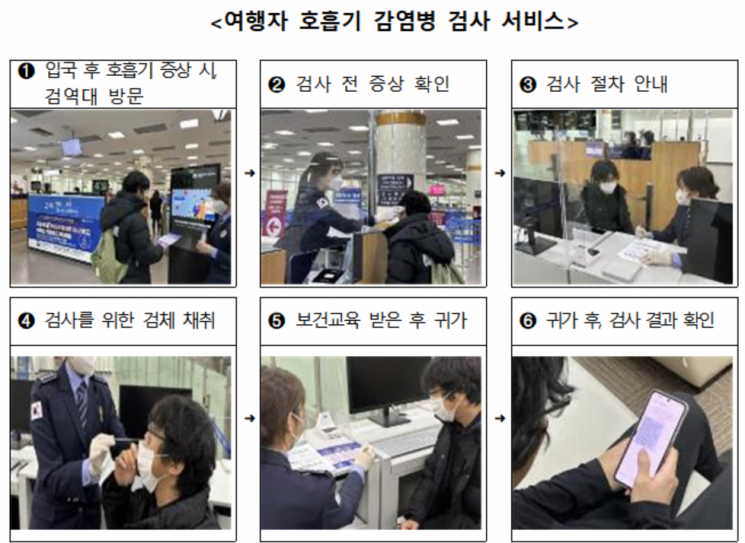
Previously, the KDCA launched a pilot project for respiratory infectious disease testing for travelers at Gimpo and Jeju airports in February this year, and has been operating the program at Gimhae Airport since April. Beginning July 15, the agency will also conduct respiratory infectious disease testing for inbound travelers at Daegu and Cheongju airports, as well as at Busan and Incheon ports. The KDCA plans to expand the program nationwide next year.
Inbound travelers who report symptoms of respiratory infectious diseases, such as coughing, during the quarantine process can receive free respiratory infectious disease testing at the quarantine office and will receive their test results via their mobile phone or email. If the test result is positive, they can obtain a certificate of positivity from the quarantine office and use it to receive National Health Insurance coverage for medical care at healthcare institutions.
According to the results of the pilot project conducted from February to June this year, a total of 184 inbound travelers with suspected respiratory infectious disease symptoms were identified at Gimpo, Jeju, and Gimhae airports. Of these, 30 requested testing services, and 7 received positive results: 2 for COVID-19, 3 for influenza A, and 2 for influenza B.
Additionally, starting July 15, the KDCA will expand the pilot program for Q-CODE (Q-Code: Quarantine Information Pre-Entry System)-based electronic quarantine from the current Gimhae, Daegu, and Cheongju airports to include Gimpo and Jeju airports.
Travelers who have stayed in or transited through infectious disease "priority quarantine management areas" are required to report their health status to quarantine officers via Q-CODE or a health declaration form. Through this pilot program, travelers can undergo screening more quickly by presenting a pre-issued OR code.
According to the KDCA, prior to the implementation of the electronic quarantine pilot program, the Q-CODE usage rate among inbound travelers at Gimhae, Daegu, and Cheongju airports was 26.0% as of August last year. However, from September last year through last month, the Q-CODE usage rate rose significantly to 92.6%.
Ji Youngmi, Commissioner of the KDCA, stated, "The expansion of this pilot project focuses on supporting inbound travelers to voluntarily report symptoms and receive necessary testing," adding, "We will continue to introduce new services to strengthen traveler-centered services."
© The Asia Business Daily(www.asiae.co.kr). All rights reserved.

















