Legislation and Judiciary Committee to Hear Ruling and Opposition Party Differences at Public Hearing
If Agreement Reached on Issues Like Cumulative Voting, Passage Expected to Accelerate
The Democratic Party of Korea announced that if a consensus is reached at the public hearing of the National Assembly Legislation and Judiciary Committee on July 11 regarding supplementary legislation for the Commercial Act amendment?such as the introduction of cumulative voting and the expansion of the number of audit committee members?it will proceed with its passage during the July session of the National Assembly.
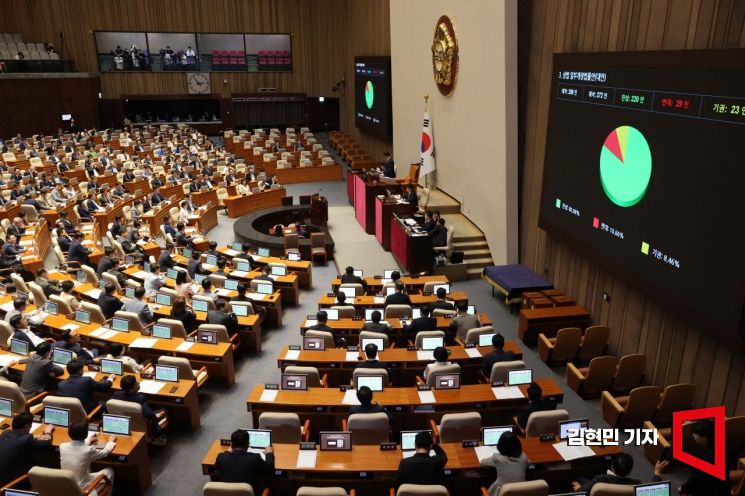 On July 3, the partial amendment to the Commercial Act was passed at the plenary session of the National Assembly. 2025.7.3 Photo by Kim Hyunmin
Moon Jinseok, Senior Deputy Floor Leader of the Democratic Party, told reporters at the National Assembly that day, "If we are able to reach an agreement through today's public hearing, the amendment could pass on the 23rd. If not, we will continue to gather opinions and ensure its passage before the end of the July extraordinary session."
Moon Jinseok stated, "The business community opposes the cumulative voting system, arguing that it disrupts and interferes with management rights. However, if operated transparently, there are cases where minority shareholders can unite and block activist funds."
As the Democratic Party repeatedly reaffirmed its stance to address supplementary legislation for the Commercial Act amendment?on which differences between the ruling and opposition parties remain?during the July session, political tensions are rising. The Commercial Act amendment is a key pledge of the Lee Jaemyung administration, but there are considerable concerns about potential side effects from the business sector and other stakeholders. While some expected the National Assembly to take a breather after the first phase of the amendment was passed through bipartisan agreement, the ruling party is moving forward rapidly. If the amendment is pushed through in July without opposition party consent, the confrontation between the parties could intensify.
The main focus is on the public hearing on the Commercial Act amendment to be held by the Legislation and Judiciary Committee on the afternoon of July 11. At this hearing, opinions will be gathered from stakeholders and experts on issues that were excluded from the amendment passed at the plenary session on July 3, namely: the introduction of cumulative voting for the election of directors at large listed companies and the expansion of the number of separately elected audit committee members.
The amendment passed at the plenary session included only three provisions: expanding the duty of loyalty of directors (from the company to both the company and shareholders), introducing electronic general meetings of shareholders, and limiting the voting rights of major shareholders and related parties to 3% when electing independent audit committee members (the 3% rule).
The public hearing will be attended by Jung Wooyong, Vice President of Policy at the Korea Listed Companies Association; Kim Woochan, Professor at Korea University Business School; Choi Junsun, Emeritus Professor at Sungkyunkwan University Law School; and Yoon Taejoon, Head of the Corporate Governance Research Center at the shareholder activism platform ACT.
Vice President Jung is expected to state, "I fully agree that discussions are necessary in terms of protecting minority shareholders and promoting coexistence between shareholders and companies. However, excessive regulation could hinder corporate growth, ultimately affecting shareholders, so careful consideration is required."
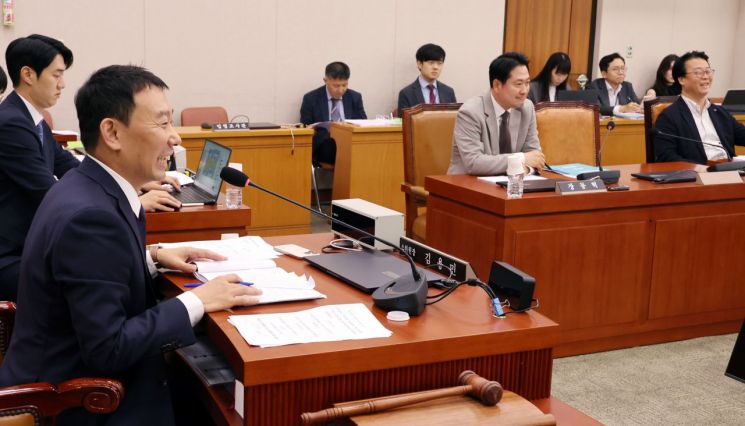
Yoon Taejoon is expected to express the view that "the Commercial Act amendment is a progressive attempt to protect the rights and interests of ordinary shareholders and to improve corporate governance, but there are still many areas that require further supplementation. In particular, detailed legislation is needed to prevent companies from circumventing the system through various loopholes. Active oversight by financial authorities and the establishment of shareholder-friendly precedents by the judiciary must go hand in hand."
Supporters of the amendment emphasize the protection of minority shareholder rights, while opponents stress concerns about undermining corporate autonomy. Opponents argue that if cumulative voting and the expansion of audit committee members are included, supplementary and balanced legislation is needed to mitigate potential side effects. They call for the introduction of management defense mechanisms such as poison pills (stock purchase rights), dual-class shares, the abolition of the crime of breach of trust, and the adoption of the business judgment rule.
The Democratic Party has stated that it is open to discussions on easing the crime of breach of trust in order to address corporate concerns about excessive litigation. At the public hearing, Emeritus Professor Choi is expected to advocate for the abolition of the aggravated punishment for specific economic crimes and the crime of breach of trust under the Commercial Act, as well as the introduction of the American-style business judgment rule, which broadly protects management decisions. Within the People Power Party, proposals have also been submitted to abolish the special breach of trust crime under the Commercial Act (the Kim Sungwon proposal) and to introduce special provisions on corporate breach of trust (the Ko Dongjin proposal).
The ruling party plans to address the Korea discount with short-, medium-, and long-term roadmaps for each issue. In the short term, if bipartisan agreement is reached on the two Commercial Act amendment provisions discussed at the public hearing, the party intends to process them during the July extraordinary session. Regarding the amendment to the Commercial Act that includes the mandatory cancellation of treasury shares, proposed by Democratic Party lawmaker Kim Namgeun, Moon indicated, "There is not enough time to include it in the July session," suggesting an adjustment of pace. Amendments to the Capital Markets Act and inclusion in the Morgan Stanley Capital International (MSCI) index are being pursued with a longer-term perspective.
© The Asia Business Daily(www.asiae.co.kr). All rights reserved.
![Clutching a Stolen Dior Bag, Saying "I Hate Being Poor but Real"... The Grotesque Con of a "Human Knockoff" [Slate]](https://cwcontent.asiae.co.kr/asiaresize/183/2026021902243444107_1771435474.jpg)

















