Clinical Results Presented at the Asian Oncology Society (AOS)
Capturing Ultra-Early Cancer Cell Signals with AI-Based FEMS Technology
GC Genome announced on July 11 that it had recently presented clinical research results demonstrating the early pancreatic cancer prediction performance of its multi-cancer early detection test 'ai-CANCERCH' at the 'Asian Oncology Society 2025'.
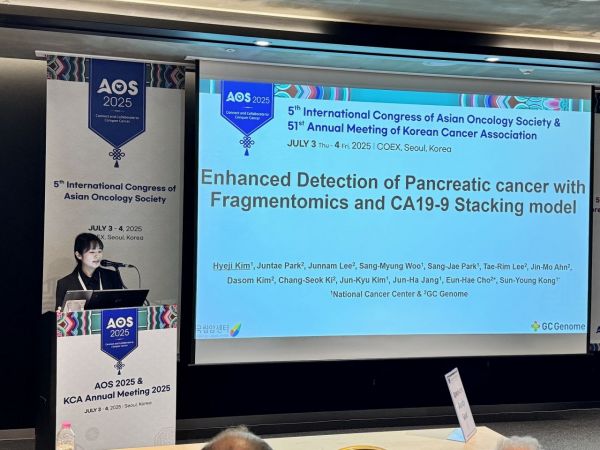 At the 'Asian Oncology Conference' held on the 3rd and 4th, clinical research results demonstrating the early pancreatic cancer prediction performance of the multi-cancer early detection test 'iCancerSearch' were presented. GC Genome
This study was conducted as a joint research project with the team led by Professor Kong Sunyoung of the Department of Laboratory Medicine at the National Cancer Center. The study utilized the core technology of ai-CANCERCH, 'FEMS (Fragment End Motif frequency by Size)', to analyze both the structural characteristics of cell-free DNA (cfDNA) in blood and the pancreatic cancer blood biomarker 'CA19-9'. Using a multimodal stacking model, the study effectively predicted early-stage pancreatic cancer.
According to the research results, ai-CANCERCH demonstrated a sensitivity of up to 87% in the early pancreatic cancer patient group. For the overall patient group, it showed a sensitivity of over 90% and a specificity of over 98%. This represents a higher precision compared to predictions based solely on the CA19-9 biomarker.
Professor Kong explained, "Pancreatic cancer often progresses without symptoms, making early diagnosis extremely difficult. This study is significant as it presents a new diagnostic possibility that can complement existing blood test methods by precisely analyzing cfDNA in blood."
The FEMS technology is a core technology of GC Genome that enables the integrated analysis of two pieces of information: the fragment size and the end motif sequence patterns of cfDNA fragments in blood. This allows for the detection of even trace amounts of cancer signals. With AI-based sophisticated analysis, it is possible to capture cfDNA signals originating from very early-stage cancer cells that are difficult to detect with conventional methods, thereby contributing to improved sensitivity and specificity in early cancer diagnosis.
This clinical achievement was published in the 2025 edition of Cancer Research (IF 12.5), a leading academic journal in the field of oncology, and was registered as a fundamental patent in Japan last month.
A GC Genome official stated, "In the future, we will accelerate our entry into the global market by expanding early diagnosis to various types of cancer beyond pancreatic cancer. We will continue to enhance our technological reliability and competitiveness in the field of precision medicine."
© The Asia Business Daily(www.asiae.co.kr). All rights reserved.

















