Imports Rise 1.8% to $20 Billion
Trade Balance Records $600 Million Deficit
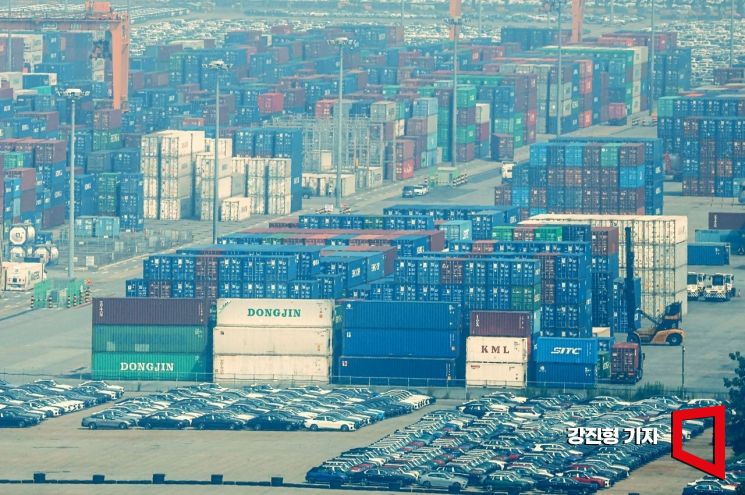 Amid U.S. President Donald Trump’s announcement on August 1 to impose a 25% reciprocal tariff on all imports from Korea, cars and containers awaiting shipment are lined up at the export yard of Pyeongtaek Port, Gyeonggi Province, on July 8, 2025. Photo by Kang Jinhyung
South Korea's exports in early July increased by 9.5% compared to the same period last year. Analysts attribute this growth, in particular, to export companies accelerating shipments in response to heightened trade tensions with the United States.
According to the Korea Customs Service on the 11th, exports from July 1 to 10 reached $19.4 billion, an increase of $1.68 billion (9.5%) compared to the same period last year. Imports during the same period totaled $20.0 billion, rising by only 1.8%. As a result, the trade balance recorded a deficit of $600 million.
The main drivers of export growth were ships (134.9%), semiconductors (12.8%), and passenger cars (13.3%). Notably, semiconductors accounted for 19.7% of total exports, up 0.6 percentage points from the previous year. On the import side, increases were seen in crude oil (4.9%), machinery (17.2%), and gas (21.9%).
Exports to major markets also rose across the board, with China (6.2%), the United States (6.1%), and the European Union (EU, 3.6%) all posting increases. In particular, exports to the United States amounted to $3.4 billion, accounting for 17.7% of the total. Meanwhile, imports from the United States fell by 13.1%, resulting in a wider trade surplus with the U.S.
It is interpreted that the so-called "pre-shipment" effect, where companies expedited shipments ahead of tariff impositions, was a key factor behind the export increase. Previously, the Trump administration in the United States had doubled tariffs on Korean steel and aluminum from 25% to 50% starting June 4. In addition, if negotiations between South Korea and the United States fail, a 25% reciprocal tariff is scheduled to be imposed from August 1, creating a double burden for Korean exporters. As a result, companies rushing to export before the tariffs take effect appear to have driven the short-term surge in exports.
An industry official said, "The timing of the U.S. signaling high tariffs coincides with this export increase," adding, "Since there are concerns that exports may decline due to future tariff hikes, companies seem to be taking preemptive measures."
However, while imports from the United States and Taiwan declined, imports from the EU (18.3%) and Japan (6.8%) increased, suggesting signs of diversification in import sources. Some experts see this as a result of supply chain adjustments in response to U.S.-China tensions and uncertainties originating from the United States.
The government has dispatched a high-level negotiation team, including the head of the Office of Trade Negotiations, to the United States to negotiate tariff relief in preparation for a worsening trade balance. As the possibility of tariffs being implemented increases, there is a growing need to closely analyze the underlying factors behind the short-term positive export statistics, given the expectation that export performance in the second half of the year will inevitably be affected.
© The Asia Business Daily(www.asiae.co.kr). All rights reserved.
![Clutching a Stolen Dior Bag, Saying "I Hate Being Poor but Real"... The Grotesque Con of a "Human Knockoff" [Slate]](https://cwcontent.asiae.co.kr/asiaresize/183/2026021902243444107_1771435474.jpg)











