KAIST announced on the 11th that the research team led by Professor Jungwoo Choi from the School of Electrical Engineering has won first place in the "Spatial Semantics-based Acoustic Scene Segmentation" category at the "IEEE DCASE Challenge 2025."
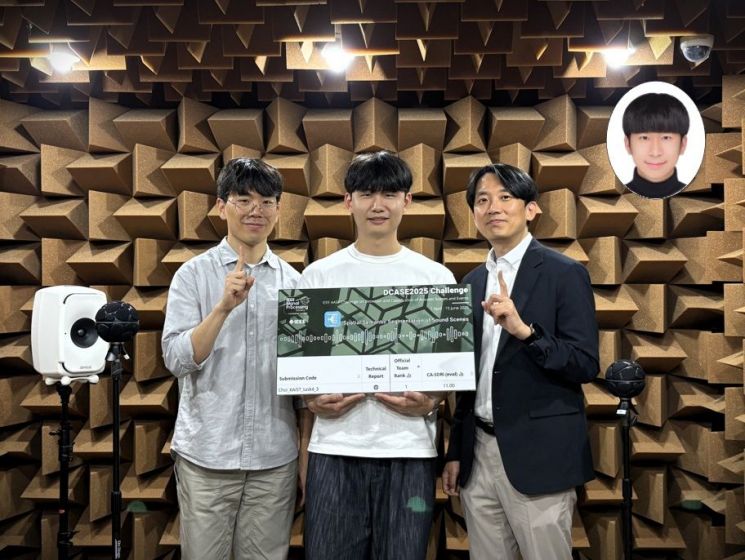 (From left) Younghoo Kwon, Integrated MS-PhD Program, Dohwan Kim, Master's Program, Jungwoo Choi, Professor, Dongheon Lee, PhD. Provided by KAIST
The "IEEE DCASE Challenge" is regarded as the world's most prestigious competition for acoustic detection and analysis. Acoustic separation and classification technologies are next-generation artificial intelligence (AI) core technologies that enable early detection of abnormal sounds in drones, factory pipelines, and border surveillance systems, as well as spatially separating and editing audio sources for AR and VR content production.
The research team participated in this challenge for the first time and achieved the world’s top title after competing against 86 teams from around the globe across six categories.
This research team, consisting of Professor Jungwoo Choi, Dr. Dongheon Lee, Younghoo Kwon (Integrated MS-PhD Program), and Dohwan Kim (Master's Program), demonstrated their capabilities in "Task 4" of the challenge's "Spatial Semantics-based Acoustic Scene Segmentation" category. Task 4 is a highly challenging field that analyzes the spatial information of multichannel signals containing mixed audio sources, separates individual sounds, and classifies them into 18 types.
The research team plans to present their technology at the DCASE Workshop to be held in Barcelona this October.
Earlier this year, Dr. Dongheon Lee developed a world-class audio source separation AI by combining the Transformer and Mamba architectures. In addition, during the challenge, the team, led by researcher Younghoo Kwon, completed a "stepwise reasoning" AI model that re-performs source separation and classification using the waveform and type of initially separated audio sources as cues.
This model mimics the human ability to separate and recognize individual sounds based on specific cues such as type, rhythm, and direction when listening to complex audio.
Using this model, the team demonstrated technical excellence by being the only participants to achieve a double-digit score (11dB) in "CA-SDRi (Source-to-Distortion Ratio improvement)," which evaluates how well the AI separates and classifies sounds.
CA-SDRi measures, in decibels (dB), how much more clearly (with less distortion) a specific sound is separated compared to the original audio. The higher the number, the more accurately and cleanly the sound has been separated.
Professor Jungwoo Choi said, "Our research team has introduced the world’s best AI models for sound separation over the past three years, and our achievements have now been officially recognized through this challenge. Despite it being our first participation, I am proud of every member of the team for achieving the world’s top position through focused research."
© The Asia Business Daily(www.asiae.co.kr). All rights reserved.

















