Korea Forest Service Raises Outbreak Forecast from "Attention" to "Caution"
"Increase in Number of Generations Attributed to Climate Change"
On July 10, the National Institute of Forest Science under the Korea Forest Service announced that it has raised the American white moth outbreak forecast from "attention" to "caution."
The larvae of the American white moth are pests that feed on the leaves of street and landscaping trees in urban areas. When they appear in large numbers, they cause inconvenience to residents and damage city landscapes. These larvae emerge two to three times a year. The American white moth is believed to have been introduced from North America in 1958 and has since spread nationwide, except for Jeju Island.
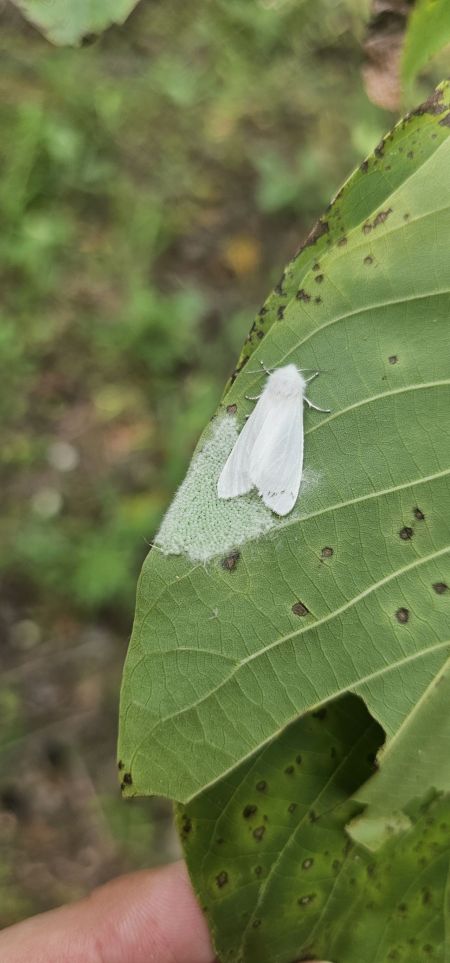
According to an analysis by the National Institute of Forest Science, which monitored the first generation of American white moths (the full life cycle from egg to larva, pupa, adult, and back to egg) collected from 1,600 broad-leaved trees in 32 fixed survey plots nationwide, the damage from second-generation larvae is expected to be greater this year than in previous years. The institute has been operating fixed survey plots and investigating damage levels annually since 1981.
This year, the damage rate from first-generation larvae observed in the fixed survey plots was 15.8%, while the damage rate from second-generation larvae is predicted to reach 26.9%. In comparison, the damage rate from second-generation larvae was 8.9% in the 2000s and 6.7% in the 2010s, indicating a recent sharp increase in damage.
The increase in damage caused by the American white moth is believed to be due to a rise in the number of generations resulting from climate change. In particular, higher temperatures in spring and autumn have extended the activity period, increasing the likelihood of a third generation emerging. To reduce larval damage in summer (August) and autumn (October), intensive monitoring and control measures are needed from mid-July to early August, when the second-generation larvae first appear.
Kim Minjung, a researcher at the Forest Insect and Disease Research Division of the National Institute of Forest Science, stated, "Since the population of the American white moth increases exponentially with each generation, early monitoring is crucial," and added, "We will do our best to support research and provide technical assistance related to forest pests occurring in residential areas."
© The Asia Business Daily(www.asiae.co.kr). All rights reserved.
![Clutching a Stolen Dior Bag, Saying "I Hate Being Poor but Real"... The Grotesque Con of a "Human Knockoff" [Slate]](https://cwcontent.asiae.co.kr/asiaresize/183/2026021902243444107_1771435474.jpg)
















