30th Anniversary Retrospective of Seo Heehwan
A Comprehensive Collection from Early Works to His Final Pieces
Shedding Light on "Hangul Calligraphy,"
Long Overshadowed by "Chinese Character Calligraphy"
"An Opportunity to Encounter the Beauty of Hangul Calligraphy"
Approximately 10,000 characters are densely written on a folding screen that spans 5.5 meters in width. The content is "Worincheongangjigok" (1981), a Buddhist hymn composed directly by King Sejong in 1449 and known as the first Hangul movable type book. This work, which is regarded as the pinnacle of Pyeongbo Hangul calligraphy that breathes life into typeface-based letters, is considered a masterpiece left by Pyeongbo Seo Heehwan (1934-1995), who devoted his entire life to Hangul calligraphy.
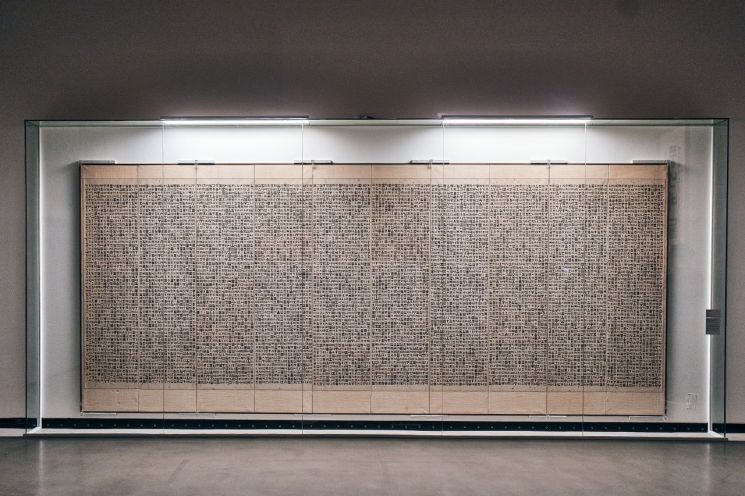 Pyeongbo Seo Heehwan's work "Worincheongangjigok" (1981), a transcription of "Worincheongangjigok," the first Hangul movable type book known to have been directly written by King Sejong, in his own calligraphy style. Seoul Calligraphy Museum, Seoul Arts Center
Since Hangul calligraphy was designated as a National Intangible Cultural Heritage in January, attention has been shifting to Hangul calligraphy, which had long been overshadowed by Chinese character calligraphy. In this context, the noteworthy Hangul calligraphy exhibition "Pyeongbo Seo Heehwan: Ordinary Steps" has opened at the Seoul Calligraphy Museum, Seoul Arts Center. This is the first solo exhibition held after Seo Heehwan's death to commemorate the 30th anniversary of his passing, showcasing over 120 works and archival materials spanning his entire life.
Seo Heehwan is a representative Hangul calligrapher of 20th-century Korea, and in 1968, he became the first to receive the Presidential Award in the calligraphy category at the 17th National Art Exhibition of Korea (Gukjeon). At a time when Chinese character calligraphy was mainstream, his award created a fresh shock in the calligraphy world. However, his award-winning work "Aeguksi" was criticized for being excessively similar to the handwriting of his teacher, Son Jaehyung (1902-1981), with some claiming that it was merely an imitation of his teacher's work. There were also voices pointing out that Hangul calligraphy lacked a "jeonbeom" (classic model or standard).
Nevertheless, Seo Heehwan used such criticism as a stepping stone to devote himself to building his own artistic world. He studied the origins of Hangul through early Joseon dynasty Hangul texts such as "Hunminjeongeum," "Yongbieocheonga," and "Worinseokbo," which are considered classics of Hangul calligraphy, and developed his own unique style. Curator Kim Hakmyeong explained, "It is difficult to say that Chinese character calligraphy is truly our own. In this respect, Seo Heehwan mastered the natural flow of the brush from the royal and folk scripts of late Joseon, and completed a refined style that was not bound by formality."
Seo Heehwan's Hangul calligraphy was used for signboards and epitaphs nationwide in the late 1960s, coinciding with the social movement that emphasized national identity (encouraging the use of Hangul over Chinese characters). His works include epitaphs for national patriots at the National Cemetery and Imjingak, the monument for the March 1st Movement (Iksan and Hoengseong), the statue of Admiral Yi Sun-sin (Mokpo), memorials for anti-Japanese activists (Seoul), and epitaphs for Ju Sigyeong and Bang Jeonghwan (Independence Hall of Korea). This exhibition also features the memorial inscription for the victims of the 1983 Burma Aung San Mausoleum bombing, the original signboard for Sudo Women's Teachers' College (now Sejong University, privately owned), and the signboard for the Korean National Commission for UNESCO (held by the Commission).
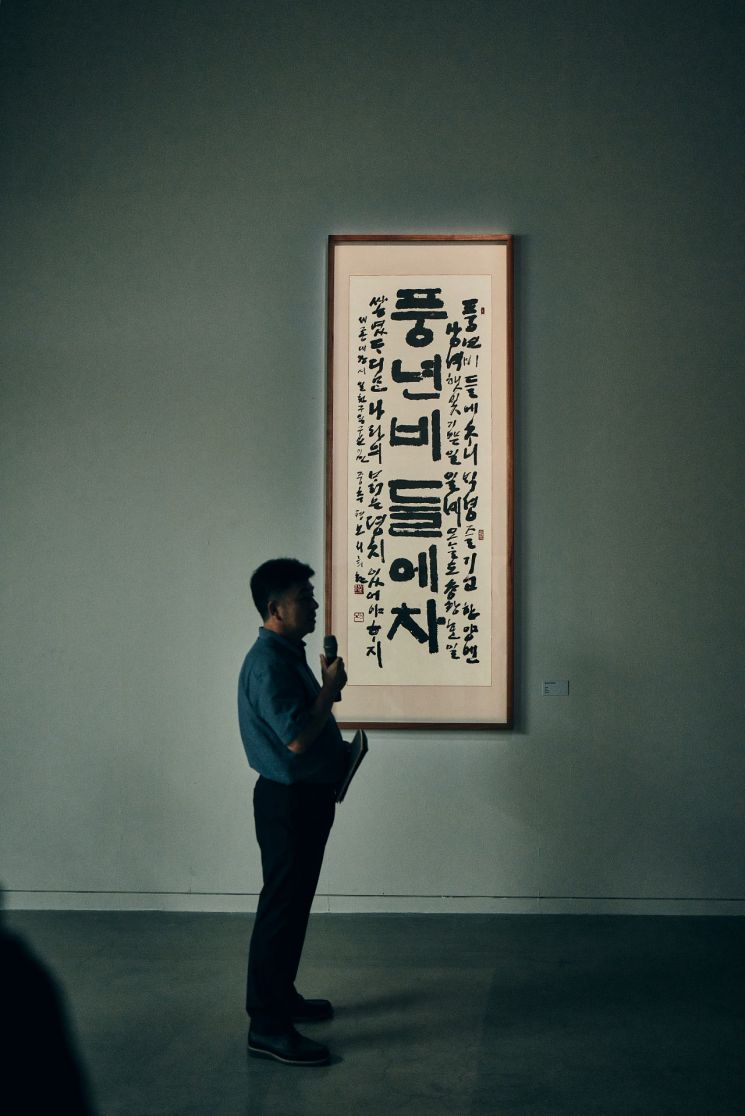 Collector Go Changjin, who has been collecting and researching the works of calligrapher Seo Heehwan for over 30 years, is explaining in front of his collection. The work in question had the 'Pungnyeonbi' and 'Deulchae' parts separated, but after extensive inquiry, collector Go Changjin found the 'Pungnyeonbi' part and completed the work. Seoul Calligraphy Museum, Seoul Arts Center
A significant number of works in this exhibition were provided by collector Go Changjin, who has been collecting and researching Seo Heehwan's works for over 30 years. He was captivated by Seo Heehwan's work, which he encountered by chance in his youth, and since then traveled all over the country to collect Seo Heehwan's pieces. "Pungnyeonbi Deulecha" (1992) is one such work. After searching nationwide for the upper part of this separated work, he was finally able to complete it. Collector Go Changjin explained, "It took a very long time and a lot of effort, but bringing together these two works, which were like separated family members, was the most rewarding experience of my life."
This exhibition is significant in that it comprehensively covers Seo Heehwan's 40-year calligraphy career, from his early days to his final years. It also serves as an opportunity to honor Seo Heehwan's dedication to Hangul calligraphy, which remained in obscurity for years overshadowed by Chinese character calligraphy.
Curator Kim Hakmyeong stated, "While there are quite a few people who enjoy Hangul calligraphy as a hobby, there are relatively few who truly understand and explore its value. The fact that Hangul calligraphy was only designated as a National Intangible Cultural Heritage in January this year shows how little public attention it has received." He added, "Nevertheless, it is encouraging that the designation of Hangul calligraphy as an intangible heritage has been promoted. I hope this exhibition will provide an opportunity for people of all ages to naturally encounter the beauty of Hangul calligraphy." The exhibition runs until October 12.
© The Asia Business Daily(www.asiae.co.kr). All rights reserved.

![Clutching a Stolen Dior Bag, Saying "I Hate Being Poor but Real"... The Grotesque Con of a "Human Knockoff" [Slate]](https://cwcontent.asiae.co.kr/asiaresize/183/2026021902243444107_1771435474.jpg)















