Retail Investors Lose Big on Double Inverse Bets
KOSPI's Relentless Rally Drives Inverse ETF Losses
Analysts Forecast Further Gains Despite Short Sellers' Hopes
As the KOSPI continues to set new yearly highs for the second consecutive day, investors who have taken short (sell) positions are becoming increasingly concerned. In particular, for so-called 'double inverse' products, which bet twice as much on a decline in the index, retail investors have invested over 1 trillion won, making significant losses inevitable.
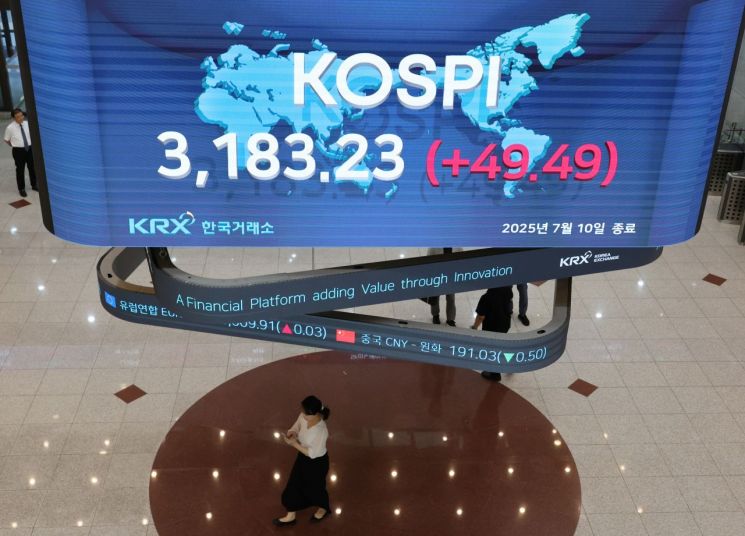
According to the Korea Exchange on July 11, the KOSPI closed the previous day at 3,183.23, up 49.49 points (1.58%). This is the highest level in three years and ten months since September 8, 2021 (3,187.55). With the KOSPI rising for four consecutive days, it is now just over 120 points away from its all-time high of 3,305.21, recorded on July 6, 2021.
With the unstoppable momentum of the KOSPI, inverse ETFs (Exchange-Traded Funds) have seen their charts plummet across the board. One of the most popular products among retail investors, the 'KODEX 200 Futures Inverse 2X' ETF, has seen its price cut in half since reaching a peak on April 9, when the market plunged due to the mutual tariff shock from the United States. During this period, while the KOSPI rebounded by about 37%, losses were amplified because the product tracks the daily return of the KOSPI200 futures index at -2 times. In just over three months, individual investors poured as much as 1.1567 trillion won into this product.
An official from a securities firm commented, "Despite macroeconomic uncertainties, the KOSPI's steep upward curve and the emergence of short-term overheating signals seem to have fueled the retail investors' frenzy for double inverse products. Given that the KOSPI has already shown resilience even in the face of global events such as Trump's tariff letter, it is now necessary to find new grounds for betting on a market decline."
Contrary to the hopes of double inverse investors, however, the securities industry is currently flooded with optimistic forecasts for the KOSPI. Byun Junho, a researcher at IBK Investment & Securities, said, "Recently, the domestic stock market's policy environment has been more favorable than ever, with the Bank of Korea's interest rate cuts, the government's supplementary budget, and stock market stimulus measures all coming together to heighten expectations." He raised his projection for the upper end of the KOSPI's trading band for the second half of the year from 3,100 to 3,400. In particular, he expects the leadership of financial stocks, which have emerged as beneficiaries as the ruling party pushes for mandatory treasury share cancellation and separate taxation on dividend income, to continue.
Kim Daejun, a researcher at Korea Investment & Securities, also stated, "Considering improvements in dividend payout ratios and treasury share cancellations, and factoring in interest rate cuts and supply-demand improvements in the fourth quarter, there is a high possibility that the index will rise further." He adjusted his KOSPI band for the second half from the previous 2,600-3,150 to 2,900-3,550. Kim explained that, compared to the third quarter, which is expected to face various negative factors, the index is more likely to rise in the fourth quarter due to anticipated interest rate cuts and improvements in supply and demand.
© The Asia Business Daily(www.asiae.co.kr). All rights reserved.
![Clutching a Stolen Dior Bag, Saying "I Hate Being Poor but Real"... The Grotesque Con of a "Human Knockoff" [Slate]](https://cwcontent.asiae.co.kr/asiaresize/183/2026021902243444107_1771435474.jpg)
















