Climate Finance Forum Seminar
"Effective Top-Down Budgeting System Must Be Established"
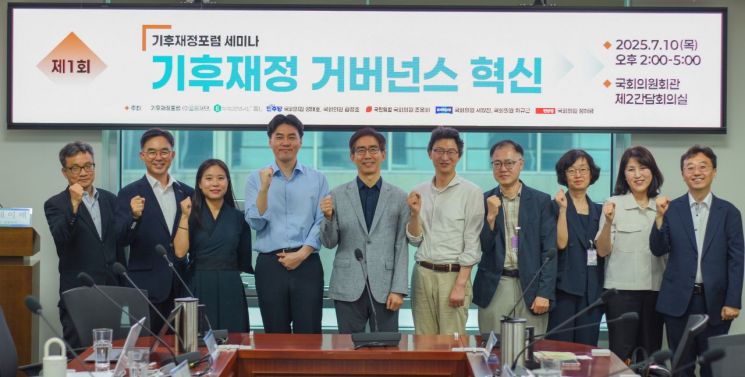
As discussions on the establishment of a Ministry of Climate and Energy are underway, centered around the National Policy Planning Committee under the new administration, experts have suggested that in order to effectively respond to climate change, it is necessary to redesign climate finance and reorganize climate governance. There was also a proposal that the newly established Ministry of Climate and Energy should manage a new climate response fund, and that a Climate Investment Corporation should be created.
On July 10, at the National Assembly Members' Office Building in Seoul, during the "Climate Finance Governance Innovation" seminar jointly hosted by lawmakers from both the Democratic Party (Jung Taeho, Kim Jungho), the People Power Party (Cho Eunhee), the Rebuilding Korea Party (Seo Wangjin, Cha Kyugeun), and the Progressive Party (Jung Hyekyung), and organized by the Climate Finance Forum (Iroum Foundation and Green Transition Institute), Choi Giwon, Head of the Economic Transition Team at the Green Transition Institute, pointed out that it is impossible to respond to climate change with the current climate budget.
According to the "First National Basic Plan for Carbon Neutrality and Green Growth (Carbon Neutrality Basic Plan)," the government has committed to investing approximately 89.9 trillion won by 2027. Specifically, over five years (2023?2027), 54.6 trillion won will be allocated for sectoral reduction measures, 19.4 trillion won for climate change adaptation measures, and 6.5 trillion won for green industry growth.
However, the investment plan through 2027 is merely the sum of the budgets of relevant ministries for climate response. Even so, investment has not been properly implemented due to budget cuts. As of 2024, it is estimated that 19.8% of the target has not been met. Additionally, there is a problem in that the lack of disclosure of project details makes it difficult to properly evaluate implementation progress.
Choi Giwon emphasized that the fiscal investment plan in the Carbon Neutrality Basic Plan should be expanded into a comprehensive "climate finance plan." He argued that investment plans for each sector should be established in line with the annual reduction targets in the Carbon Neutrality Basic Plan, and that a funding plan should be developed and executed accordingly.
He also stressed that investment plans related to emissions, such as fossil fuel subsidies, should be reduced, and that the gap between current investment plans and the shortfall in investment should be clearly identified in advance.
Choi Giwon identified five major tasks for climate governance reform: establishing an integrated climate policy system across all ministries; making the Presidential Committee on Carbon Neutrality and Green Growth (the Carbon Neutrality Committee) more effective and strengthening public participation; creating a Ministry of Climate Economy and shifting industrial and energy strategies; enhancing expertise, citizen participation, and data-based approaches; and innovating climate finance and expanding the climate response fund.
Choi Giwon stated, "If the Ministry of Climate and Energy is to be reorganized, funding must follow," adding, "The climate response fund currently under the Ministry of Economy and Finance should be transferred to the Ministry of Climate and Energy, and a Climate Investment Corporation should be established to handle policy finance."
Lee Sangmin, Senior Research Fellow at the Korea Institute of Public Finance, pointed out that, due to the surge in energy consumption from artificial intelligence (AI) and data center trends, the government is failing to maintain even the existing budget for climate response. He further emphasized that simply reorganizing government agencies related to climate, such as creating a Ministry of Climate and Energy, is insufficient for climate governance reform.
Lee Sangmin explained, "Existing organizations may remain structurally separate, operating as different bureaus or offices within the same ministry, effectively functioning as 'two families under one roof.' Even if some policy integration occurs, there is a risk that departments with larger budgets or organizational size may exert excessive influence." Ultimately, regardless of how ministries are reorganized, budgets must be set according to the guidelines of the Ministry of Economy and Finance.
He stated, "Climate issues should not be treated as a 'division of the pie' like existing government projects, but rather as an 'all-sector, all-ministry' initiative that every ministry must consider. We must seek ways to effectively establish a top-down budgeting system (Total Budget Allocation and Autonomous Budgeting System)."
As a way to improve this, Lee Sangmin called for strengthening the authority of the Carbon Neutrality Committee. He argued that the committee should be able to oversee budgeting, execution, and performance evaluation across all sectors and ministries.
In the subsequent discussion, Heo Kyungseon, Director of the Asia-Pacific Fiscal Cooperation Center at the Korea Institute of Public Finance, pointed out, "To accurately estimate the scale of the climate budget, efforts are needed to precisely calculate the total costs required for climate response, including greenhouse gas reduction and climate adaptation." He noted that a comprehensive estimate of total climate response costs has not been conducted, and that the scale of government fiscal responsibility has never been discussed.
Oh Youngmin, Professor of Public Administration at Dongguk University, pointed out that despite the expertise in climate budget formulation, there is currently no body or procedure to comprehensively formulate and review climate-related budgets across ministries. He stated, "Climate budgets scattered across ministries should be comprehensively reviewed and formulated," and added, "A specialized body that can enhance the rationality and efficiency of budget allocation should be established within the Carbon Neutrality Committee or the newly created Ministry of Climate and Energy."
Ko Jaekyung, Director of the Climate and Environment Division at the Gyeonggi Research Institute, stated, "The fiscal soundness-oriented budget structure of the Ministry of Economy and Finance acts as a structural limitation that undermines the strategy and execution of climate finance." He went on to say, "Although region-led carbon neutrality is being emphasized, the lack of authority, standards, and financial support for local governments limits their implementation capacity." This is due to insufficient linkage between central and local governments in the fiscal investment plan of the Carbon Neutrality Basic Plan.
Jin Ik, Director of Economic Analysis at the National Assembly Budget Office, said, "I generally agree with the need to establish a top-down budgeting system, strengthen the Carbon Neutrality Committee, and change climate governance," and suggested, "Quantitative analysis of the effectiveness of climate budget execution should also be expanded." He added, "The feedback mechanism in the climate budget formulation process should be specified, and guidelines for implementation monitoring, performance evaluation, and future budget formulation should also be established."
© The Asia Business Daily(www.asiae.co.kr). All rights reserved.

















