Listening to Best Practices Ahead of the Implementation of the "Integrated Care Support Act"
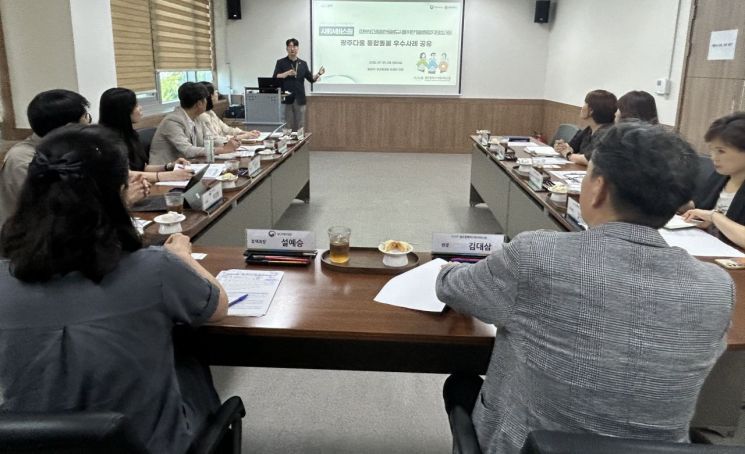 An employee of the Gwangju Social Service Agency explained the "Gwangju-style Integrated Care" project to officials from the Ministry of Health and Welfare who visited Gwangju on the 9th ahead of the nationwide implementation of the "Regional Care Integrated Support Act." Provided by Gwangju Social Service Agency.
The Ministry of Health and Welfare visited the Gwangju Social Service Agency to share advanced models ahead of the nationwide implementation of the "Regional Care Integrated Support Act" scheduled for March next year.
On the afternoon of the 9th, a delegation from the Ministry of Health and Welfare, including the Director of Social Service Policy, and officials from the Central Social Service Agency visited the Gwangju Social Service Agency. They listened to the case of Gwangju Social Service Agency, which manages the Gwangju-style Integrated Care project, in preparation for the implementation of the "Regional Care Integrated Support Act," and discussed policy directions.
During the visit, the Gwangju Social Service Agency, as a partner in delivering the "Gwangju-style Integrated Care" project?which has become the standard model for care in Korea?explained its "comprehensive care quality management" for warm and thorough care, as well as the current status of "multi-layered care" in collaboration with the local community.
In particular, the agency described its support for difficult private cases through the Safe Care Center (formerly the Comprehensive Home Care Center), its record of providing the largest amount of public care services nationwide, and introduced new care projects linked to IoT-based remote care, the university RISE project, and the Hometown Love Donation Program, drawing interest and positive responses from the visiting delegation.
Seol Yesung, Director of Social Service Policy at the Ministry of Health and Welfare, said, "I was deeply impressed by Gwangju's community-based care system, which is organically connected among local governments, social service agencies, the private sector, universities, and citizens who love their hometown. As we prepare for the implementation of the regional integrated care project, the pioneering case of the Gwangju Social Service Agency will be of great help in developing and distributing manuals and providing training to reduce service gaps between regions."
Kim Daesam, President of the Gwangju Social Service Agency, stated, "With the implementation of the Regional Care Integrated Support Act, I hope this will serve as an opportunity to unify and further advance the basic functions and projects of social service agencies nationwide. We will continue to work towards building a sustainable care society centered on people and relationships."
© The Asia Business Daily(www.asiae.co.kr). All rights reserved.
![Clutching a Stolen Dior Bag, Saying "I Hate Being Poor but Real"... The Grotesque Con of a "Human Knockoff" [Slate]](https://cwcontent.asiae.co.kr/asiaresize/183/2026021902243444107_1771435474.jpg)
















