The Public Procurement Service (PPS) is accelerating its regulatory reset of public procurement and plans to complete the initiative within this year. The regulatory reset is being led by the PPS, which is conducting a comprehensive review of procurement regulations from the ground up to determine whether each rule should be maintained, abolished, or relaxed.
The PPS announced on July 10 that it recently held a joint public-private "Procurement Field Regulatory Innovation Committee" (hereinafter referred to as the Committee) at the Seoul Regional Public Procurement Service. During the meeting, the Committee finalized 80 key tasks for the regulatory reset, including those related to Multiple Award Schedules (MAS), excellent products, innovative products, and facility construction contracts.
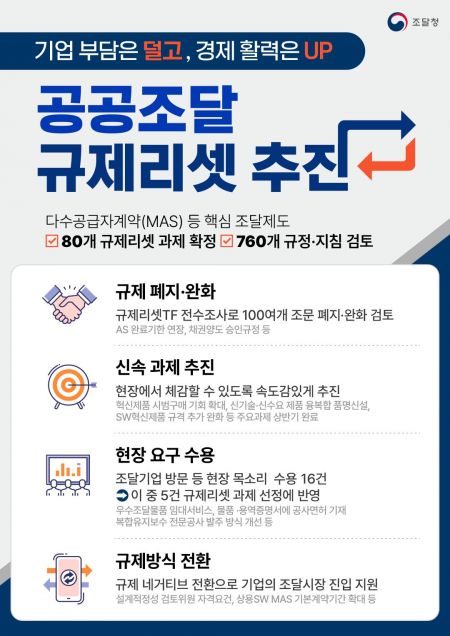
The Committee reviewed the PPS's plans for the regulatory reset and the progress of the comprehensive review of regulations. It also examined the implementation details and objectives of core procurement systems before finalizing the tasks to be included in the regulatory reset.
Previously, in March, the PPS launched a Regulatory Reset Task Force (TF) and conducted a comprehensive review of 760 procurement regulations and guidelines. By the end of May, the agency identified over 100 provisions requiring deregulation among more than 7,000 articles across 82 regulations related to core systems.
Provisions identified as requiring deregulation included: ▲ facilitating convenience for demand institutions at adjacent construction sites in construction contracts; ▲ excessively short deadlines for after-sales service completion; ▲ provisions requiring the PPS to approve the assignment of claims even in cases where the PPS does not directly make payments.
The PPS explained that, based on the Committee's final decisions, it will swiftly proceed with amending (abolishing or relaxing) the provisions of tasks included in the regulatory reset.
In addition, investigations will continue into 198 general system regulations and 480 internal guidelines that have not yet been reviewed. The PPS aims to complete the remaining comprehensive reviews of general system regulations and internal guidelines, as well as the public procurement regulatory reset, within this year. Through a year-end Committee meeting, the agency will conduct a final assessment of the results of the comprehensive review of all 760 procurement regulations and the outcomes of the regulatory reset.
In the meantime, the PPS has responded to requests for system improvements from the field by designating over 50 improvement measures as regulatory reset tasks, with most amendment procedures completed in the first half of the year. Notable examples include the pilot operation of raising the second-stage base amount for MAS contracts of certain medium-term competitive products, the pilot project for the price adjustment system, and the expansion of the number of collaborative manufacturing companies for innovative products.
PPS Deputy Administrator Baek Seungbo stated, "The regulatory reset is an important tool for revitalizing the real economy and laying the foundation for future progress. By the end of this year, the PPS will proactively eliminate regulations from the perspective of businesses, focus on shifting to a negative regulatory framework, and strive for rationalization of regulations."
© The Asia Business Daily(www.asiae.co.kr). All rights reserved.
![User Who Sold Erroneously Deposited Bitcoins to Repay Debt and Fund Entertainment... What Did the Supreme Court Decide in 2021? [Legal Issue Check]](https://cwcontent.asiae.co.kr/asiaresize/183/2026020910431234020_1770601391.png)
















