Online Application via Card Company Apps and Local Gift Certificate Apps
In-person Application Available at Community Centers and Partner Banks
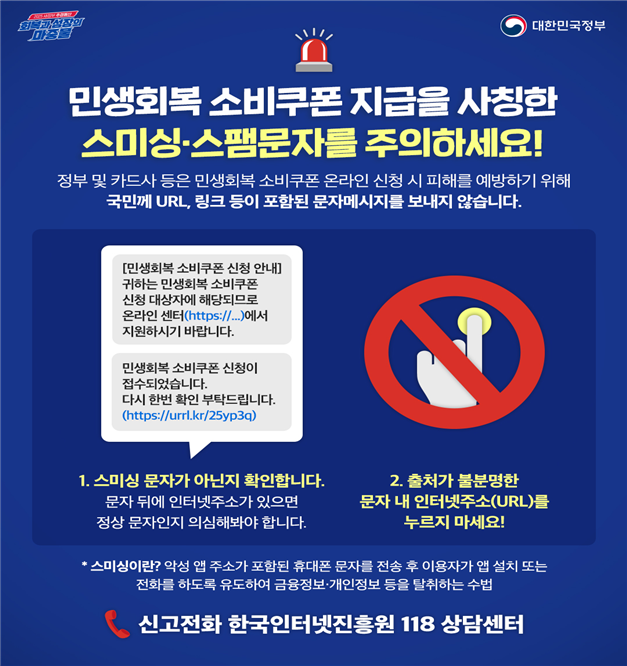
The government emphasized that it will not send any text messages or SNS notifications containing an internet address (URL or link) to announce the application or distribution of the 'Livelihood Recovery Consumption Coupon.'
With expectations that smishing (SMS phishing) scams impersonating the government, credit card companies, or banks?regarding recipient eligibility and amount, card usage approval, or applications?will increase, users are once again urged to exercise caution.
The Livelihood Recovery Consumption Coupon can be applied for online via credit card company apps or websites, call centers or ARS, and local gift certificate apps or websites, or offline in person at banks affiliated with the card or at local government offices (community centers).
To prevent smishing damage, users are strongly encouraged to utilize the advance notification service provided by Gukminbiseo. If users receive SNS notifications from unclear sources other than Gukminbiseo, credit card companies, or banks, or if they receive suspicious SNS notifications containing internet addresses from sources claiming to be the government or credit card companies, they should examine them closely.
To proactively prevent smishing damage, the government, credit card companies, and local currency companies will not send any text messages or SNS notifications containing an internet address (URL or link) related to the Livelihood Recovery Consumption Coupon.
Therefore, if a message appears suspicious and is not an official notification, users should not click on it and should delete it immediately. If the message has already been opened, the internet address (URL) within the message should never be clicked.
If a user receives a suspicious smishing message or suspects infection by a malicious app after clicking an internet address (URL) in a message, they can refer to the 'Guidelines for Action in Case of Smishing Damage' and report or consult with the Korea Internet & Security Agency's '118' hotline, which operates 24 hours a day and is free of charge.
© The Asia Business Daily(www.asiae.co.kr). All rights reserved.

















