Able to Meet Peak Demand of Up to 97.8GW
Support for Vulnerable Groups with Energy Vouchers and Eased Progressive Rate System
Integrated Situation Room to Operate Until September
As record-breaking heatwaves continue day after day and electricity demand soars to midsummer levels, the government is launching emergency measures to manage the power supply. The plan is to thoroughly manage the situation by inspecting power generation facilities and securing reserve resources to ensure there are no problems even if demand peaks at 97.8GW.
On July 10, the Ministry of Trade, Industry and Energy announced its "Summer Power Supply and Demand Outlook and Measures" at a cabinet meeting chaired by the Prime Minister, stating, "We are making all-out efforts to ensure an uninterrupted power supply."
Since the beginning of this month, the use of cooling devices has surged, pushing electricity consumption beyond typical midsummer levels. The average temperature for the first week of July, from the 1st to the 7th, was 28.2 degrees Celsius, surpassing the previous record high of 27.1 degrees set in 2022. In Seoul, the temperature soared to 37.8 degrees on July 8, breaking last summer's highest record. The Ministry of Trade, Industry and Energy projects that if these weather conditions persist, peak power demand could reach as high as 97.8GW by the end of July or early August.
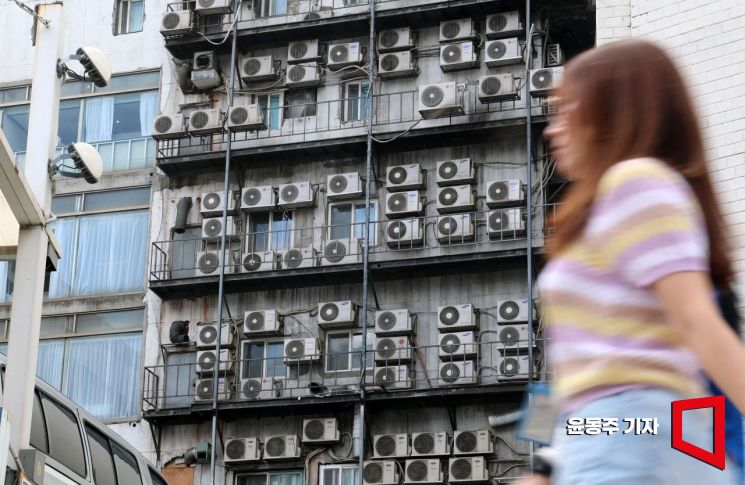 As the rainy season continues along with nationwide heatwaves, humid and hot weather persists. On July 1, 2025, an air conditioner outdoor unit is installed on a building near Namdaemun Market in Jung-gu, Seoul. Photo by Yoon Dongju
Actual demand is also rising rapidly. As of 6 p.m. on July 8, peak power demand reached 95.7GW, the second-highest figure ever recorded. For July, this is an all-time high. The Ministry believes that, given the likelihood of even higher temperatures through early August and the characteristic rigidity of cooling demand (which does not decrease once it starts), there is a possibility that this year's peak could surpass the all-time record of 97.1GW set on August 20, 2024.
Accordingly, the government has increased power supply capacity to 106.6GW this summer, which is 1.2GW higher than last year. If demand remains at the baseline forecast of 94.1GW, the reserve margin will be 12.6GW. Even in the worst-case scenario, with demand reaching 97.8GW, the government expects to secure a reserve margin of 8.8GW, ensuring a stable supply.
In addition, the government has prepared a total of 8.7GW in emergency reserve resources. These are structured to be activated immediately in a crisis through phased measures such as increasing coal power output, reliability demand response (DR), voltage reduction, and emergency demand control.
To guard against supply instability caused by generator failures or natural disasters, the government has also completed pre-inspections and maintenance of major facilities. Preventive measures, such as replacing aging transmission lines and drainage facilities and inspecting towers in areas vulnerable to landslides, have been completed in advance. The government is also prepared to activate rapid recovery systems in the event of any damage.
At the same time, the government is implementing rational energy use measures for public institutions and pursuing demand management efforts through citizen participation incentive programs such as energy cashback. Support measures for small business owners and energy-vulnerable groups are also being expanded, including the distribution of high-efficiency cooling devices, subsidies for purchasing high-efficiency home appliances, and installment payment options for electricity bills.
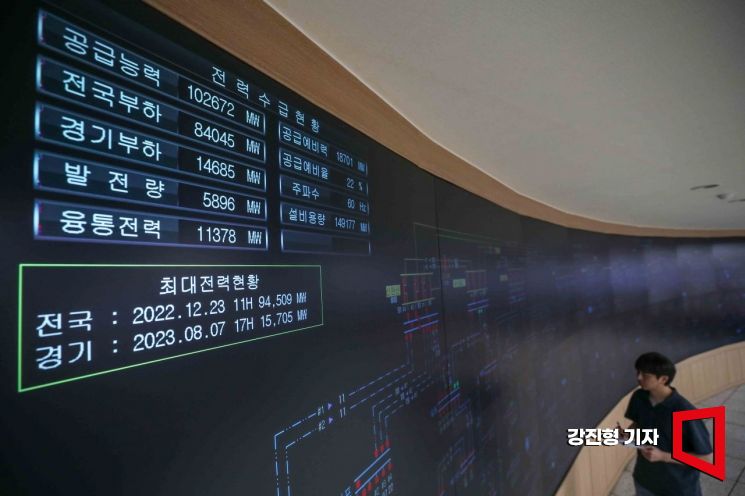 On the 7th, as heatwaves and tropical nights continue across most regions nationwide, officials are checking the power supply status at the System Operation Center of the Power Management Division, Korea Electric Power Corporation Gyeonggi Headquarters in Suwon, Gyeonggi. Photo by Kang Jinhyung aymsdream@
In particular, since July 1, the government has provided the annual energy voucher amount (up to 701,300 KRW) in a lump sum and has increased the electricity bill reduction cap to a maximum of 20,000 KRW per month.
Additionally, the government has temporarily eased the progressive electricity rate system to reduce household burdens from increased cooling usage. The first tier has been raised from 0-200kWh to 0-300kWh, and the second tier from 200-400kWh to 300-450kWh.
For households that have applied for the energy voucher but have not actually used it, the government is providing frequent notifications via text message and KakaoTalk, and postal workers are making direct visits to explain how to use the vouchers, as part of efforts to encourage actual usage.
The Ministry of Trade, Industry and Energy will operate the Integrated Power Supply and Demand Situation Room for 72 days from July 10 to September 9, and will conduct supply and demand crisis response drills with related power agencies to check real-time response capabilities.
Minister of Trade, Industry and Energy Ahn Dukgeun said, "We still have sufficient reserves, so the power supply and demand situation remains stable," and added, "We will continue to thoroughly manage the situation by activating pre-prepared response measures in a timely manner, regardless of typhoons, equipment failures, or any other circumstances, to ensure that the public is not inconvenienced."
© The Asia Business Daily(www.asiae.co.kr). All rights reserved.


















