Permission Granted for Multi-Family Housing in Previously Restricted Quasi-Industrial Zones
Recommended Uses Introduced to Revitalize Low-Rise Street Fronts
In anticipation of the opening of the Shinansan Line, the construction of multi-family housing will be permitted within quasi-industrial zones to develop the Sindoksan Station area into a residential and employment-oriented urban center.
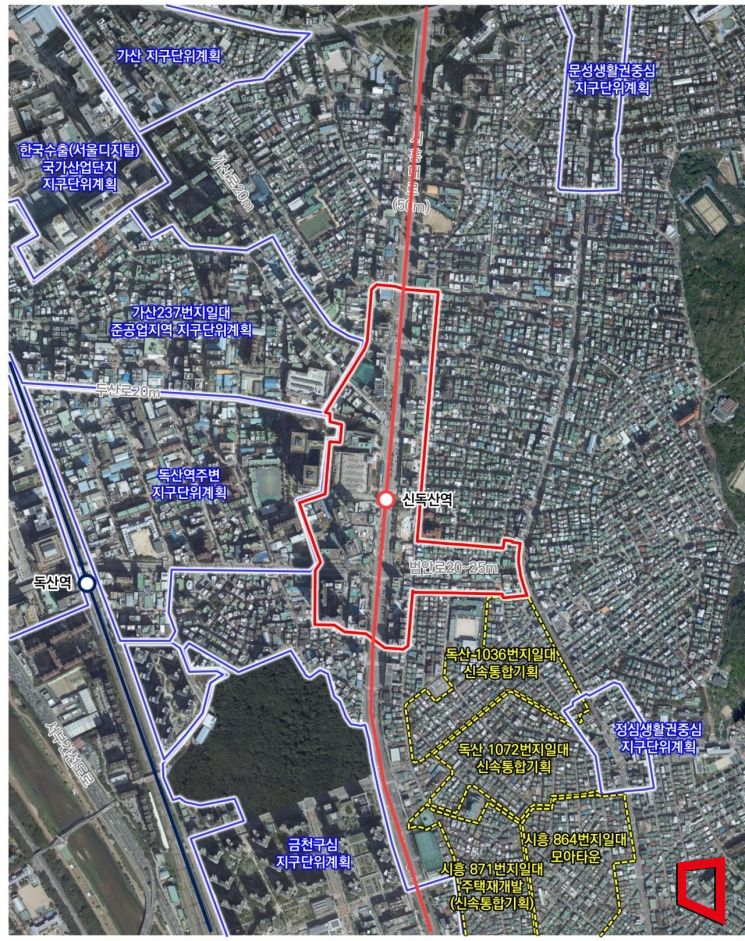
The Seoul Metropolitan Government announced on the 10th that the 12th Urban Architecture Joint Committee had approved, with modifications, the proposal for the designation and planning decision of the Doksan District Unit Planning Zone.
The area around Sindoksan Station is scheduled to see the opening of the Shinansan Line in 2027, and large-scale expedited integrated planning projects are being promoted nearby. In response, since the 2018 redevelopment, the city has pursued changes to the district unit plan, taking into account the altered conditions both inside and outside the zone. The city aims to strengthen development conditions along Siheung-daero and improve the pedestrian environment along Beoman-ro to enhance the quality of the surrounding residential areas.
Previously, the construction of multi-family housing was not permitted within the quasi-industrial zones of the Doksan District Unit Planning Zone. Reflecting the policy announced in November last year, "Seoul Quasi-Industrial Zone System Improvement Plan," the city has now allowed multi-family housing use, enabling the realization of residential proximity to workplaces as a residential area supporting G-Valley.
To respond to large-scale development such as the selection of expedited integrated planning (redevelopment projects) in areas including 1037 Doksan-dong, the city has expanded the district unit planning zone to include the area along Beoman-ro, which connects Siheung-daero and Doksan-ro. To activate the street level, retail stores, cafes, and performance venues will be introduced as recommended uses. The city will also gradually improve the pedestrian environment by establishing building setback lines and front open spaces.
To improve the poor pedestrian environment by connecting the newly established Sindoksan Station subway entrance with pedestrian-friendly streets, the city has developed a plan to create building setback lines and pocket parks, encouraging the formation of pedestrian-friendly streets. The space will be developed to be pleasant and accessible for both residents and visitors.
Cho Namjun, Director of the Seoul Urban Space Headquarters, stated, "We expect that the designation and planning of the Doksan District Unit Planning Zone, along with the opening of Sindoksan Station and the introduction of residential functions within quasi-industrial zones, will further invigorate the local living environment."
© The Asia Business Daily(www.asiae.co.kr). All rights reserved.

















