"Brazil's Former President Witch Hunt Must End"
...Intervening in Foreign Politics Through Tariffs
U.S. President Donald Trump has sent and made public letters specifying reciprocal tariff rates that will be applied to eight countries, including Brazil and the Philippines, starting August 1.
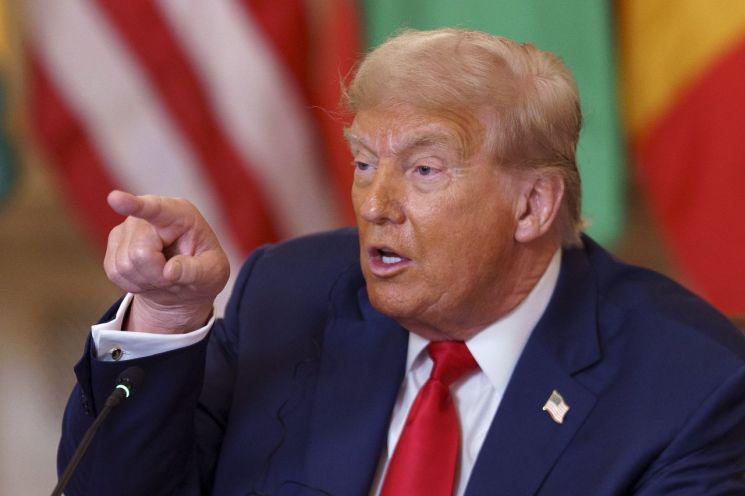
On July 9 (local time), President Trump posted a total of eight letters on the social media platform Truth Social, specifying reciprocal tariff rates of 20% for the Philippines, 25% for Brunei and Moldova, 30% for Algeria, Iraq, Libya, and Sri Lanka, and 50% for Brazil.
Compared to the reciprocal tariff rates announced on April 2, the rate for the Philippines has increased by 3 percentage points from 17% to 20%, and Brunei's rate has risen by 1 percentage point from 24% to 25%. Algeria's rate remains unchanged. Sri Lanka's rate has been reduced by 14 percentage points (from 44% to 30%), Iraq's by 9 percentage points (from 39% to 30%), Libya's by 1 percentage point (from 31% to 30%), and Moldova's by 6 percentage points (from 31% to 25%).
The most notable aspect of the letters was President Trump's announcement that he would apply a reciprocal tariff rate of 50% to Brazil, a 40 percentage point increase from the 10% base tariff applied in April, citing political reasons. In his letter to Brazilian President Luiz Inacio Lula da Silva, Trump described the ongoing trial of former President Jair Bolsonaro as an "international disgrace," stating, "This trial must not proceed. The witch hunt must end immediately." He further claimed that free elections in Brazil and the fundamental freedom of expression for Americans are under attack, and declared that a 50% tariff would be imposed on all Brazilian goods entering the United States starting August 1.
In addition, President Trump addressed Brazil's tariff and non-tariff barriers, stating that the United States and Brazil must move beyond their existing trade relationship. Trump cited "Brazil's continued attacks on U.S. companies' digital trade activities and other unfair trade practices," and announced that he had instructed U.S. Trade Representative Jamieson Greer to immediately begin an investigation into Brazil under Section 301 of the Trade Act.
Ultimately, President Trump has publicly announced a policy that supports the hardline conservative former President Bolsonaro, with whom he had a good relationship during his first term, while putting pressure on the progressive President Lula, who stands in opposition to Bolsonaro. As a result, Trump's tariff letter to Brazil is seen as an example of using tariffs as a means of intervening in the political and judicial affairs of another country. Former President Bolsonaro, often referred to as the "Trump of Brazil," has been indicted on charges including attempting to retain power through various activities with former defense and justice ministers after losing the 2022 presidential election to current President Lula.
Meanwhile, letters regarding the European Union (EU) and India, two of the United States’ major trading partners, have not yet been made public, drawing attention to the ongoing negotiations. It is reported that U.S. Treasury Secretary Scott Besant, who has been involved in the tariff negotiations, advised President Trump to postpone the imposition of reciprocal tariffs to August 1, based on progress being made in negotiations with some key partners, including India and the EU.
President Trump, who had initially planned to impose the reciprocal tariffs starting July 9 after a 90-day grace period, has rescheduled their implementation to August 1 and has been sending tariff letters to world leaders since July 7.
© The Asia Business Daily(www.asiae.co.kr). All rights reserved.

















