Designation as a Special Planning Zone to Improve Pedestrian Environment
Height Plans Revised in Consideration of Changes from Surrounding Development
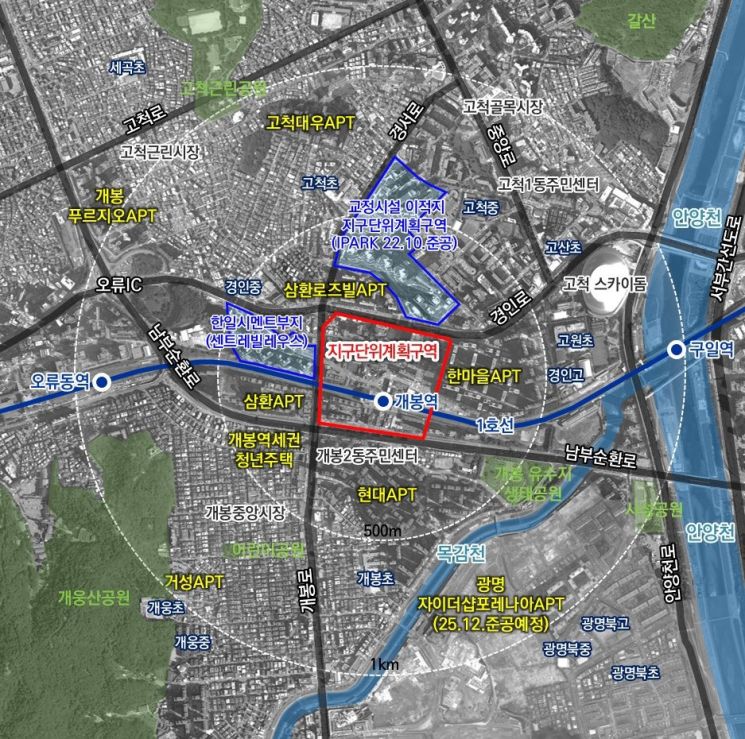
The pedestrian environment around Gaebong Station in Guro-gu, Seoul, which sees an average of about 20,000 passengers boarding and alighting each day, will be improved.
On July 10, Seoul City announced that it had approved with amendments the "Gaebong Station District Unit Plan Decision (Amendment) (Draft)" at the 12th Urban and Architectural Joint Committee meeting held the previous day.
The target area, designated as the Gaebong District Center in 2018, is adjacent to major roads such as Gyeongin-ro and Nambu Beltway and includes Gaebong Station. Gaebong Station serves as a transportation hub, with approximately 20,000 daily passengers and five bus routes passing through. Due to nearby residential apartment development projects, about 10,000 households are being supplied, further establishing the area as a residential center.
In this revision of the district unit plan, the city focused on enhancing the status of the area as a district center by reflecting its unique characteristics and recent changes. In particular, the city plans to strengthen the area's role as a hub by improving the Gaebong Station plaza environment and preparing customized management plans that take into account the residential nature of the area.
First, the city will designate the area around the aging buildings near Gaebong Station plaza as a special planning zone to improve the pedestrian environment in the busy Gaebong Station area, which is crowded due to heavy foot traffic. The area is often congested with bus transfer passengers, and the subway entrances are narrow, making passage inconvenient.
Going forward, the city plans to expand the plaza, which has been narrowed by the installation of bus stops, and to disperse users by creating new subway entrances. In addition, the city will encourage the supply of cultural and sports facilities in response to the demand for new residential apartments.
With the end of operations at the Gaebong Radar, a military facility, height restrictions have been eased, and the city has revised height plans to accommodate changes brought about by surrounding area development. Height limits, previously set at 60-70 meters for main roads and 40-50 meters for secondary roads, have been reestablished at 120 meters for main roads and 100 meters for secondary roads.
Additionally, the city plans to improve regulations that have been perceived as restrictive by revising the floor area ratio system and lifting unnecessary joint development requirements, reflecting recent changes to district unit plan establishment standards.
Cho Namjun, Director of the Seoul Urban Space Headquarters, stated, "Through the revision of the Gaebong Station district unit plan, we expect to revitalize the area and establish it as a residential center by improving the plaza, which serves as a regional hub, and by addressing regulatory issues that have been perceived as restrictive."
© The Asia Business Daily(www.asiae.co.kr). All rights reserved.
![Clutching a Stolen Dior Bag, Saying "I Hate Being Poor but Real"... The Grotesque Con of a "Human Knockoff" [Slate]](https://cwcontent.asiae.co.kr/asiaresize/183/2026021902243444107_1771435474.jpg)
















