17,963 Court-Ordered Foreclosure Applications Nationwide in the First Half
Upward Trend Since the First Half of 2023
Foreclosures Expected to Rise Further Due to Tighter Jeonse Tenant Exit Loan Limits
"I am concerned because the maximum loan amount I was planning to receive to return the jeonse deposit to my tenant is being reduced to 100 million won."
Since last month, new lending regulations have significantly reduced the limit on home mortgage loans for landlords to return jeonse deposits (jeonse tenant exit loans). As landlords face increasing difficulties in securing funds to return deposits, there are growing concerns that the number of court-ordered foreclosures could surge. If a landlord fails to return the jeonse deposit, the tenant can initiate a foreclosure auction and recover the deposit from the auction proceeds. The impact of the 2022 jeonse fraud has already led the number of court-ordered foreclosures in the first half of this year to reach a record high, and there are predictions that the number of foreclosures could continue to rise.
According to the Court Registration Information Plaza on July 10, the number of apartment buildings (including officetels, apartments, row houses, and multiplex houses) nationwide for which court-ordered foreclosure proceedings were initiated in the first half of this year was 17,963. This is an increase of 37 cases compared to 17,926 cases in the second half of last year.
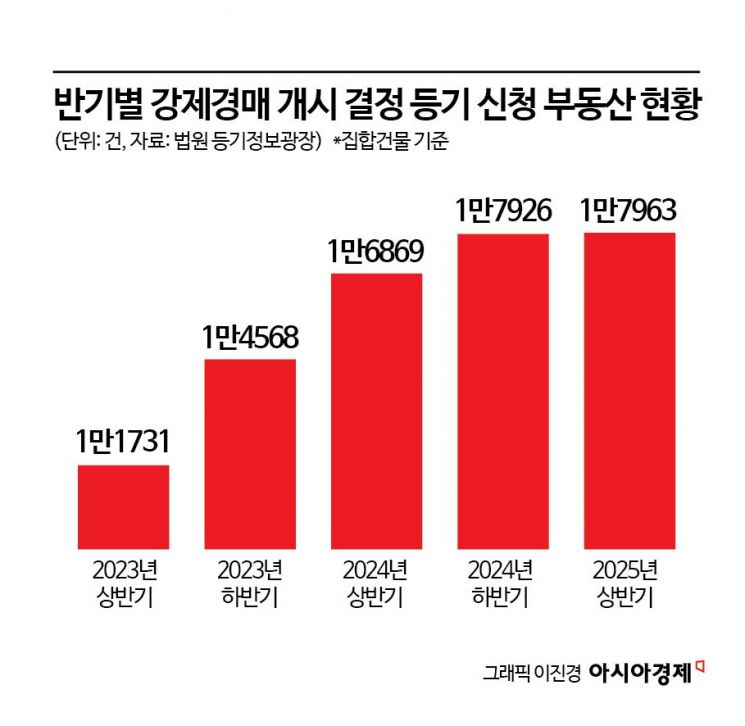
The number of apartment buildings subject to court-ordered foreclosure proceedings on a half-year basis has been on the rise since 11,731 cases in the first half of 2023. In the second half of the same year, the number increased by more than 2,800 to reach 14,568 cases. By the second half of last year, the number was close to 18,000, marking an increase of 6,232 cases over two years.
This rise in court-ordered foreclosures is attributed to an increasing number of landlords who are unable to return deposits as jeonse prices have not risen. In areas such as Incheon, where jeonse fraud was concentrated, jeonse prices have still not recovered to previous levels. Meanwhile, tenants, concerned about potential fraud, are trying to vacate, further increasing the financial burden on landlords. In Incheon, the number of foreclosure applications rose from 281 cases in April to 455 cases last month. According to the Korea Real Estate Board's nationwide housing price trend survey, Incheon's comprehensive jeonse price index for housing fell by a cumulative 0.37% from January to May this year.
Lee Juhyun, a senior researcher at GGI Auction, explained, "Most of the property types subject to court-ordered foreclosure appear to be row houses and multiplex houses that were exposed to jeonse fraud issues." She added, "In the case of row houses and multiplex houses, the jeonse price ratio increased when housing prices rose in 2021, but as prices fell, the so-called 'negative equity jeonse' and 'reverse jeonse' phenomena became more pronounced." She continued, "There are also a large number of cases where the Korea Housing and Urban Guarantee Corporation (HUG) returned the jeonse deposit to tenants instead of the landlord and subsequently filed for foreclosure on the property."
There are also claims that the trend of increasing numbers of apartment buildings being sent to the foreclosure market may continue in the second half of the year. Due to last month's lending regulations, the limit for jeonse tenant exit loans will be reduced to 100 million won. Furthermore, this is only available to owners of a single home, and those with two or more homes are not eligible for the loan at all. As this regulation effectively blocks gap investment (purchasing with existing jeonse tenants), the supply of jeonse properties is expected to decrease, and except for areas with strong potential for jeonse price increases, there is a high possibility that more tenants will initiate court-ordered foreclosures to recover their deposits. Senior researcher Lee said, "The number of court-ordered foreclosure applications nationwide is expected to increase going forward. In areas like Seoul, where jeonse supply is limited but demand remains strong, the increase may be minimal. However, in the outskirts of Seoul, as well as in Gyeonggi and Incheon, if the jeonse market circulation does not improve, the number of cases will inevitably continue to rise."
© The Asia Business Daily(www.asiae.co.kr). All rights reserved.



















