Aside from humanitarian aid...
Reconstruction projects have stalled
Industry says "there's nothing to gain"...
Small ODA share, US and EU firmly in control
The reconstruction project in Ukraine has recently come under renewed attention due to the ongoing investigation into Sambu Construction. This initiative once raised high expectations for large-scale participation by Korean companies. Two years ago, Sambu Construction and several other firms were grouped as "theme stocks" in the securities market because of this anticipation.
Recently, however, both the government and companies appear to be stepping back. The disappearance of optimism is attributed to a combination of factors: the prolonged war, a shrinking market size, and the limitations of Official Development Assistance (ODA). Within the construction industry, there are now voices of resignation, with some saying, "There is hardly any reason for companies to even show interest at this point."
Aside from humanitarian aid... Reconstruction projects have stalled
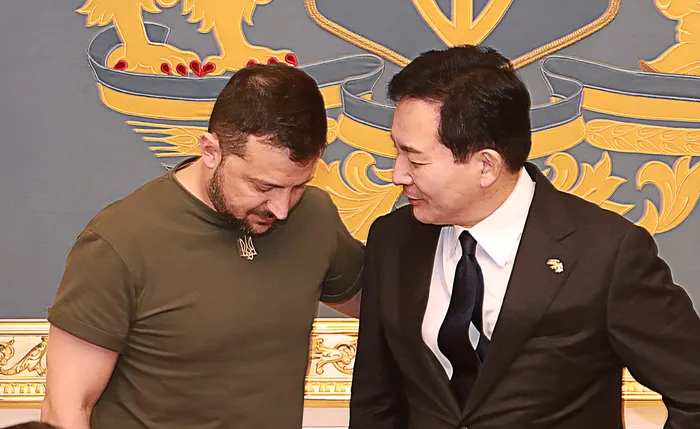 In 2023, Won Heeryong, then Minister of Land, Infrastructure and Transport, who led the Reconstruction Cooperation Group, visited Ukraine (right). He announced six major reconstruction projects with the Ukrainian government. Ministry of Land, Infrastructure and Transport.
In 2023, the Ministry of Land, Infrastructure and Transport selected six major reconstruction projects, including urban and residential initiatives, and actively engaged by providing master plans for complex urban and residential developments in Ukraine. Won Heeryong, then Minister of Land, Infrastructure and Transport, led the Reconstruction Cooperation Group to Ukraine and announced these projects together with the Ukrainian government. The six projects included the Kyiv Transportation Master Plan, Uman City Smart City Master Plan, Boryspil Airport modernization, Bucha City wastewater treatment facilities, Kakhovka Dam reconstruction support, and railway line upgrades for high-speed connections (such as Kyiv to Poland).
Now, two years later, there is almost no real progress on these projects. On July 10, an official from the Ministry of Land, Infrastructure and Transport stated, "Currently, apart from humanitarian aid, there are virtually no projects being carried out," adding, "Due to the prolonged war, there are far fewer business opportunities than initially expected." While the transportation master plan has been handed over to the Ukrainian government, most of the other projects remain at the planning stage.
The Ukrainian government estimated its reconstruction needs at $900 billion (about 1,240 trillion won) in 2023. Earlier this year, the United Nations revised this figure downward to $524 billion (about 720 trillion won), which does not even account for damages in Russian-occupied territories. According to Korea Overseas Infrastructure and Urban Development Corporation (KIND), damages in occupied territories represent about half of the total. Should these areas be incorporated into Russia in the future, opportunities for Korean companies to participate will become even more limited.
Industry says "there's nothing to gain"... Small ODA share, US and EU firmly in control
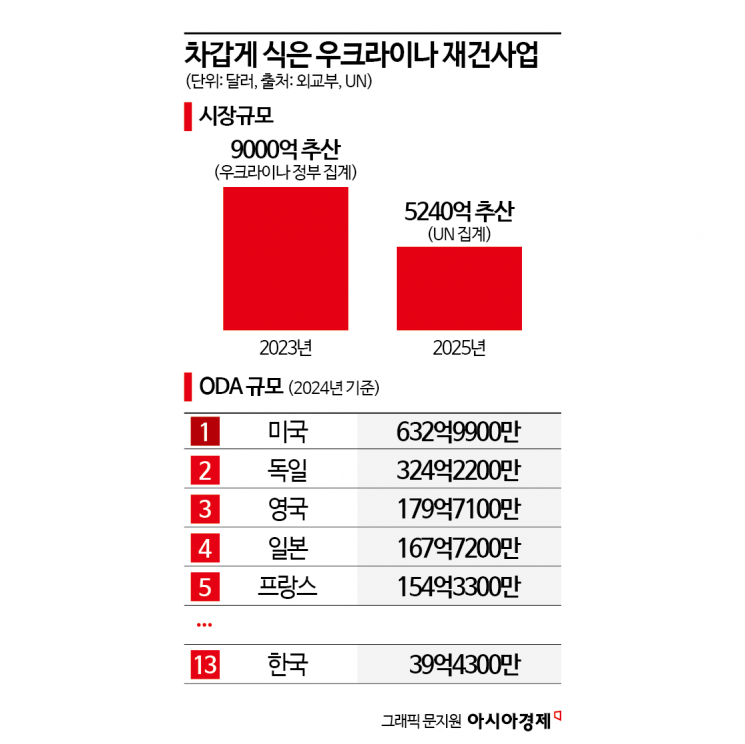
Ukraine is pursuing its reconstruction projects through an ODA-based international aid model, where aid is provided on the condition that local companies participate. Korea's share of ODA is small, making it difficult to exert substantial influence. As of last year, Korea's ODA amounted to $3.943 billion, ranking 13th among 32 major countries. The Economic Development Cooperation Fund (EDCF) to be allocated to Ukraine by 2026 is also only around $2.1 billion. In contrast, the United States and the European Union have announced plans to inject tens of billions of dollars. The recently launched US-led "Minerals Agreement Fund" is a new framework that turns half of Ukraine's mineral revenues into a fund for reconstruction resources. Compared to such new mechanisms, Korea's presence remains limited.
The only visible move by the Korean government is the Economic Innovation Partnership Program (EIPP), which KIND, an agency under the Ministry of Land, Infrastructure and Transport, is currently pursuing with Ukraine. EIPP is part of the Ministry of Economy and Finance's ODA projects and is a consulting program that shares expertise in urban development. A government official commented, "It is literally just at the consulting level," and added, "It is far from actual construction contracts."
Major construction companies, once buoyed by high expectations, have now cooled considerably. A representative from one construction firm said, "The ODA itself is too small for us to take the lead in winning contracts." Another commented, "Contrary to expectations, there doesn't seem to be much to gain," expressing a cautious stance. Some analysts suggest that reconstruction in Russian-occupied territories could present future opportunities. However, considering North Korea-Russia diplomatic relations and the current sanctions against Russia, direct participation by Korean companies is unlikely to be easy.
© The Asia Business Daily(www.asiae.co.kr). All rights reserved.


















