The government repatriated a total of six North Korean residents who had drifted to South Korea by wooden boat between March and May, sending them back to North Korea via the East Sea on the morning of the 9th. It was reported that all of them had expressed their intention to return to North Korea.
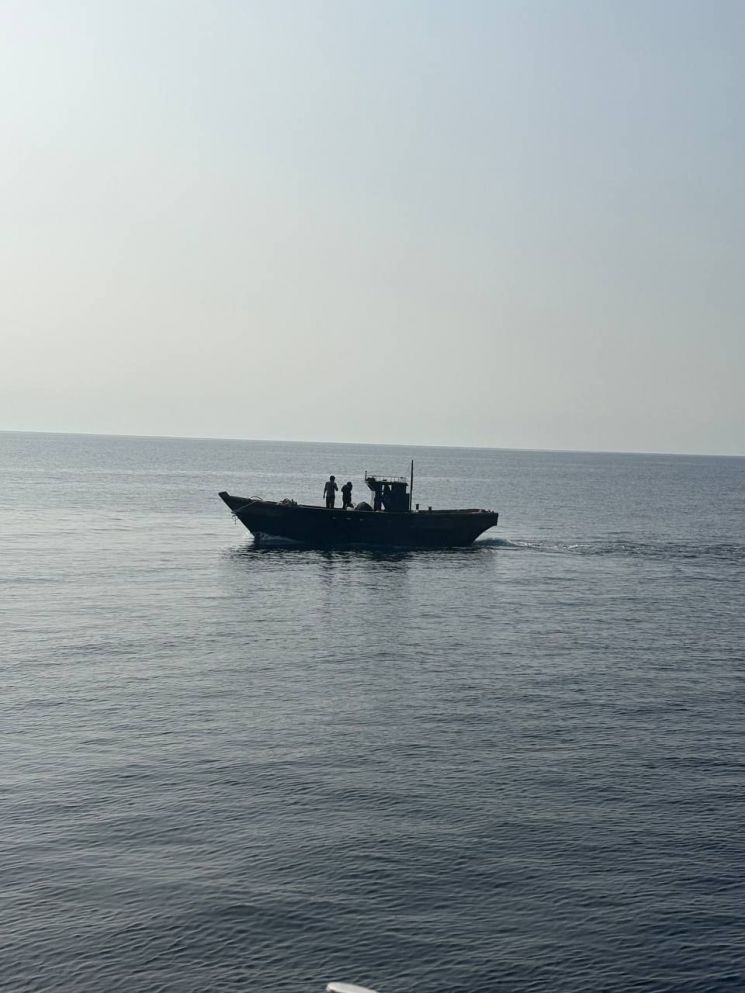 At around 9 a.m. on the 9th, six North Korean residents were returning to North Korea by a wooden boat in the East Sea. Ministry of Unification
A Ministry of Unification official told reporters that day, "We repatriated all six North Korean residents with their full consent," adding, "At 8:56 a.m., the North Korean residents' vessel (a wooden boat) crossed the Northern Limit Line (NLL)." Of the six residents who returned to North Korea that day, two had been rescued in the West Sea in March, and the remaining four had been rescued in the East Sea in May. All were male fishermen in their 30s and 40s with families in North Korea. The boat found and rescued in the West Sea was inoperable due to a malfunction, so they returned to North Korea on their own by boarding the vessel rescued in the East Sea together.
The government notified the North of the fact that North Korean residents had drifted to and been rescued in the South via the United Nations Command (UNC) communication channel. Afterward, the government continued to inform the North one to two times a week about the condition of the rescued residents, but there was no significant response. During this process, the government and the UNC repeatedly confirmed the North Korean residents' voluntary intention to return.
The timing and location of the government's repatriation were also communicated to the North twice through the UNC channel. Again, the North did not respond at all, but appeared in the East Sea according to the government's announced repatriation plan. The official explained, "At the time of repatriation, a North Korean patrol boat and a large vessel, presumed to be for towing, were present at the transfer point," and added, "At 9:24 a.m., a North Korean fishing boat, presumed to be for towing, met the wooden boat carrying the six residents, but instead of towing, they proceeded to North Korea on their own."
Regarding the reason for not choosing repatriation via the overland route at Panmunjom, the official explained, "Given the tense situation between the two Koreas, going to Panmunjom would have meant direct face-to-face contact with North Korean personnel," and added, "There was concern about whether a face-to-face method was appropriate when there was no clear response from North Korea regarding the repatriation plan." For this reason, the wooden boat that the North Korean residents had come down on was repaired so they could return to the sea on their own.
The North Korean wooden boat was equipped with an engine and other propulsion devices. For humanitarian reasons, the government provided cleaning and inspection services within the scope not violating sanctions against North Korea. At the time of repatriation, the boat carrying the North Korean residents was equipped with basic safety items such as life jackets, emergency food, and water. Regarding the several months' delay in repatriation, the Ministry of Unification official expressed regret, saying, "If communication between the two Koreas had been smoother, the issue could have been resolved much sooner." The official repeatedly emphasized that this repatriation was carried out "on humanitarian grounds," stating, "We confirmed the North Korean residents' voluntary intention to return multiple times and, in cooperation with relevant agencies, ensured their safety until repatriation."
© The Asia Business Daily(www.asiae.co.kr). All rights reserved.

















