Net Inflow of $5.08 Billion in Securities Investment Funds
Stock Net Inflows Expand... Bond Net Inflows Shrink to $2.81 Billion
Funds from foreign investors net-invested in the domestic stock market increased for the second consecutive month. This was due to improved foreign investor sentiment, driven by expectations for new government policies. In the bond market, investment continued to focus on medium- and long-term bonds, but the scale of net inflows decreased as redemptions of government bonds coincided.
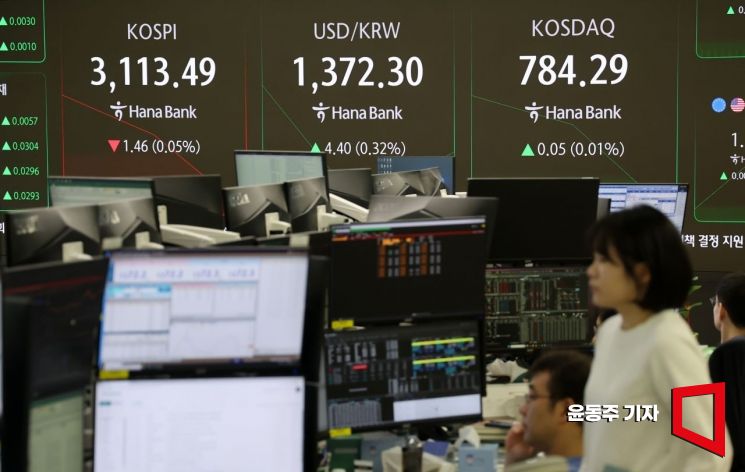 On the 8th, as the KOSPI index entered a pause around the 3,110 level and started the session flat, dealers were busy moving in the Hana Bank dealing room in Jung-gu, Seoul. 2025.07.09 Photo by Dongju Yoon
According to the "Trends in International Financial and Foreign Exchange Markets after June 2025" released by the Bank of Korea on the 9th, foreign funds in the domestic stock and bond markets recorded a net inflow of $5.08 billion last month. Although this figure was lower than the previous month's $9.29 billion?the highest since May 2023?the net inflow trend continued for the second consecutive month.
Net inflows into stocks amounted to $2.27 billion. After turning to a net inflow of $1.45 billion in May?the first net inflow in ten months?the scale expanded further. A Bank of Korea official explained, "Foreign investor sentiment improved due to expectations for new government policies."
Net inflows into bonds totaled $2.81 billion. Compared to April ($7.63 billion) and May ($7.83 billion), the scale of net inflows decreased. Despite continued investment in medium- and long-term bonds, the overall amount declined due to redemptions of government bonds.
The won-dollar exchange rate fell significantly from 1,380.1 won per dollar at the end of May to 1,350 won at the end of June. The daily volatility rate in June was 0.64%, up from 0.52% in the previous month. A Bank of Korea official explained, "The won-dollar exchange rate initially rose due to the Middle East conflict, but then fell as geopolitical risks eased and expectations for a U.S. Federal Reserve rate cut strengthened." The official added, "However, the volatility rate increased due to heightened geopolitical risks."
The Bank of Korea official also stated, "In the international financial market, favorable investor sentiment continues due to progress in trade negotiations and the easing of conflicts in the Middle East," and added, "In the domestic foreign exchange sector, domestic banks' external foreign currency borrowing conditions remain stable."
© The Asia Business Daily(www.asiae.co.kr). All rights reserved.
![Clutching a Stolen Dior Bag, Saying "I Hate Being Poor but Real"... The Grotesque Con of a "Human Knockoff" [Slate]](https://cwcontent.asiae.co.kr/asiaresize/183/2026021902243444107_1771435474.jpg)











