Tariff Rates and Timing for Semiconductors Still Undecided
Pharmaceuticals to Face Tariffs After 1 to 1.5-Year Grace Period
Copper Prices Surge Following Tariff Announcement
The administration of U.S. President Donald Trump, which the previous day sent letters notifying 14 countries, including South Korea and Japan, of plans to impose high tariffs, has decided to announce its tariff plans for semiconductors, pharmaceuticals, and copper as early as the end of this month. As the tariff front expands, with mounting confusion and uncertainty in global supply chains, concerns are growing that the global trade war will intensify.
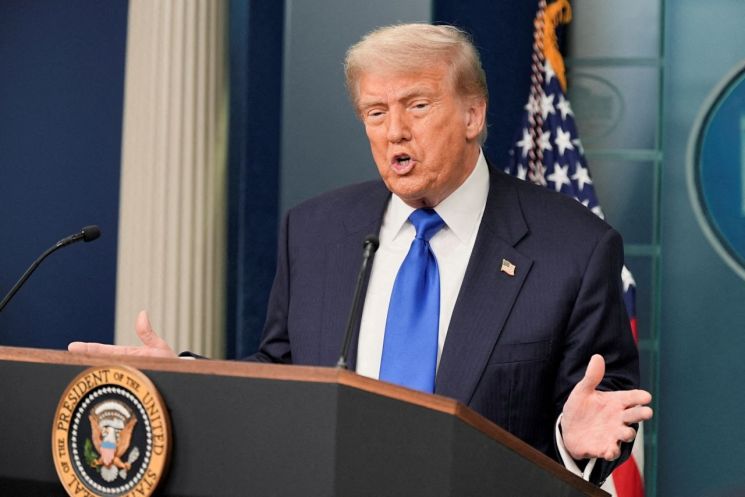
On July 8 (local time), President Trump stated during a Cabinet meeting at the White House, "There will be an announcement regarding pharmaceuticals, semiconductors, and a few other areas." However, he did not mention specific tariff rates, the timing of the announcement, or when the tariffs would be imposed on semiconductors.
Regarding tariffs on pharmaceuticals, President Trump said, "We will give them a period of one year or a year and a half, and if they do not come in (to the U.S.) within that period, tariffs will be imposed after that," adding, "The tariffs will be very, very high, around 200%." This is interpreted as giving overseas manufacturers a grace period of one to one and a half years to relocate their production facilities to the U.S., after which ultra-high tariffs would be applied.
Previously, President Trump had been conducting an investigation under Section 232 of the Trade Expansion Act to determine whether imports of semiconductors, pharmaceuticals, and copper pose a risk to U.S. national security. Section 232 of the Trade Expansion Act allows the president to take measures such as imposing tariffs if imports of certain items are deemed to threaten national security.
On this day, President Trump also stated, "We will announce tariffs on copper imported into the United States," adding that the tariff rate would be 50%. U.S. Secretary of Commerce Howard Lutnick said in an interview with CNBC that the investigation related to copper tariffs has already been completed and "the tariffs are likely to take effect between the end of July and August 1." He also said that investigations into pharmaceuticals and semiconductors are scheduled to be completed by the end of this month, "after which the president will decide on his policy."
This measure is seen as an effort to expand domestic production of copper, which is essential for various consumer goods in the U.S., including electric vehicles (EVs), military equipment, and power grids. According to the White House, copper is the second most widely used metal among materials utilized by the U.S. Department of Defense. It is a key material not only for infrastructure such as wiring but also for electric vehicles. The Japanese newspaper Nihon Keizai Shimbun (Nikkei) reported that the Trump administration is pushing to expand domestic copper production as a matter of national security, considering the strategic importance of copper.
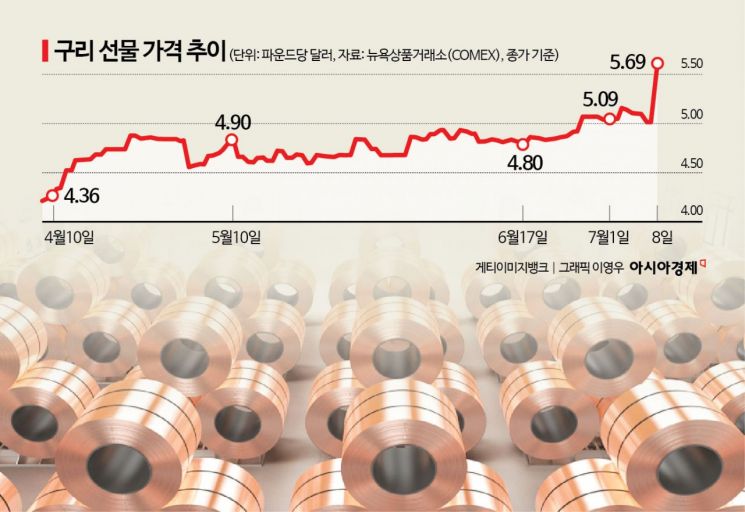
After President Trump announced plans to impose a 50% tariff on copper imports, copper futures prices soared. On the New York Mercantile Exchange (COMEX) that day, copper futures prices rose by as much as 17% from the previous day's closing price, marking a record surge. The closing price reached $5.68 per pound. In terms of daily increase, this is the highest since 1989. As President Trump announces tariff plans arbitrarily, concerns are being raised that the world trade order is being thrown into chaos and trade friction between countries may intensify. Reuters pointed out, "Trading partners around the world are finding it difficult to even agree on a basic framework in negotiations with the U.S. because the new tariffs are being announced in a disorderly manner," adding, "This is also complicating internal discussions on domestic concessions."
Within the U.S., there are also repeated warnings that imposing tariffs could instead trigger supply chain instability, increase costs, and weaken industrial competitiveness. U.S. business media outlet CNBC reported, "Many pharmaceutical companies have warned that the tariffs could lead to higher costs, discourage investment in the U.S., and disrupt the pharmaceutical supply chain, putting patients at risk," and have been pushing back against the measures.
Pierre Gratton, president of the Mining Association of Canada, also warned, "The U.S. does not have sufficient copper refining capacity or smelters and relies on imports from Canada, so such high tariff rates would hurt U.S. manufacturing."
Some argue that tariffs may not lead to the attraction of production facilities or increased investment in the U.S., but could instead hinder such trends. The Associated Press (AP) reported, "Despite the CHIPS Act, which encourages domestic semiconductor manufacturing, uncertainties surrounding semiconductor-related tariffs and policies are causing project delays, such as at Samsung's Texas plant," adding, "This could become a significant obstacle to the growth of the semiconductor industry and the U.S. securing technological competitiveness."
© The Asia Business Daily(www.asiae.co.kr). All rights reserved.


















