Due to climate change, "climate anxiety," in which the younger generation experiences feelings of helplessness, loss, or anger, has been identified as a social issue that warrants close attention in the future. There are also forecasts that regional disparities in disasters, such as floods and droughts, will become even more severe going forward.
According to Yonhap News on July 8, Shim Minyoung, Director of the National Trauma Center at the National Center for Mental Health, made these remarks during a presentation on "Climate Change and Mental Health" at the "Climate Health Forum" held at Seoul Square by the Korea Disease Control and Prevention Agency and others. Director Shim argued, "Extreme heat, wildfires, and other events caused by climate change become traumatic incidents that increase the prevalence of depression, anxiety, sleep disorders, and post-traumatic stress disorder (PTSD)."
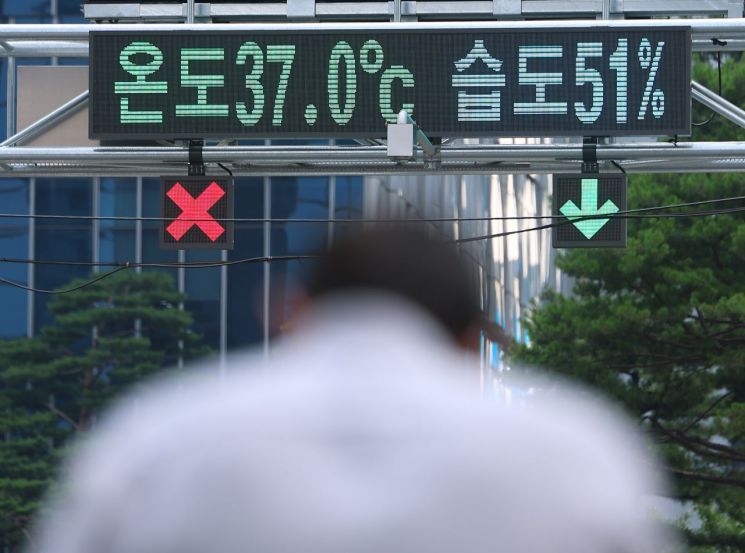 On the 8th, a screen in downtown Seoul displayed "Temperature 37 degrees," marking the highest temperature ever recorded in early July since the start of modern meteorological observations. Photo by Yonhap News.
According to an analysis by the National Trauma Center of the mental health status of those affected by the 2019 Gangwon wildfires, 65% of wildfire survivors experienced insomnia, and 58% experienced symptoms of anxiety. About one in four wildfire survivors suffered from moderate or higher levels of psychological distress, and 13% received psychiatric treatment.
Director Shim stated, "A problem that has recently come into focus is climate anxiety," adding, "Climate anxiety mainly appears among adolescents and young adults, and leads to feelings of helplessness, loss, and anger."
She continued, "It goes beyond a simple emotional response and affects a wide range of life decisions, including education, career, relationships, and family planning. Although climate anxiety is not classified as a mental disorder, it is already being addressed as a future-oriented mental health issue by the World Health Organization (WHO) and various research institutions. Therefore, it is necessary to conduct domestic surveys and develop generation-specific responses."
She further emphasized, "Mental health indicators and future predictive analyses now need to be explicitly included in climate health impact assessments. It is also necessary to establish a psychological support system for climate disasters and to expand community-based mental health services."
Kim Ho, a professor at Seoul National University School of Public Health, who delivered a keynote presentation at the forum, pointed out that regional disparities in disasters across the Korean Peninsula are widening due to climate change, based on the upcoming "Korea Climate Change Assessment Report 2025" to be published this year.
According to the report, as regional disparities in precipitation increase, topographical factors such as latitude and longitude are expected to significantly determine regional precipitation characteristics. In addition, the frequency and scale of floods and droughts are predicted to rise, and the gap between affected regions is also expected to widen.
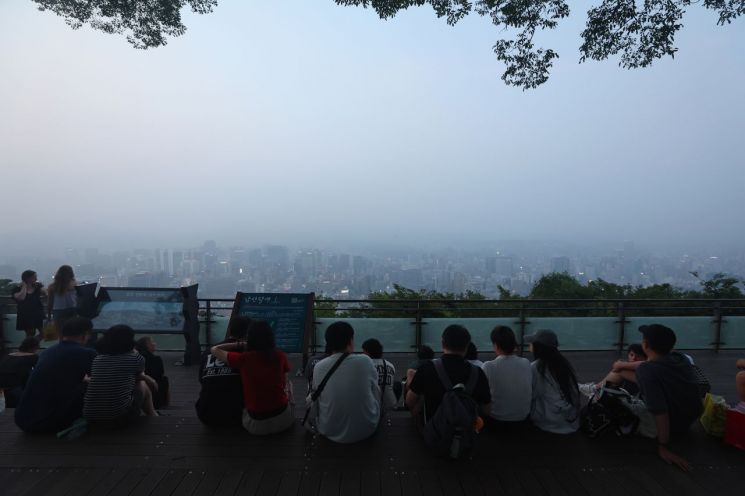 On the 7th, when the first heatwave warning of the year was issued in the Seoul area, citizens and tourists visiting Namsan in Seoul were taking a rest. Photo by Yonhap News
Climate change is also expected to bring about major changes in forestry and agricultural resources. The area of coniferous and mixed forests is already decreasing, while the area of broadleaf forests is increasing. Predictions using the forest carbon model (KO-G-Dynamics) indicate that Korea’s annual forest carbon absorption will decline, while the intensity and frequency of forest-related disasters will rise.
Since 2010, the government has published an assessment report every five years analyzing the current state of climate change on the Korean Peninsula and projecting future climate changes, based on the Intergovernmental Panel on Climate Change (IPCC) reports.
© The Asia Business Daily(www.asiae.co.kr). All rights reserved.


















