Full-Scale Vision for a 5 Million Tourist City and the "Yeongsangang Renaissance"
Accelerating Growth as a National Garden and Energy Industry Hub
Comprehensive Innovation in Living Conditions, Agriculture, and Welfare
Policy Achievements for a Young City, Including "Zero-Won" Youth Housing
All-Out Effort to Attract the Ministry of Climate and Energy and Secure Future Growth Engines
"Promise to Strengthen Regional Competitiveness and Improve Citizens' Quality of Life"
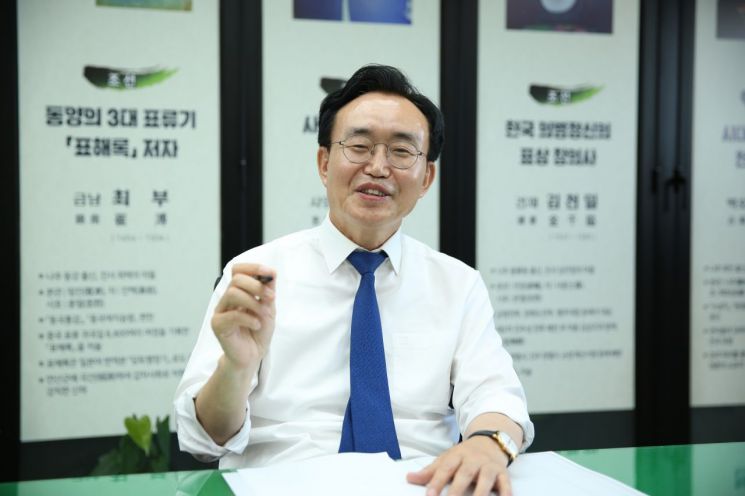 Yoon Byungtae, mayor of Naju, is reflecting on the path taken so far on the occasion of the 3rd anniversary of the 8th term of the elected government and explaining the administrative direction for the remaining year. Photo by Naju City
The core of the blueprint drawn by Yoon Byungtae, mayor of Naju, during the three years of the 8th term of the elected government, is to attract large-scale tourism through the realization of the 'Yeongsangang Renaissance' and to establish Naju as the energy capital of South Korea.
This marks the beginning of Mayor Yoon's innovative administration, aiming to dispel the shadows of an aging population and demographic decline, and to redraw the next 100 years for the region. The results reflect his extensive experience as an economic and budget expert at the Ministry of Economy and Finance, which manages the nation's finances, as well as his service at the Presidential Office and as Vice Governor of Jeollanam-do, encompassing both central and local government.
For the remaining year, Mayor Yoon has set a goal of completing the remaining pieces of the puzzle under the slogan "Happy Naju to Live In, Leading Naju," by implementing field-oriented administration and comprehensively refining city policies in tourism, energy, agriculture, education, welfare, and youth policy.
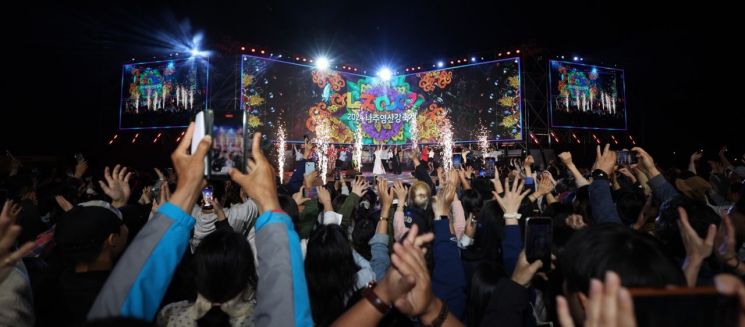 A scene from the 'Musical Big Show,' one of the programs held at the Naju Yeongsangang Festival last year. Provided by Naju City
◇"Making Yeongsangang a National Garden"... Launching the Era of 5 Million Tourists
Naju is a city that embraces the Yeongsangang River, known as the "lifeline of Honam." Mayor Yoon believes that the treasures created by Yeongsangang over thousands of years are the "key" to opening the era of 5 million tourists in Naju.
The potential has already been demonstrated. Naju City has been developing the 'Yeongsangang Garden' in the riparian ecological wetland area and has been hosting the 'Naju Yeongsangang Festival' since 2023. Last year, the festival attracted a record 360,000 visitors.
Naju City plans to take it a step further by aiming to develop the Yeongsangang Garden into the largest and best national garden in Korea.
Momentum increased when Naju was selected as the host city for the '2025 Second Half Garden Festival' organized by Jeollanam-do in June.
In particular, from October 8 to 29, a garden festival will be held at Yeongsangang Garden to showcase its potential.
Efforts are also underway to further materialize this vision through a variety of programs, including the Naju Yeongsangang Festival (October 8-12), the National Naju Marathon (October 12), and the International Agricultural Expo (October 23-29).
Additionally, Naju plans to fully realize the 'Yeongsangang Renaissance' and usher in the era of 5 million annual tourists through large-scale tourism resources that blend gardens, ecology, culture, and agriculture, such as Neureoji, which features peninsula-shaped natural terrain, the 34-kilometer Yeongsangang riverside road, and Sigyeongjeong, a site rich in history and literature.
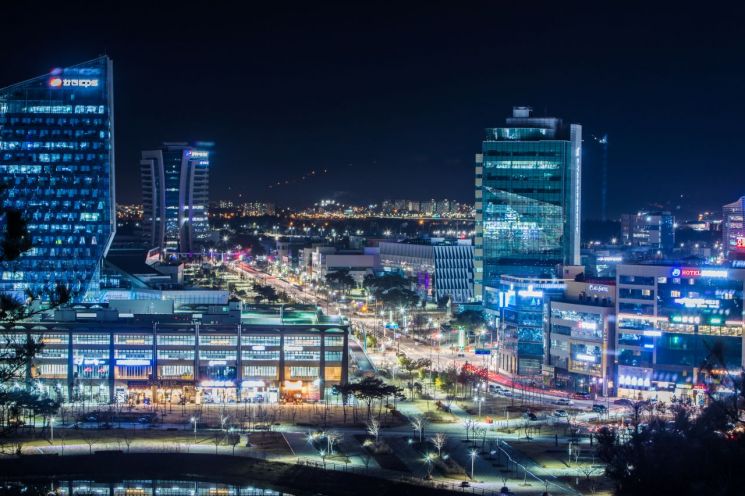 Night view of Bitgaram Innovation City in Naju, where major energy public enterprises such as Korea Electric Power Corporation are concentrated. Provided by Naju City
◇All-out Effort to Attract the Ministry of Climate and Energy to Naju, the Energy Capital of Korea
The plan to create an energy industry cluster in the Gwangju-Jeonnam Joint Innovation City (Bitgaram), which is growing as the center of South Korea's energy industry, is steadily moving forward.
Naju City is seeking to solidify this plan by attracting the 'Ministry of Climate and Energy,' a policy being promoted by the Lee Jaemyung administration. For Naju, which is establishing itself as an energy city, attracting the ministry is closely linked to the establishment of a new control tower.
For the second year in a row, the 'Naju Global Energy Forum' will be held in September, inviting world-renowned scholars to promote Naju as the optimal destination for investment in new energy industries.
Based on this, Naju is focusing on expanding the 'new energy industry ecosystem' by establishing a national energy industrial complex, attracting artificial sun research facilities, creating the KENTECH (Korea Institute of Energy Technology) energy cluster, and building the National Naju Energy Science Museum.
Mayor Yoon's efforts to foster Naju as a global hub for new energy industries are also gaining momentum.
◇Significant Improvement of Living Conditions in Bitgaram Innovation City
Naju City is making renewed efforts to achieve a population of 50,000 in Bitgaram Innovation City. Moving beyond mere rhetoric, the city is pursuing real change, focusing administrative power on improving residents' quality of life.
First, the city is significantly expanding living SOC (social overhead capital) infrastructure to enhance the quality of life for residents. The Bitgaram-dong Living SOC Complex Center is scheduled to open early next year. The center, with a total floor area of 4,480 square meters (one basement level, two above ground), will house facilities such as a children's library, comprehensive childcare support, and a shared food market for citizens' convenience.
Additionally, the Multipurpose Innovation Center will be completed this year. With a total floor area of 20,191 square meters (one basement level, five above ground), it will include an indoor swimming pool, a multipurpose gymnasium, a cultural center, the Innovation City Development Foundation, and a youth startup support center.
A city official stated, "The Innovation City is the core area of Naju as an energy city. However, it is true that its status is weaker than originally planned. To address this, we decided to focus on improving infrastructure for residents, believing that practical administrative efforts are the answer."
◇Innovation in Agricultural and Livestock Bioindustry... Expanding Exports and Food Upcycling
Naju has long been a center of high value-added agriculture, such as pears, even within Jeollanam-do, known as the "agricultural province." However, Mayor Yoon has been concerned about the reality of agriculture focusing only on the primary stage of "production and shipment."
To address this, Mayor Yoon is implementing various policy revisions. In the agricultural sector, the city is fostering high value-added bioindustries. Last year, Naju became the first in the country to attract a 'Food Upcycling Research Support Center,' leading the way in recycling agricultural by-products and achieving carbon neutrality.
Naju is also focusing on exporting local agricultural and specialty foods. Recently, the city signed agricultural and seafood export agreements worth 57.6 billion KRW with eight countries, including the United States, Australia, and Vietnam.
In particular, by developing the certified premium brand 'Cheonnyeonieum Naju Pear,' the city has increased farm incomes, and 'Naju Mall,' which sells local specialty products at affordable prices, achieved a record annual sales of 1.1 billion KRW last year.
In addition, to address labor shortages caused by rural aging, the number of foreign seasonal workers was significantly increased from 32 in 2022 to 660 this year.
◇"Naju, a City Where It's Good to Have and Raise Children"
Naju City has greatly expanded its childbirth and childcare support policies to create a "city where it is good to have and raise children." The city has abolished residency and income requirements for all childbirth support programs, including infertility treatments and examinations, childbirth incentives, and household care services.
This is to create a tighter safety net for those in welfare blind spots.
As a core universal welfare policy, childbirth incentives have been raised to 3 million KRW for the first child, 5 million KRW for the second, and 10 million KRW for the third and subsequent children. The basic child allowance provides 200,000 KRW per month until age 18, totaling 43.2 million KRW.
Naju also introduced the 'Aisukssuk Library Project' for the first time in Jeollanam-do, supporting prenatal reading education and parenting education for pregnant women and parents of newborns. The '365-Day Hourly Childcare Service,' available on weekdays and weekends, has also received positive feedback from citizens.
The 365-day hourly childcare service is a core policy of the 8th term, promising to expand support for facilities for infants and young children (from 6 months to under 7 years old), and is highly regarded for providing a safe childcare environment.
◇Designation as a Special Education Development Zone... Accelerating Local Talent Development
Mayor Yoon plans to foster Naju as a cradle for nurturing local talent, aiming to develop Naju into a city renowned for quality education.
Proactively, Naju City established the Naju Future Education Support Center in 2023 to enhance educational competitiveness to the level of the Seoul metropolitan area, providing "online lecture support" and "career experience programs."
Last year, Naju was designated as the first pilot area for the Ministry of Education's "Special Education Development Zone." By 2028, the city will implement 17 detailed projects under four strategies: "Collaborative Care Education," "Glocal Specialized Education," "Customized Education Linked to Local Resources," and "Industry-Specific Skilled Workforce Training."
◇Nation's First 'Zero-Won Rental Housing'... Building a City That Attracts Young People
Local cities across the country are deeply concerned as they age due to various factors such as low income and population decline. Naju seeks solutions from its youth, aiming to rejuvenate the entire city by making it a place where young people return.
Naju City has introduced bold support policies to help young people settle. From 2023 to this year, the city supplied 135 units of "zero-won rental housing" to young people employed in Naju, requiring only maintenance fees and no deposit. This is the first such case nationwide.
The city also provides monthly housing support of 200,000 KRW for up to 12 months to employed youth. Other youth-oriented policies include the "Youth Stepping Stone Savings Account" (matching 100,000 KRW monthly savings), support for interview attire and photography for job seekers, and more.
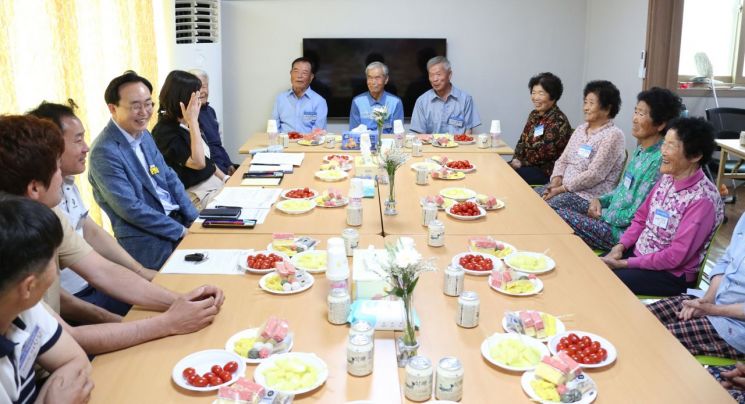 Naju City is the first in Jeollanam-do to provide standing tables and chairs to 620 senior centers within the city, creating a comfortable and safe leisure environment for the elderly. Photo by Naju City
◇Expanding and Strengthening Senior Welfare Tailored to the Elderly
Naju City is also paying significant attention to senior welfare in response to an aging population. Previously, the city accelerated the distribution of standing tables and chairs to senior centers, completing the provision to all 620 centers by the end of 2023, ahead of the phased plan that began in 2022, based on senior satisfaction.
Although a small change, this policy reflects Mayor Yoon's commitment to improving the most practical aspects first. In addition, the city provides generous support for replacing and repairing cooling systems in summer and heating costs in winter.
Separately, the Naju Senior Welfare Center was recently selected for the Ministry of Land, Infrastructure and Transport's "Public Building Green Remodeling" project. A total budget of 2 billion KRW (including 1.4 billion KRW in national funds) will be invested to transform the facility into an eco-friendly welfare center with high-efficiency insulation, windows, and HVAC systems.
◇A Mayor Who Keeps Promises... 67% Pledge Fulfillment Rate
The performance of Mayor Yoon's 8th term pledges is also noteworthy. As of the end of 2024, Naju completed or is implementing 66 out of 98 pledges, achieving a fulfillment rate of 67.34%, according to an evaluation of 226 basic local governments nationwide. This is over 14% higher than the national average fulfillment rate for basic local governments (53.05%).
As a result, Naju received the highest grade, "SA (Special A)," in the pledge fulfillment and information disclosure evaluation by the Korea Manifesto Implementation Headquarters, demonstrating the city's faithful implementation of promises to citizens.
Mayor Yoon stated, "As we enter the fourth year of the 8th term, I will do my utmost to complete the 'Yeongsangang Renaissance Era,' a promise to citizens, and to realize the 'Era of 5 Million Naju Tourists,' '200,000 Global Small but Strong City,' and 'Energy Capital of Korea.' I will devote myself fully together with over 1,200 public officials."
He added, "We will also steadily pursue key tasks such as attracting the Ministry of Climate and Energy, establishing a Northeast Asia energy industry hub linked to Bitgaram Innovation City, expediting the Gwangju-Naju metropolitan railway, restoring the history and culture of the Mahan cultural area, and relocating public institutions for Innovation City Season 2, to prepare for Naju's next 100 years."
© The Asia Business Daily(www.asiae.co.kr). All rights reserved.



















