Selected as the Lead Institution for the "Quantum Computing Service and Utilization System Establishment" Project
A Promising Combination of Supercomputers and Quantum Computers
The Korea Institute of Science and Technology Information (President Lee Sik, KISTI) announced on July 7 that it will introduce IonQ's next-generation system "Tempo," a quantum computer from the United States, as part of the "Quantum Computing Service and Utilization System Establishment Project" promoted by the Ministry of Science and ICT. (As previously reported on June 26)
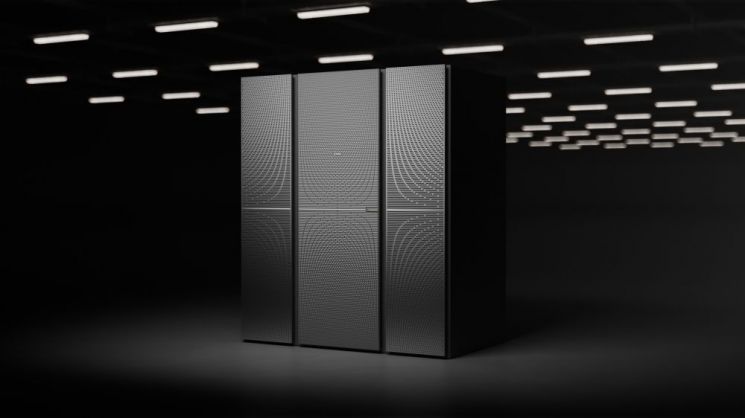
This project is a key national R&D initiative aimed at establishing a foundation for quantum computing utilization at the national level and building a hybrid computing service system that integrates supercomputers and quantum computers. KISTI was selected as the lead institution after a thorough evaluation process.
The Tempo system to be introduced at KISTI is the first barium-based, improved ion trap quantum computer, featuring long coherence times, high fidelity, and all-to-all connectivity between qubits, which significantly expands its range of applicable applications. KISTI signed a Memorandum of Understanding (MoU) with IonQ on April 16.
Ham Jaekyun, head of the Quantum Information Application Research Center at KISTI and principal researcher, explained that "Tempo will be installed in Korea for the first time in the world."
KISTI and IonQ outcompeted IBM's quantum computer, which had already been introduced in Korea, to win this project. As a result, it is expected that the domestic quantum computing landscape will expand from IBM's superconducting technology to include ion trap technology. It is known that KISTI chose IonQ as its partner with this effect in mind. The rapidly increasing use of quantum computers by researchers is also expected to accelerate further.
Through this project, KISTI plans to leverage its extensive experience in operating and servicing national supercomputing infrastructure to establish a stable quantum computing infrastructure, providing a quantum computing demonstration and research platform accessible to domestic researchers.
In addition, KISTI will implement and offer a hybrid computing platform linked to the national supercomputer No. 6, which is scheduled to be operational next year. This means that quantum computers, which have not yet achieved error-free perfect computation, can be supplemented by being connected to supercomputers centered on NVIDIA GPUs.
National Supercomputer No. 6 is similar to the AI data centers that have recently become a hot topic. Projects connecting AI data centers and quantum computers are rare even globally. The expected entry of the national supercomputer No. 6 into the global top 10, combined with quantum computing, is anticipated to create significant synergy.
KISTI plans to promote the development and dissemination of quantum computing platforms and operate a variety of programs, including quantum computing education, practice-based hackathons and workshops, and industry-tailored consulting. Through these efforts, KISTI aims to play a key role as a hub for research and industry applications of quantum computing.
According to KISTI, MegazoneCloud will participate as a joint research institution, while SDT Co., Sookmyung Women's University, Gwangju Institute of Science and Technology (GIST), and Kumoh National Institute of Technology will participate as subcontracted research institutions. These organizations will collaborate in various areas, including the construction of the quantum computer, the development and establishment of the service platform, the development of quantum computing-supercomputing hybrid technology, and user support and dissemination.
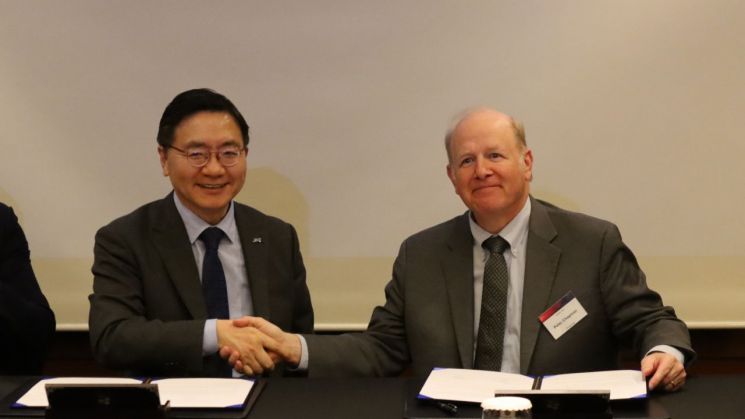
President Lee Sik stated, "The quantum computer being introduced this time will be operated not only as a standalone quantum computer but also in hybrid computing with supercomputers, enabling domestic researchers, students, and industry experts to effectively utilize the quantum computing environment. Through this project, we expect to accumulate national experience in the operation, service, and utilization of various quantum platforms, and further contribute to the advancement of domestic quantum computing research and the industrial ecosystem."
© The Asia Business Daily(www.asiae.co.kr). All rights reserved.


















