Prime Minister Carney: "Contributing to Trade Diversification"
...Energy Export Infrastructure Investment Expected to Increase
The New York Times (NYT) reported on July 7 (local time) that a Canadian liquefied natural gas (LNG) project, in which Korea Gas Corporation has invested, has commenced its first export to South Korea via an LNG carrier.
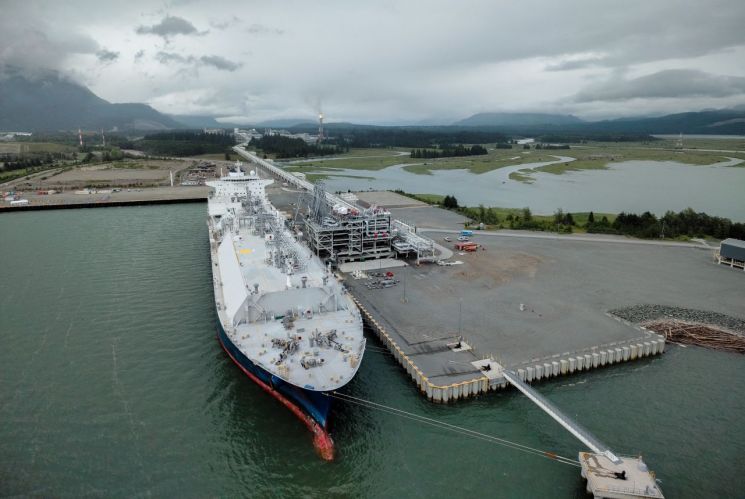 On the 28th of last month (local time), the liquefied natural gas (LNG) carrier Gaslog Glasgow docked at the LNG Canada project facility located in Kitimat, British Columbia, Canada. Photo by Reuters Yonhap News
NYT stated, "A ship carrying LNG from Canada for the first time is heading to South Korea. Through this, Canada is seeking to reduce its export dependence on neighboring countries." The article continued, "After the trade war and threats of territorial annexation initiated by U.S. President Donald Trump, Canada has been seeking to diversify its export markets, and this marks the first natural gas export to Asia."
The joint venture 'LNG Canada', which is leading this project, announced in a statement last week that it had successfully completed the loading of the first LNG carrier. Chris Coope, CEO of LNG Canada, described it as "a historic moment for all of Canada," adding, "We are proud to be part of the effort to diversify Canada's export markets and to help supply low-carbon energy to the world for decades to come."
The LNG Canada project involves the construction of a natural gas liquefaction plant and export facility on the western coast of Kitimat, British Columbia, Canada. The project, which reached its final investment decision in 2018, has a total scale of 48 billion Canadian dollars (approximately 48 trillion won). Energy company Shell leads the project with a 40% stake, while Korea Gas Corporation (5%), China’s state-owned PetroChina (15%), Malaysia’s state-owned Petronas (25%), and Japan’s Mitsubishi Corporation (15%) are participating as joint venture partners. The first phase of the completed natural gas liquefaction plant is equipped with two units capable of producing a total of 14 million tons of LNG annually. There are at least six other natural gas plants currently under development, and the LNG production capacity is expected to double in the future.
With President Trump imposing high tariffs on Canada and threatening to annex it as the 51st state, the Canadian government places great significance on this project. Although Canada, particularly Alberta, possesses vast reserves of oil and natural gas, its energy exports have relied on pipelines to the United States.
Canadian Prime Minister Mark Carney emphasized in a statement last week, "Canada has what the world needs," adding, "With LNG Canada’s first shipment to Asia, Canada will export energy to reliable partners, diversify its trade, and help reduce global (greenhouse gas) emissions by replacing coal." David Eby, Premier of British Columbia, also stressed that reducing Canada’s dependence on the United States is more important than ever, stating, "With Canada’s abundant resources and its strategic location for transportation, projects like this will drive a more independent Canada forward."
Industry analysts note that, amid geopolitical changes such as Russia’s invasion of Ukraine and the strengthening of U.S. protectionism, Canada is facing new opportunities as an energy exporter. Kent Fellows, a professor at the University of Calgary, explained, "As Russia has begun to be shunned in global trade due to the war in Ukraine, Canada’s potential to export natural gas to other countries has increased." He added, "Many countries are also viewing long-term relations with the United States as more uncertain than before, due to President Trump’s recent tariff policies."
Meanwhile, to further expand energy exports to Asia, additional large-scale pipeline construction projects connecting Canada’s oil-producing regions with export terminals are expected. In order to export Alberta’s oil and natural gas to Asian countries, it is essential to build long-distance pipelines linking oil and gas fields with port facilities in British Columbia. Earlier, Prime Minister Carney said at an event in Alberta on July 6 that there is a very high possibility that new pipeline construction projects connecting the western coast will be proposed by the private sector, according to Bloomberg News.
© The Asia Business Daily(www.asiae.co.kr). All rights reserved.

















