First Observation in March... 25 to 28 Days from Egg-Laying to Hatching
55 to 56 Days from Hatching to Fledging
The entire breeding process of the grey heron, which made its home in the bamboo forest along the Taehwagang River in Ulsan, has been observed for the first time.
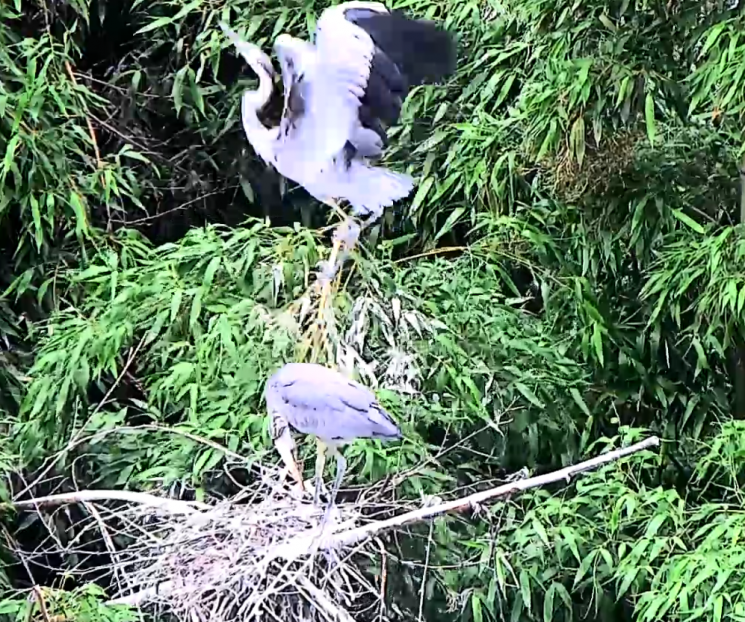
Since the installation of observation cameras in 2016, this is the first time that every stage?from mating and egg-laying to hatching and the fledging of the chicks?has been captured on camera.
The Ulsan city government announced that it had observed the complete breeding process of the grey heron nesting in the bamboo forest at Samho Migratory Bird Park along the Taehwagang River in Nam-gu, using the observation cameras installed there.
In 2020, the breeding process of baby grey herons was also observed at the Taehwagang Migratory Bird Ecological Center. At that time, the process from incubation to the chicks leaving the nest was recorded. This year, however, the entire process from the moment the female laid her eggs until the chicks left the nest was captured on camera.
The first observation occurred on March 20, when a nest with two eggs was caught on camera. At that moment, a male suddenly flew onto the nest, causing it to tilt and the eggs to fall out, marking the beginning of the observation.
On March 21, the camera captured the female grey heron (identified by her short head plumes) laying a single egg. On March 27, at around 2:50 p.m., the second egg was laid. On March 29, a third egg was laid, after which the male and female began incubating the eggs in turns.
After 28 days of incubation, on April 17, the first egg hatched and a chick emerged. The second and third eggs hatched on April 22 and April 24, respectively. This matches the breeding period of 25 to 28 days from egg-laying to hatching, as recorded in bird field guides.
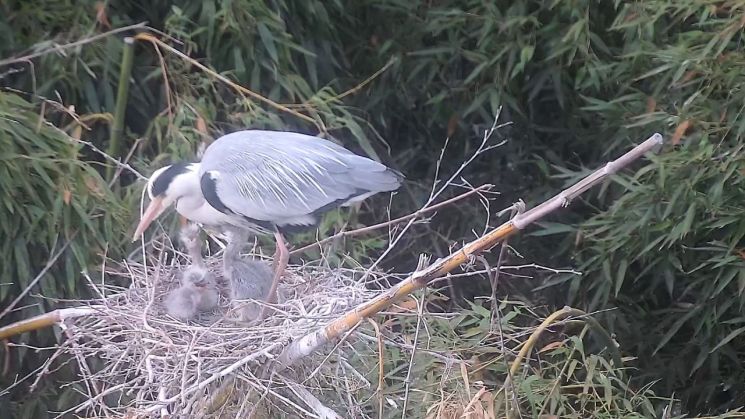
Of the three hatched grey heron chicks, the third chick was found dead after being pushed out of the nest by its siblings on May 13, just 20 days after hatching.
The remaining two chicks also faced life-threatening challenges. During a brief flight practice by the first chick, the second chick fell beneath the nest due to an unstable landing but managed to climb back up with desperate wing flapping.
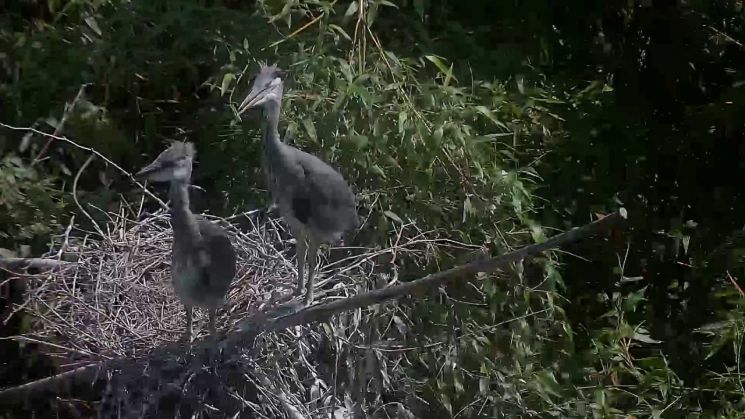
Additionally, the first chick fell under the nest after being attacked by an intermediate egret. When the second chick signaled with its wings for the first chick to climb up, the first chick managed to return to the nest.
The first grey heron chick completely left the nest on June 12, which was the 56th day after hatching. The second chick also left the nest on June 16, the 55th day after hatching.
Afterward, from June 19, intermediate egrets began occupying the empty nest, bringing food to the site.
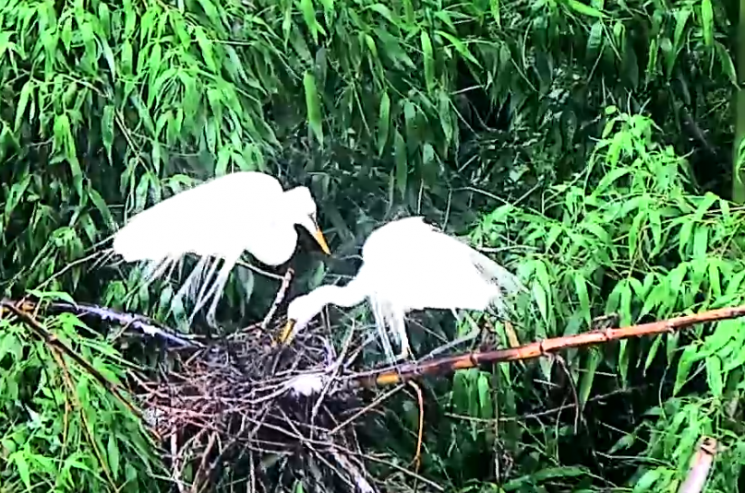
The grey heron (scientific name: Ardea cinerea, English: grey heron) is the largest species in the heron family and the largest egret species found in the Taehwagang bamboo forest. Its body length is 90 to 100 centimeters, making it larger than the intermediate egret but smaller than the great egret. Its diet includes fish, frogs, snakes, field mice, shrimp, insects, and small birds.
From late February to mid-May, the grey heron lays three to five eggs and incubates them for 25 to 28 days before they hatch. The male and female take turns raising the chicks, and it is recorded that the chicks usually fledge after 50 to 55 days. However, in this observation, the chicks left the nest after this period had passed.
A city official stated, "This observation of breeding egrets in the Taehwagang bamboo forest was made possible because an administrative intern took a keen interest and continuously reviewed and monitored the footage," adding, "The observation videos will be used for educational purposes through the Ulsan Migratory Bird Travel Bus and the Bird Safari website."
The Ulsan city government is also continuously observing other egret species that come to breed along the Taehwagang River. Seven species of egrets (grey heron, great egret, intermediate egret, little egret, cattle egret, black-crowned night heron, and Chinese pond heron) visit and breed in the Taehwagang bamboo forest.
Every year from May to July, the city operates a breeding observation experience center for visitors to observe the breeding process of egrets, the summer guests of the Taehwagang River.
© The Asia Business Daily(www.asiae.co.kr). All rights reserved.



















