A new theory explaining spin-orbit interaction without orbital angular momentum
Expected to aid development of next-generation spin-based memory semiconductors... Published in Phys. Rev. Lett.
"God does not play dice." This is a famous statement by Einstein, criticizing the probabilistic thinking of quantum mechanics.
Paradoxically, his theory of relativity has become an essential tool for explaining electrons, which are the main subject of observation in quantum mechanics. This is because electrons are particles so small that they must be analyzed using quantum mechanics, but also so fast that the theory of relativity is required.
The two theories have different starting points, making it difficult to provide a consistent explanation. However, a theory that bridges this gap was published in Physical Review Letters, the most prestigious journal in physics, on June 27.
There is now speculation that textbooks on solid-state physics, which deal with the motion of electrons, may need to be rewritten.
On July 8, Professor Nojung Park of the UNIST Department of Physics and Professor Kyunghwan Kim's team at Yonsei University announced that they have proposed a new theory that allows for a more accurate explanation of the 'spin' of electrons in solids.
 Research team, (from left) Professor Kyunghwan Kim of Yonsei University, Professor Nojung Park of UNIST, Dr. Beomseop Kim of UNIST (currently a postdoctoral researcher at the University of Pennsylvania). Provided by UNIST
Electrons have two types of rotation: spin and orbital angular momentum. If spin is likened to the Earth's rotation on its axis, orbital angular momentum can be compared to the Earth's revolution around the Sun. Spin and orbital angular momentum influence each other through 'spin-orbit coupling,' which determines properties such as magnetism and conductivity in materials.
The problem is that spin-orbit coupling is derived from the relativistic high-energy domain, whereas in environments dealing with actual materials such as solids or semiconductors, quantum mechanics at low energy is dominant.
When researchers attempt to study spin-orbit coupling within materials, the two theories have different premises, making it difficult to explain phenomena within a single computational framework. For example, it is even difficult to define orbital angular momentum precisely within a solid lattice.
The research team proposed a new theory that explains the relativistic effect of spin-orbit coupling within materials without using orbital angular momentum. They defined the concept of 'spin-lattice interaction.'
The team validated this new computational method by applying it to real physical systems.
They confirmed that for various materials?such as 1D conductors (Pt chain), 2D insulators (h-BN), and 3D semiconductors (GaAs)?they could predict spin distribution, spin current, and magnetic response more accurately and efficiently than with existing methods.
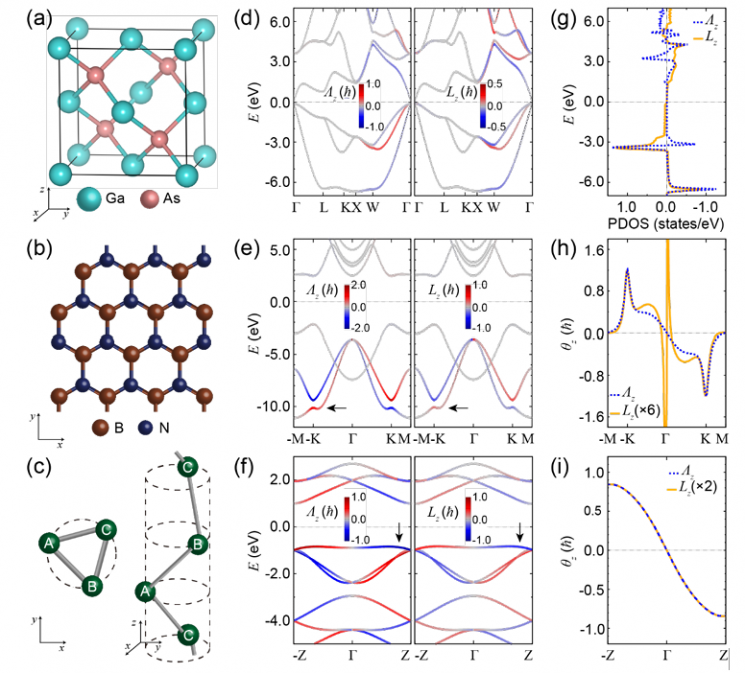 Comparison of Spin-Lattice Interaction and Conventional Spin-Orbit Coupling in 1D (Pt Chain), 2D (h-BN), and 3D (GaAs) Materials.
The joint research team stated, "This approach resolves the computational inconsistencies that have arisen from the gap between quantum mechanics and the theory of relativity," and added, "It is expected to be widely used as a fundamental theory for the design of spin-based electronic devices, such as spintronics and next-generation memory semiconductor devices."
This research was led by Dr. Beomseop Kim of UNIST (currently a postdoctoral researcher at the University of Pennsylvania) as the first author.
The study was supported by the National Research Foundation of Korea under the Ministry of Science and ICT, the UNIST-Samsung Electronics semiconductor industry-academic project, Yonsei University, and the SRC Center for Quantum Angular Momentum Dynamics.
© The Asia Business Daily(www.asiae.co.kr). All rights reserved.


















