Typhoons Split the High-Pressure System, Bringing Easterly Winds
Cooler in the East, Hotter in the West
Prolonged Heat Wave Expected in Seoul and Other Western Regions
Heat wave advisories have been issued nationwide, and most regions are experiencing continued heat with apparent temperatures around 35 degrees Celsius. In particular, this time, hotter weather is expected in areas west of the Baekdudaegan mountain range compared to the east. Emergency alerts for scorching heat have been sounded in the Seoul metropolitan area, including Seoul and Gyeonggi Province.
According to the Korea Meteorological Administration on July 8, the daytime high temperatures are forecast to range from 27 to 36 degrees Celsius. In some areas, such as Cheongju in North Chungcheong Province, Gwangmyeong in Gyeonggi Province, and Gwangjin in Seoul, the minimum temperatures are hovering between 27 and 28 degrees Celsius, indicating that the heat wave will persist both day and night for some time. On July 7, the highest temperatures in Andong and Miryang reached 39.2 degrees Celsius, nearly hitting 40 degrees.
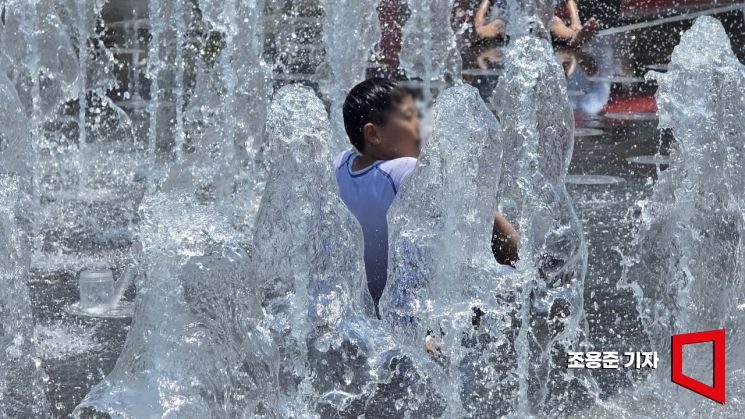 On the 19th, when the daytime high temperature exceeded 33 degrees Celsius and the humid weather continued, children visiting the fountain at Gwanghwamun Square in Jongno-gu, Seoul, enjoyed playing in the water. The Korea Meteorological Administration forecasted that starting tomorrow, heavy rain would fall nationwide due to the influence of the monsoon front. 2025.6.19 Photo by Jo Yongjun
Tropical nights are expected to continue for the time being, especially in the western regions of the Korean Peninsula and Jeju Island. A tropical night refers to a phenomenon in which the temperature remains at or above 25 degrees Celsius between 6 p.m. and 9 a.m. the following morning. Last year, Seoul experienced a total of 36 tropical nights, marking the longest period since weather observations began.
The cause of the scorching heat is that Typhoon No. 2 and No. 3, which are passing near Japan, are splitting the North Pacific high-pressure system in two, and the high-pressure system remaining to the west is affecting Korea. As this high-pressure system moves northward and Korea is positioned at its southern edge, the country comes under the influence of easterly winds. Subsequently, the heated air that has crossed the Baekdudaegan mountain range descends upon the western part of the Korean Peninsula. The Korea Meteorological Administration stated, "There is a high risk of heat-related illnesses, so people should refrain from outdoor activities and going out, and manage food thoroughly to prevent food poisoning."
Since July 7, a heat wave warning has been in effect across all of Seoul for the first time this summer. This is 18 days earlier than the first warning issued last year. The Seoul Metropolitan Government has strengthened its response system by increasing the number of heat wave response teams from five to eight. At construction sites commissioned by the city, outdoor work between 2 p.m. and 5 p.m. is to be suspended in principle, except in cases of emergency safety tasks or other unavoidable circumstances.
As the monsoon season ended early and the full-scale heat began, there have been casualties and property damage. According to the Korea Disease Control and Prevention Agency's emergency room surveillance system for heat-related illnesses, as of July 6, a cumulative total of 59 cases of heat-related illness had been reported. On July 6, there was even a fatality. At around 3 p.m. on July 6, a man in his 40s who had climbed Palgaksan in Yeongdeok, North Gyeongsang Province, collapsed while descending and lost his life. On the same day, a male hiker in his 50s was also found collapsed near a trail on Gubongsan in North Jeolla Province and ultimately died. Livestock deaths have reached 137,382, which is about three times higher than the same period last year (45,812).
© The Asia Business Daily(www.asiae.co.kr). All rights reserved.

















