Trump: "Japan Is Very Tough"
Ishiba: "Even With Allies, We Must Speak Up"
On July 7 (local time), U.S. President Donald Trump sent a letter to Japan, as well as to South Korea, newly setting a reciprocal tariff rate of 25%.
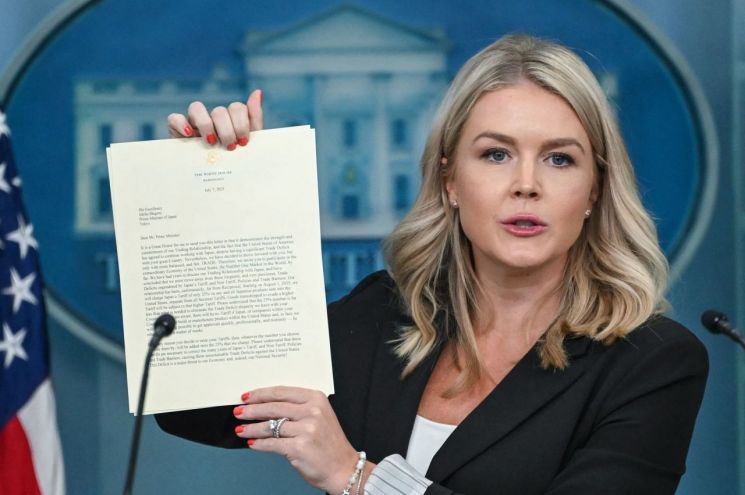 Caroline Leavitt, White House Press Secretary, displaying President Trump's tariff letter. Photo by AFP Yonhap News
In the letter to Japan, which President Trump made public on the social networking service Truth Social that day, he announced that starting August 1, all Japanese products entering the United States would be subject to a 25% tariff. He also stated that products transshipped from Japan to the United States would be subject to an even higher tariff rate.
The 25% tariff rate is a 1 percentage point increase from the 24% reciprocal tariff rate that President Trump had originally set for Japan. This is the same rate as the tariff imposed on South Korea, to which a letter was sent on the same day.
In the letter addressed to Japanese Prime Minister Shigeru Ishiba, President Trump emphasized the U.S. trade deficit with Japan and warned that if Japan raises its tariffs against the United States in response to these measures, the U.S. would further increase its own tariffs by the same amount. At the same time, President Trump added that if Japan opens its trade market and eliminates tariff and non-tariff barriers, "these tariffs will be adjusted."
Aside from the country name and the recipient, Prime Minister Ishiba, the contents of the letter were identical to those sent to South Korea. Although the tariff rate was slightly raised from the initially announced 24% to 25%, the implementation date was postponed to August 1, which is interpreted as effectively extending the tariff grace period to allow for additional negotiation time.
The Trump administration set reciprocal tariffs on 57 countries, including South Korea, on April 2, and began implementing them on April 9. However, the tariffs were immediately suspended for 90 days, and the expiration date of the suspension (the 8th) was set as the deadline for trade negotiations with each country regarding tariff rates, trade balances, and the elimination of non-tariff barriers. Previously, the United States and Japan held their seventh round of negotiations on June 27 in Washington, D.C., with Secretary of Commerce Howard Lutnick and Minister for Economic Revitalization Ryosei Akazawa, but failed to reach an agreement. At the time, Minister Akazawa reportedly extended his stay by one day to try to meet with Secretary of the Treasury Scott Besant for further negotiations, but was unable to secure a meeting.
Since then, the Trump administration has been increasing its pressure on Japan. On June 30, President Trump wrote on Truth Social, "I have great respect for Japan," but added, "However, despite suffering from a severe rice shortage, they refuse to import our rice." On July 1, aboard Air Force One, he commented regarding Japan, "We have been negotiating with Japan, but I am not sure if we will reach an agreement. I doubt we will reach a deal with Japan." He also remarked, "They are very tough," and added, "They are very spoiled."
Prime Minister Ishiba has also maintained a firm stance, saying, "Even with allies, we must say what needs to be said." Appearing on NHK's party leader debate program the previous day, Prime Minister Ishiba stated, "We (Japan) are the largest investor and job creator in the United States, and we are different from other countries." He added, "It is natural that negotiations will take time and be difficult, and we will not compromise because of this."
© The Asia Business Daily(www.asiae.co.kr). All rights reserved.

















