Government Reduces Imported Soybean Supply, Impacting Small and Medium Enterprises
Consumer Prices Expected to Rise, Concerns Over "Tofu Supply Shortage in October"
"At this rate, we may have to shut down our factory by October." This is the candid statement of a representative from a domestic tofu manufacturing company. The shortage of soybeans, the main ingredient, means that in a few months, it may no longer be possible to produce tofu. This situation is closely related to the government's decision to reduce the volume of imported soybeans supplied directly this year. Concerns are being raised that a tofu supply shortage could occur, not only affecting everyday meals for ordinary people but also impacting restaurants and school meal services.
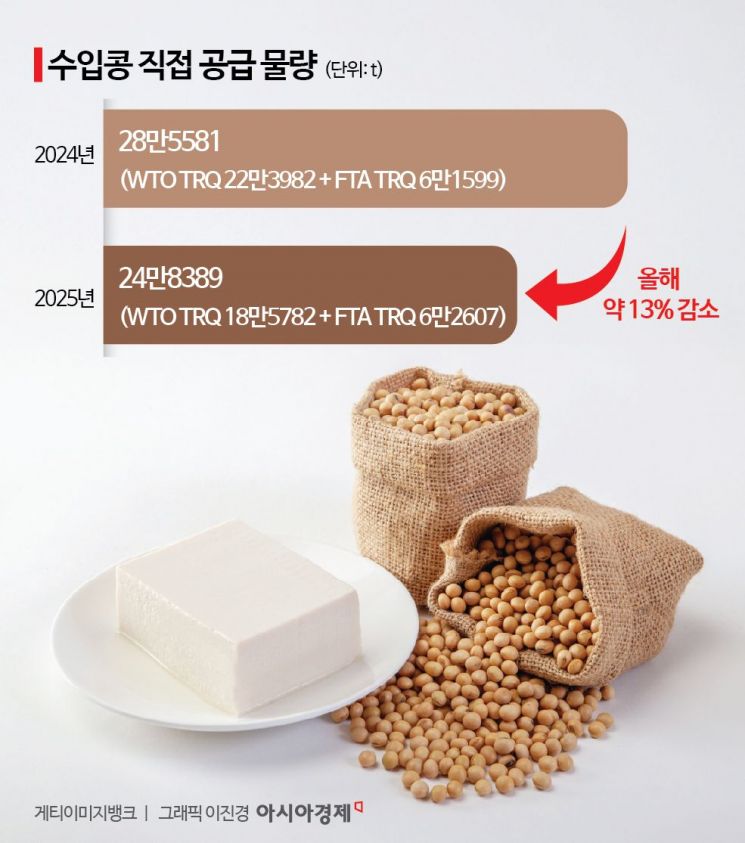
According to the tofu manufacturing industry on July 8, the supply of imported soybeans in Korea is expected to decrease significantly this year compared to last year. Industry estimates indicate that the direct supply of imported soybeans this year will be 248,389 tons, which is a decrease of 37,192 tons compared to last year's planned supply. This represents a 13% reduction year-on-year.
Soybeans, which are subject to import management and government supply control, are distributed through the 'Tariff Rate Quota (TRQ)' system, utilizing both World Trade Organization (WTO) TRQ and Free Trade Agreement (FTA) TRQ volumes. Each year, about 280,000 tons are supplied, but this year, only the basic WTO volume was supplied without any increase, resulting in a shortfall of approximately 38,000 tons. While industries using imported soybeans can procure some raw materials through state trading or import license auctions, these volumes have also decreased compared to last year.
Warning lights are flashing for companies that use soybeans as raw materials. In particular, small and medium-sized enterprises (SMEs), which lack the capacity to secure inventory, are expected to face severe instability in sourcing raw materials. About 80% of domestic tofu is made from imported soybeans, which are much cheaper than domestic soybeans, making them the primary choice for SMEs in both production and sales. There are about 1,800 small and medium-sized tofu manufacturing companies nationwide. If these companies are unable to secure supplies of imported soybeans, they may be forced to halt factory operations.
The Ministry of Agriculture, Food and Rural Affairs and the Korea Agro-Fisheries & Food Trade Corporation have reduced direct supplies of imported soybeans to protect domestic soybeans. While the policy of supporting crop diversification in rice paddies has increased domestic soybean production, consumption has remained stagnant. As a result, the supply of imported soybeans has been reduced to increase the proportion of domestic soybeans used in products such as tofu.
However, the tofu manufacturing industry points out that domestic soybeans are four to five times more expensive than imported soybeans, effectively dividing the market and making it impossible to substitute imported soybeans. An industry insider stated, "Because of the significant price gap, reducing the supply of imported soybeans will not increase domestic soybean consumption," adding, "Small and medium manufacturers that have traditionally used imported soybeans are already specialized in the imported soybean tofu market, making it impossible for them to enter the domestic soybean tofu market."
The Ministry of Agriculture, Food and Rural Affairs is aware of this situation. However, unlike the urgent concerns of SMEs, the ministry intends to first observe how much can be substituted with domestic soybeans. The ministry has implemented a discount supply program to help tofu companies switch to domestic soybeans, and the reserved supply is expected to be distributed within this month. A ministry official said, "It is still a period that requires review," adding, "We need to monitor the situation further before deciding whether to increase the supply of imported soybeans or continue supplying domestic soybeans at a discount."
The problem is that even with discounted domestic soybeans, there is still about a twofold price difference, making it impossible to replace imported soybeans as a raw material for tofu. In reality, the contracted volume of domestic soybeans to be supplied this month is only about 7,000 tons, which is known to be limited compared to the demand from tofu processing companies. Industry voices warn that if the reduction in imported soybean supply continues and only the uncompetitive domestic soybeans are pushed, small and medium-sized enterprises using soybeans for tofu, soy sauce, doenjang, and other processed products will inevitably be hit in the second half of the year. A tofu industry representative said, "Production disruptions due to raw material shortages are highly likely to be passed on to consumers as price increases," adding, "Expanding supply is an urgent matter."
© The Asia Business Daily(www.asiae.co.kr). All rights reserved.

















