Various Flying Insects Swarm Amid Scorching Heat
As Bugs Multiply, Carnivorous Plants Like Sundew Surge in Popularity
Plant Sellers Say, "Busier Than Ever"
Gaining Attention as an Eco-Friendly Pest Control Option
"Usually, orders dry up during the rainy season, but in my 25 years of work, I've never been this busy at this time of year," she said.
On July 7, Hwa Jin Lee, 61, who runs the carnivorous plant sales business 'Green Shark' in Gwangju, Gyeonggi Province, was busy watering her carnivorous plants. Typically, the rainy season is the off-season for carnivorous plant sales, but orders have continued to come in. Lee said, "This early summer, sales of carnivorous plants have more than doubled compared to the same period last year," adding, "Because so many new insects like lovebugs (Plecia nearctica) have appeared, more people are turning to carnivorous plants as an eco-friendly pest control option."
 Hwa Jin Lee, who runs a carnivorous plant sales business, is taking care of carnivorous plants. Photo by Seon Jin Byun
With the deadly heat and a surge in various bugs, more people are seeking out carnivorous plants. In particular, as local governments' pest control efforts against the invasive lovebug, which has proliferated every summer in recent years, remain limited, citizens are turning to carnivorous plants as a self-help measure.
According to Google Trends, the weekly search index for carnivorous plants reached 95?the highest point of the year?from June 29 to July 5. By region, Chungnam scored 100, Gyeonggi 70, and Seoul 66. Google Trends converts the change in search volume for a specific keyword into a relative value from 0 to 100.
Carnivorous plants are gaining attention as an eco-friendly pest control method. They can be safely used instead of insecticides in spaces shared with children or pets.
By far the most popular carnivorous plant is the sundew. It secretes a sticky mucus on the surface of its leaves to attract and trap flying insects, which are then digested, allowing people to see the captured bugs with their own eyes. Sundews are effective not only against lovebugs but also for catching fruit flies and mosquitoes, and they are popular because a single pot can be purchased for between 5,000 and 10,000 won. Park Jungyong, 41, who is raising a six-year-old child, said, "After buying a sundew, I could see one or two bugs stuck to the leaves within a day or two," adding, "My child found it interesting, so it was educational as well."
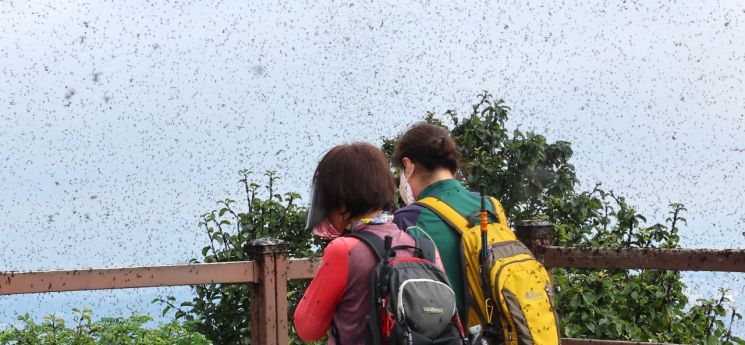
Han, 37, who lives in Nowon-gu, Seoul, also purchased a carnivorous plant as an alternative after lovebugs started entering her home two weeks ago. Choi, 55, who runs a restaurant, recently brought a sundew into her establishment. Choi said, "I used to keep the door open to attract customers, but I had trouble when lovebugs came in. Seeing the bugs actually get caught gives me confidence in its effectiveness."
Some argue that local governments should take a more active role in pest control. This is because not only lovebugs but also other summer insects, such as the Asian mayfly, could become rampant. The Asian mayfly, nicknamed 'Tinkerbell,' often swarms around lights such as street lamps, causing discomfort, but like the lovebug, it is not officially designated as a pest.
Seung Kwan Shin, a professor in the Department of Biological Sciences at Seoul National University, said, "Even if an insect does not cause direct harm to humans, there is sufficient need for pest control if it causes inconvenience in daily life or damages aesthetics," adding, "After scientific evaluation of insecticide effectiveness, appropriate concentrations, and environmental impact, an integrated, ecology-based pest control strategy is needed."
© The Asia Business Daily(www.asiae.co.kr). All rights reserved.


















