Korea Automobile & Mobility Industry Association: "Global Electric Vehicle Market Status"
"Rising Uncertainties Threaten Long-Term Sustainability"
One out of every five new cars registered worldwide this year has been an electric vehicle, according to recent data.
According to the "Global Electric Vehicle Market Status from January to May" report released by the Korea Automobile & Mobility Industry Association on July 7, approximately 7.73 million electric vehicles were sold globally from January to May, marking a 33.6% increase compared to the same period last year. Electric vehicles include battery electric vehicles (BEVs), plug-in hybrid electric vehicles (PHEVs), and fuel cell electric vehicles (FCEVs).
Sales of battery electric vehicles reached 5.02 million units, up 34.5% year-on-year, accounting for 13.7% of the total new car market. Sales increased in most regions except Japan, with strong growth in Europe and China driving the overall expansion.
Plug-in hybrid electric vehicle sales rose 31.9% year-on-year to 2.72 million units, representing 7.4% of the total new car market.
The growth of the global electric vehicle market was largely driven by China and Europe, the two largest markets. China, as the largest electric vehicle market, saw sales rise 41.1% year-on-year to 5.22 million units, accounting for 40.1% of the global market.
The European market grew 24.2% year-on-year to approximately 1.43 million units, while the United States recorded sales of about 600,000 units, a 5.7% increase compared to the previous year.
In contrast, the Japanese market declined for the second consecutive year, falling 10.3% year-on-year to around 40,000 units. This decrease was attributed to several factors: the complexity of revised subsidy programs despite increased EV subsidies, declining sales of Nissan's mini electric vehicles, a lack of new models, delays in charging infrastructure development, and strong demand for hybrid electric vehicles (HEVs).
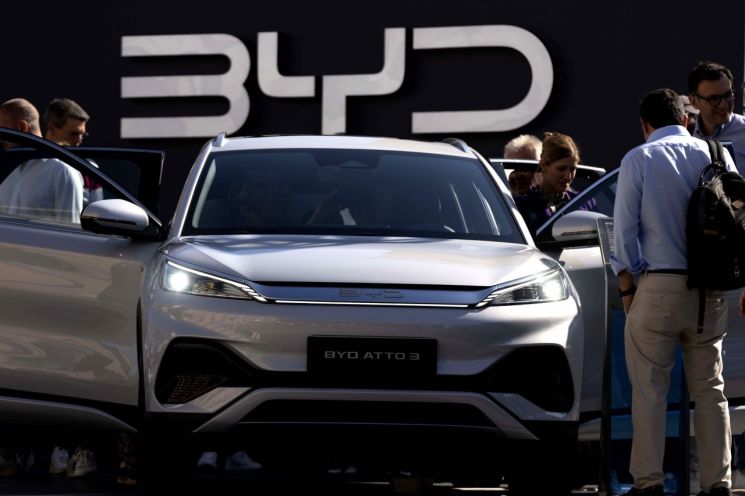
By manufacturer, Chinese companies such as BYD showed remarkable growth.
BYD sold 1.96 million units, a 44.8% increase year-on-year, driven by domestic market stimulus policies, expanded production, and aggressive price cuts. Geely Group, which owns Volvo, Polestar, and Zeekr, recorded 780,000 units, up 81.8% from the previous year, surpassing Tesla to take second place.
Tesla sold 630,000 units, a 19.0% decrease year-on-year, as sales dropped simultaneously in China, the United States, and Europe. This was due to intensified competition in China, delays in the launch of the new Model Y, and backlash against Elon Musk's political activities. Hyundai Motor and Kia ranked ninth with 220,000 units sold.
The report pointed out that, despite continued growth in the electric vehicle market, a range of complex uncertainties are expanding and threatening its long-term sustainability.
The report stated, "The strong pro-internal combustion engine policies being pursued by the second Trump administration in the United States, such as the repeal of Inflation Reduction Act (IRA) incentives, are maximizing uncertainty in the huge U.S. electric vehicle market and could affect the pace of electrification." "Chinese companies, backed by strong government support, are intensifying global price competition through aggressive price cuts and new product launches, raising concerns about declining sales and deteriorating profitability for major non-Chinese manufacturers."
Kang Namhoon, president of the Korea Automobile & Mobility Industry Association, emphasized, "It is essential to encourage technological innovation and production investment by companies through consistent and stable policy support, and to maintain a long-term and predictable incentive system. This will be a key driving force in securing leadership in future industries and promoting the joint growth of the entire related ecosystem."
© The Asia Business Daily(www.asiae.co.kr). All rights reserved.


















