Surface and Perceived Temperatures Rise by 2 to 3 Degrees
Urban High-Temperature Zones Expand Outward, Intensifying Heat Island Effect
Heat-Related Illness Cases Begin to Increase Again
Over the past three years, heat environment indicators have generally increased throughout Gwangju. Regardless of whether the area is urban or suburban, there has been a clear upward trend in surface temperature, humidity, perceived temperature, and heat index.
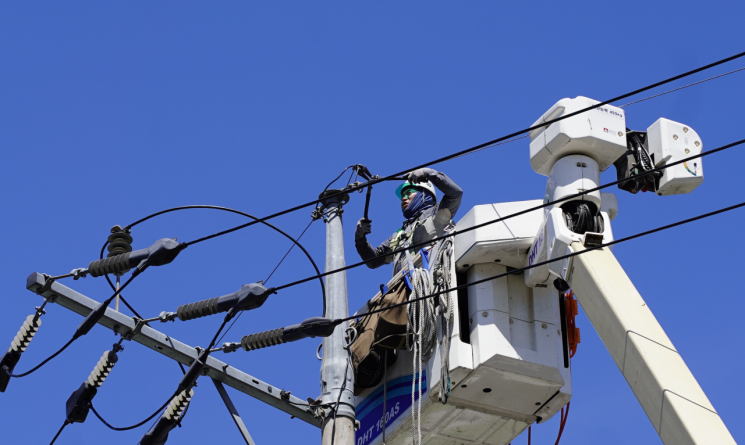 On the afternoon of the 2nd, when a heatwave warning was issued, an electrical worker climbed onto a high-altitude work vehicle to perform live-line work in Wonsan-dong, Nam-gu, Gwangju. The electricity they handle is 22,900 volts, and high-risk work continues under the summer sun, exposing them to the danger of electric shock. Photo by Song Bohyun.
According to the "Planning Study for the Establishment of a Detailed Heatwave Vulnerability Map for Creating a Cool City," announced by the Gwangju Climate and Energy Agency on July 7, the summer heat environment indicators in Gwangju from 2022 to 2024 have generally risen compared to 2019 to 2021. The average surface temperature in urban areas has increased from 36-37 degrees Celsius to above 38 degrees, and the perceived temperature has also risen from an average of 35-36 degrees to as high as 38 degrees.
Both of these indicators have increased by an average of about 2 to 3 degrees. In particular, high-temperature zones have been clearly observed to expand outward from densely populated commercial and residential areas in the city center. It is analyzed that both the range and intensity of heat diffusion have increased simultaneously.
The heat index, which quantifies the intensity of heat by reflecting both temperature and humidity, also rose from an average of 22-24 to 24-25. When the heat index exceeds 27, the risk of heat-related illnesses such as heatstroke increases. Along with the rise in these indicators, the actual number of heat-related illness cases is also on the rise.
The number of heat-related illness cases in Gwangju surged until 2018, then showed a decline for a period, but has been increasing again since 2022. The proportion of heat-related illness cases was particularly high in densely populated districts such as Buk-gu and Gwangsan-gu.
Except for Mudeungsan, most of Gwangju consists of a basin topography at an altitude below 200 meters, which makes it prone to heat accumulation. In addition, decades of urbanization and unplanned development have reduced green spaces and increased the area of artificial pavement, making it even more difficult for heat to dissipate and escape.
Kim Jongpil, secretary general of the Gwangju Environmental Movement Association, stated, "Recently, apartment complexes have been concentrated along riversides and mountains, blocking wind paths and worsening the urban heat island effect. With the climate crisis intensifying, Gwangju's temperature is likely to rise even further in the future. It is urgent to create wind corridors and establish carbon reduction measures."
© The Asia Business Daily(www.asiae.co.kr). All rights reserved.
![Clutching a Stolen Dior Bag, Saying "I Hate Being Poor but Real"... The Grotesque Con of a "Human Knockoff" [Slate]](https://cwcontent.asiae.co.kr/asiaresize/183/2026021902243444107_1771435474.jpg)
















