SPD: "Initiating Dissolution Proceedings Against Far-Right AfD"
Constitutional Court Approval Unlikely... "Complex Procedures"
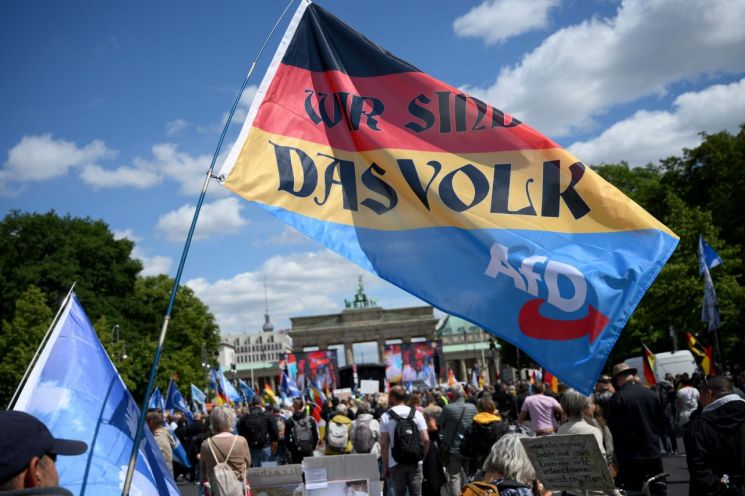 In May, the German Federal Office for the Protection of the Constitution (BfV) designated the far-right party Alternative for Germany (AfD) as a right-wing extremist organization, prompting AfD supporters to hold protests in downtown Berlin. Photo by AFP Yonhap News
The Social Democratic Party (SPD), a key member of Germany's coalition government, is attempting to initiate dissolution proceedings against the far-right party Alternative for Germany (AfD), but the process is proving difficult. AfD enjoys significant popularity, having secured over 20% support in the general election this February. There are widespread concerns that a forced attempt to disband the party could backfire, resulting in an even more solidified base of far-right supporters.
German SPD: "AfD is an illegal party, will begin dissolution proceedings"
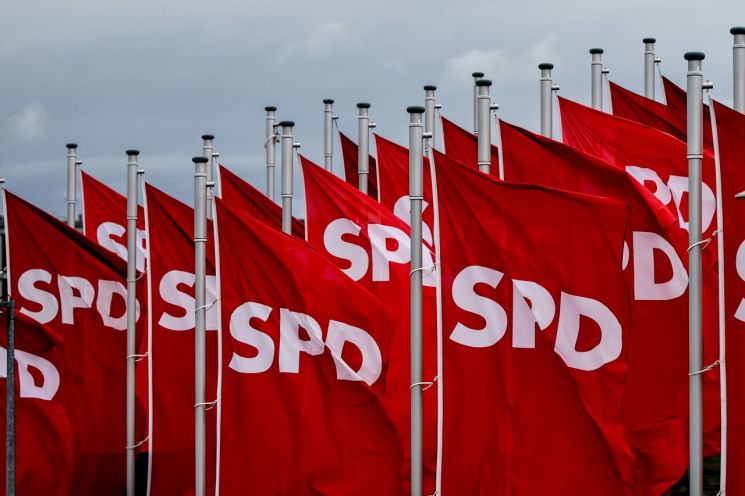
According to German public broadcaster Deutsche Welle, on June 30 (local time), the SPD announced at its party congress that it would designate AfD as an unconstitutional party and begin the process of dissolving it. At the party congress, a resolution urging the dissolution of AfD was passed unanimously, and the SPD now plans to file a petition with the German Federal Constitutional Court to request a ruling on AfD's unconstitutionality and dissolution.
SPD co-leader and German Vice Chancellor Lars Klingbeil emphasized at the congress, "There is no room for hesitation when the intelligence agency has already designated this party as an extremist force," adding, "We must now create the conditions to immediately submit a motion to the Constitutional Court to determine whether AfD is unconstitutional."
In early May, the German Federal Office for the Protection of the Constitution (BfV) stated that AfD had been "proven to be a right-wing extremist force" and confirmed that "suspicions that it pursues a line threatening the basic order of liberal democracy have been substantiated." The BfV explained, "AfD does not recognize immigrants of Islamic background as equal members of society and displays an exclusionary attitude toward race and ethnicity." The agency added, "Since 2021, authorities have classified AfD as a suspected right-wing extremist organization and begun surveillance. Going forward, parliamentary approval procedures for measures such as communications monitoring will be further streamlined."
Strict requirements for party dissolution by the German Constitutional Court: "Unconstitutionality must be clear"

However, there is a prevailing view that the German Constitutional Court's procedures and requirements for dissolving a political party are so strict that any application for dissolution is likely to be rejected.
For a party to be dissolved through a constitutional court ruling in Germany, two conditions must be met: first, the party must engage in actions and hold militant positions that oppose the liberal democratic order; second, it must have sufficient popular support to pose a real threat to democracy. Because these criteria are ambiguous, trials can be prolonged.
In the case of the minor neo-Nazi party Die Heimat, which openly identifies as a neo-Nazi party, the party faced constitutional dissolution proceedings in 2003, 2007, and 2021. However, all cases were dismissed on the grounds that the party did not have enough popular support to threaten the democratic system. Only public funding and tax benefits for the party were withdrawn.
Till Holterhus, a constitutional law professor at Leuphana University of L?neburg, told CNN, "A constitutional dissolution trial involves reviewing thousands of pages of evidence and witness testimony to determine whether the party has truly acted unconstitutionally." He added, "Since World War II, only two parties have been dissolved: the Socialist Reich Party (SRP), which was the successor to the Nazis, and the far-left German Communist Party (KPD). Party dissolution itself is considered a last resort and is conducted with extreme caution overall."
Within German political circles, there is also opposition to the move, with some arguing that a failed dissolution attempt could simply provide a rallying point for far-right forces. Thorsten Frei, Chief of Staff to Chancellor Friedrich Merz, said in an interview with German public broadcaster ARD earlier this month, "If we do not have clear evidence, an application to dissolve AfD could backfire," emphasizing, "We need to be more cautious about dissolution measures and must confront AfD through political means."
© The Asia Business Daily(www.asiae.co.kr). All rights reserved.



















