Aiming to Secure Seats in Next November's Midterm Elections
Party Registration Uncertainty and Enormous Costs Pose Major Hurdles
Elon Musk, CEO of Tesla, who was once referred to as U.S. President Donald Trump's "first buddy" but has recently become a new political rival, announced the formation of a new party. However, analysts point out that the reality of American politics, where it is difficult for a third party to gain a foothold, stands as a major obstacle in his path.
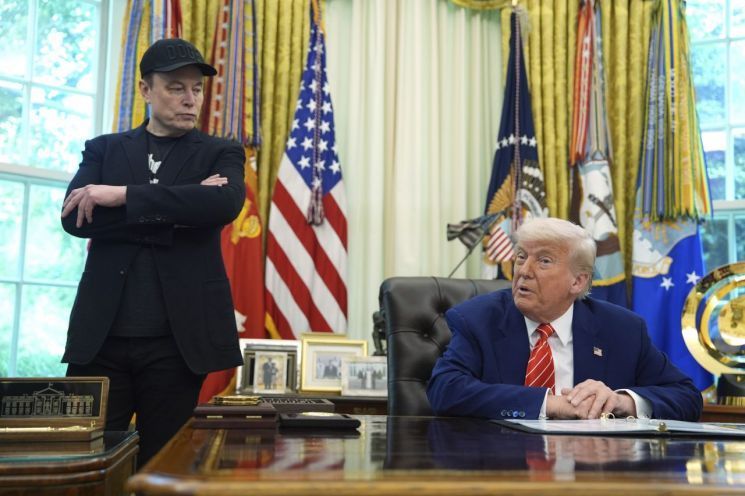
On July 5 (local time), Musk announced on X (formerly Twitter), "Today, the 'America Party' is being founded to return freedom to you." Musk, who has opposed President Trump's "one big, beautiful bill" (tax cut bill) that includes tax cuts and large-scale spending plans, argued that both of the established major parties, the Republicans and Democrats, are "in cahoots" and are driving America to bankruptcy.
In a post the previous day, Musk said, "We will focus intensely on 2-3 Senate seats and 8-10 House seats," adding, "With this, we can sufficiently act as the deciding votes on controversial bills." This signals his intention to hold the casting vote and block President Trump's policies. Musk is expected to first recruit Republican lawmakers who opposed the tax cut bill on the grounds that it does not align with his political philosophy and whom President Trump has singled out as targets for defeat in the next election. However, it has been reported that Musk has not yet initiated the official party formation procedures with the Federal Election Commission (FEC).
However, CBS News pointed out that, given the different party and election laws in all 50 states and the checks from the established political powers, forming a national party "could be a daunting task even for the richest person in the world." U.S. election expert Brett Kappel analyzed, "Every state's laws are biased in favor of the two major parties and make it difficult for third parties to emerge," adding, "There are extremely high barriers to forming a new party and getting on the ballot. If you have unlimited money, it is possible, but it would be a project spanning several years and would cost hundreds of millions of dollars."
Musk's net worth is estimated to be around $350 billion. Therefore, the financial aspect may not pose a significant problem for him. However, even aside from this, it is expected to be difficult for him to field new party candidates in the midterm elections in November of the following year as he intends. In the United States, a federal system, the requirements for party formation and election candidacy vary by state. For example, in California, a party must register either by having 0.33% of voters (about 75,000 people) join as party members or by collecting 1.1 million signatures. Even after registration, if the number of party members falls below the threshold or voter turnout is insufficient, the party's qualification is revoked.
Starting as a state-level party and then expanding into a national party is also expected to be a tough challenge. To become a national party, one must obtain advisory opinions from the FEC, but established parties often try to block this through lawsuits and other means.
CBS explained, "Just looking at the hardships existing third parties have faced shows how difficult the process of forming a new national party is," adding, "The Green Party and Libertarian Party were established decades ago, but they are still struggling to get on state ballots and register as parties." The Washington Post also pointed out, "Parties outside the U.S. two-party system have existed for a long time, but in recent years, there have been few cases of nationwide support," noting, "The last time a presidential candidate who was not from the Republican or Democratic Party won electoral votes was in 1968, when George Wallace of the American Independent Party won five southern states."
Additionally, the Washington Post noted that billionaire Ross Perot, who ran as an independent in the 1992 U.S. presidential election, received 18.9% of the national vote but failed to secure a single electoral vote due to the winner-takes-all system.
© The Asia Business Daily(www.asiae.co.kr). All rights reserved.

















