People with Sensitive Skin Advised to Wash After Contact
According to experts, swarms of red-bodied gnat flies, commonly known as lovebugs, are considered beneficial insects for the ecosystem, but may cause skin irritation in people with sensitive skin.
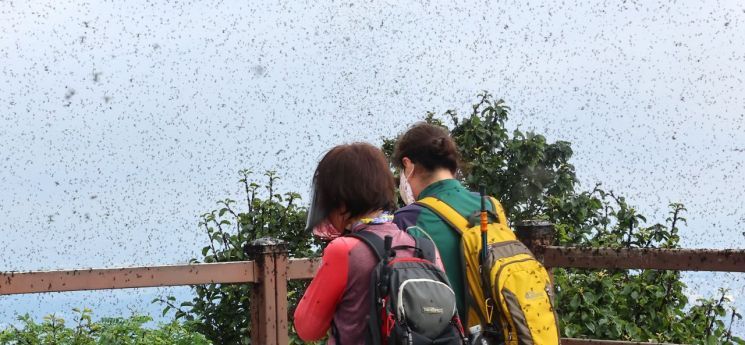 On the morning of the 30th of last month, the summit of Gyeyang Mountain in Gyeyang District, Incheon, was covered with lovebugs (red-bodied gnat flies), causing inconvenience to hikers. Photo by Yonhap News
As of July 5, the medical community reports that unlike other insects that secrete highly toxic fluids, lovebugs do not possess toxic substances that cause severe blisters on the skin. A professor of dermatology stated, "There is currently no medical evidence that the bodily fluids or excretions of lovebugs directly cause dermatitis." However, the professor also explained, "If the remains or excretions of lovebugs remain on the skin for a long time in hot and humid conditions, bacteria may proliferate or oxidants may form, which can lead to irritant contact dermatitis." These skin symptoms are reported to occur more frequently in individuals with weakened skin barriers.
Experts recommend that people with weak skin barriers wash the affected area with lukewarm water and a mild cleanser after contact with lovebugs. If mild itching or burning occurs, applying a cold compress and using a low-irritant moisturizer can help alleviate symptoms. In cases of severe irritation or if swelling or blisters develop, a topical low-concentration steroid may be used, but if symptoms persist, it is essential to seek medical attention from a dermatologist.
Even for those who are not particularly sensitive, it is recommended to follow basic hygiene practices during periods when lovebugs are prevalent. It is advisable not to rub insects off the skin with your hands; instead, use a dry towel or wet tissue to wipe them off and wash your hands afterward.
Lovebugs belong to the family Bibionidae in the order Diptera. They are characterized by their unique habit of moving around in male-female pairs. Although they were first reported in Korea in 2022, recent analyses suggest that their population has surged due to rising temperatures and changes in their habitat. While they play a beneficial role in the ecosystem, their tendency to approach people has led to growing complaints from citizens.
Complaints related to lovebugs have increased from around 4,400 cases in 2022 to approximately 9,200 cases last year. Lovebugs typically appear temporarily from mid-June to early July and then naturally disappear, but as citizens have continued to report inconveniences, the Ministry of Environment recently implemented eco-friendly control measures using water in the Gyeyang Mountain area of Incheon, where the outbreak was severe. Kim Donggun, director of the Environmental Ecology Research Institute at Sahmyook University, explained, "Since lovebugs can develop resistance to insecticides, it is better for the ecosystem to control their population using environmentally friendly methods rather than chemical control."
© The Asia Business Daily(www.asiae.co.kr). All rights reserved.
![Clutching a Stolen Dior Bag, Saying "I Hate Being Poor but Real"... The Grotesque Con of a "Human Knockoff" [Slate]](https://cwcontent.asiae.co.kr/asiaresize/183/2026021902243444107_1771435474.jpg)
















