Nikkei Analyzes South Korea's Stock Market Rally
"Similar to Former Prime Minister Abe's Signature Policy"
Analysis Suggests Focus on Stock Prices Aims to Attract Capital
There has been analysis within Japan suggesting that President Lee's stock market policies are similar to the economic policies pursued by former Japanese Prime Minister Shinzo Abe after he returned to power at the end of 2012.
According to a report by Nihon Keizai Shimbun (Nikkei) on the 5th, as of July 3, the KOSPI index had risen by about 30% since the beginning of the year, the highest among the Group of Twenty (G20) countries. On June 20, the KOSPI index surpassed the 3,000 mark for the first time in three and a half years.
An official from Nomura Securities told Nikkei, "Purchases of large-cap stocks by foreign investors are pushing up the market."
Nikkei analyzed that President Lee Jaemyung is showing an attitude of trying to make the stock market an "ally," as evidenced by his declaration to usher in the "KOSPI 5000 era."
Nikkei commented that this approach is similar to former Prime Minister Abe's remarks in September 2013 at the New York Stock Exchange, where he urged investors to "buy my Abenomics." "Abenomics" refers to Abe's signature economic policy.
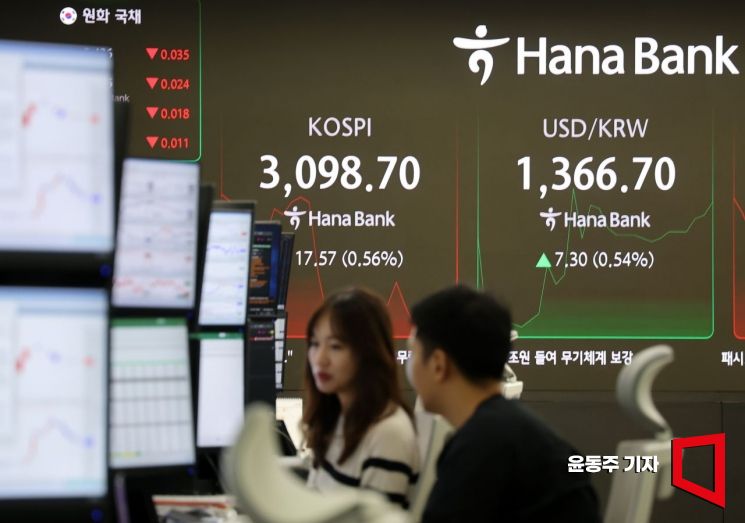 On the 4th, the index status board in the dealing room of Hana Bank in Jung-gu, Seoul, displays information on KOSPI, KOSDAQ, and exchange rates. Photo by Yoon Dongju.
At that time, foreign investors who trusted Abe's remarks invested in the Japanese stock market, and in 2013, the Nikkei 225, Japan's leading stock index, rose by as much as 57%.
Nikkei noted, "Foreign investors pay close attention to whether a government is friendly toward the stock market," adding, "South Korea lost credibility after former President Yoon Sukyeol declared emergency martial law in December 2024, but President Lee's remarks show an intention to attract capital by emphasizing a pro-stock market stance."
The newspaper also reported that the amendment to the Commercial Act, which passed the National Assembly on July 3, includes a provision requiring executives of listed companies to prioritize shareholder interests in their duties. Nikkei pointed out that such institutional reforms are also similar to Abenomics.
Nikkei explained, "The Abe administration pursued bold monetary policies, proactive fiscal policies, and growth strategies to encourage private investment." At the time, Japan established the foundation for a reevaluation of its stock market by encouraging companies to introduce independent outside directors representing minority shareholders and to increase return on equity (ROE).
However, the newspaper added that it takes time for reforms to bear fruit, and that in Japan, reforms stalled, leading foreign investors to turn to net selling in 2015 and 2016.
Nikkei also noted that in South Korea, both government approval ratings and stock prices have risen with the launch of the new administration, but projected that whether the KOSPI reaches 5,000 will depend on the results of reform implementation.
© The Asia Business Daily(www.asiae.co.kr). All rights reserved.

















