ERP Integration Completed After Emart-Everyday Merger
Expansion of Integrated Purchasing and Large-Scale Discount Events
Emart announced on July 4 that following its merger with Emart Everyday, it has fully launched an integrated Enterprise Resource Planning (ERP) system, accelerating innovation across all areas of distribution, including integrated purchasing and logistics.
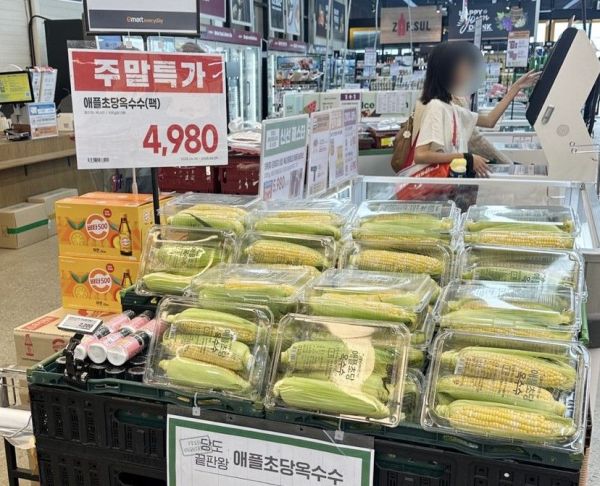 'Unique Popular Agricultural Products' Chodang Corn displayed at Emart Everyday store. The integrated purchasing of Emart and Everyday has enabled an increase in the supply of trendy fresh food products, and the integrated ERP system has also contributed to this integrated purchasing. Provided by Emart.
In July last year, Emart completed an absorption-type merger with Everyday, officially launching the integrated Emart. The company unified its operational system by incorporating Everyday into the existing ERP system, which already covered Emart, Traders, and No Brand, as of April this year.
The system integration applies to the entire distribution process, from purchasing to logistics, display, and checkout. By standardizing data structures that were previously managed separately by business type, Emart has established a foundation for providing customers with a faster and more accurate shopping experience.
The company expects that the integration will further enhance its purchasing competitiveness and increase the scale of operational cost savings. Emart, Traders, No Brand, and Everyday now manage the entire distribution process?including purchasing, ordering, inventory, and logistics?within a single ERP system. This structure enables the company to source more products at lower prices. Major promotions such as the “Goraeit Festa” are also being held jointly with Everyday, maximizing the synergy of integration.
A notable example is the “Yukyuk (Meat Meat) Day” event held in June. Emart offered imported pork belly at around 700 KRW per 100 grams, about 40% lower than the previous year. This was possible because Emart and Everyday jointly purchased inventory, increasing the daily supply of imported pork belly from an average of 9 tons last year to over 30 tons this year.
Seafood products such as mulhoe (spicy raw fish soup) and live abalone, which were rarely seen at Everyday, a Super Supermarket (SSM), are now being displayed. Due to the logistical challenges of delivering seafood directly from the source, SSMs previously found it difficult to sell these items. However, integrated purchasing has secured a stable distribution network, allowing Everyday to expand its product range. In addition, products that require a certain minimum purchase volume, such as Chodang corn and Russet potatoes, are now being sold as well.
Operational efficiency has also improved. Previously, suppliers had to prepare separate contracts to supply both Emart and Everyday simultaneously, but now this can be handled at once. As a result, productivity has improved by 60%.
Improvements have also been made to the logistics system to reduce logistics costs per unit. In May, Emart integrated the ambient logistics function of the Everyday Gyeongsan logistics center into the Emart Daegu logistics center. The company plans to sequentially transfer the ambient logistics function of the Everyday Pyeongtaek center to the Emart Yeoju and Siwha centers during the second half of the year.
Meanwhile, Emart plans to further enhance management efficiency by actively utilizing new technologies such as AI in addition to the integrated ERP. On June 30, Emart launched an “AI Chatbot Service” in collaboration with Copilot Chat. This service, designed for Emart employees, automatically provides guidance on complex food-related regulations such as Ministry of Food and Drug Safety standards, and collects various data to predict prices and demand for agricultural products like cabbage. It is designed to learn from data not covered by general-purpose generative AI, supporting Emart’s unique “optimal product planning.” Emart stated, “By actively utilizing new IT technologies, we will continue to increase customer-perceived benefits such as automated product display, personalized product recommendations and promotions, and improved delivery speed, and solidify our position as a leading company in the distribution industry.”
© The Asia Business Daily(www.asiae.co.kr). All rights reserved.

















