Number of Hong Kong Visitors to Japan Drops by 11.2% in May
The domestic airline and travel industries are closely monitoring the situation surrounding the "July Japan Megaquake Theory." As of July 4, one-way tickets from Incheon to Narita on low-cost carriers (LCCs) are priced between 50,000 and 70,000 won.
This is in contrast to July last year, when round-trip tickets rose to the 400,000 won range. The airline industry believes that a combination of factors?including the appreciation of the yen, increased supply of flights to Japan, and the megaquake theory?have contributed to this situation.
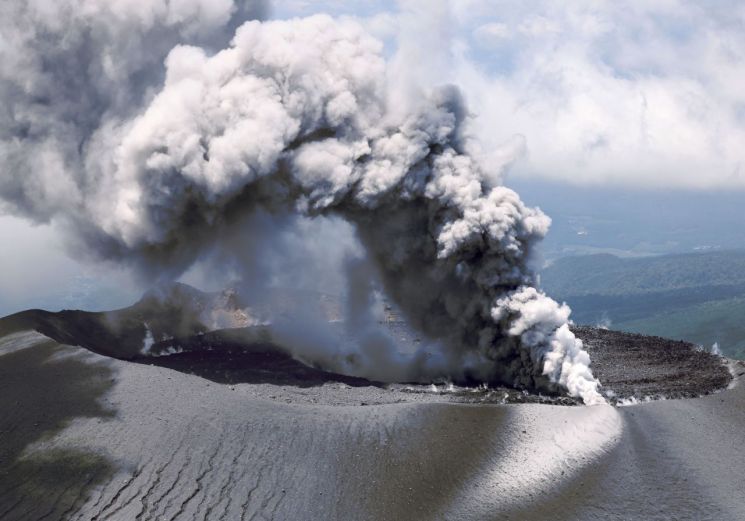 Kyodo News reported that smoke from Shinmoedake, an active volcano in Kyushu, Japan, soared up to 5,000 meters in the sky on the 3rd. The photo shows the eruption of Shinmoedake on June 28. Photo by Yonhap News
The region most sensitive to the Japan megaquake theory is Hong Kong. On July 2, Greater Bay Airlines of Hong Kong announced it would temporarily suspend regular routes connecting Hong Kong with two small Japanese cities, starting September 1.
According to Kyodo News, the airline explained that the spread of the megaquake theory in Hong Kong led to a sharp decline in passengers and deteriorating business performance, making it difficult to maintain these routes. Previously, for the same reason, the airline reduced some flights between Hong Kong and Tokushima and Sendai in May.
In the same month, it was also reported that the Chinese Embassy in Japan advised Chinese nationals living in Japan to be cautious about earthquakes and to carefully consider purchasing real estate in Japan.
 'The Great Disaster was in March 2011' on the cover of a Japanese manga book. Screenshot from Aladin.
The airline industry sees the appreciation of the yen, increased supply of flights to Japan, and the megaquake theory as complex, interrelated factors. However, the reactions of netizens and others are quite different.
On social networking services (SNS), it is easy to find people who say they have changed their travel plans out of concern for earthquakes. One user commented, "I'm worried, but since I can't cancel, I'm going anyway," and another said, "I'm so happy the tickets are cheaper."
These reactions stem from the 2021 reissue of the Japanese manga "The Complete Edition of The Future I Saw." The manga artist, Ryo Tatsuki, who claims to frequently have prophetic dreams, first published the work in 1999 based on what she saw in her dreams.
At the time of its initial release, the manga did not attract much attention. However, after the 2011 Great East Japan Earthquake, the phrase "The Great Disaster was in March 2011" on the cover of the manga became widely known, leading to renewed interest. The out-of-print original was traded for over 1 million won on secondhand markets and auction sites, and some people even impersonated Tatsuki.
To address various controversies, Tatsuki released a complete edition in 2021, adding a new prophecy that "the real disaster will occur in July 2025." She claimed that a massive explosion under the sea between Japan and the Philippines would trigger a mega-tsunami that would engulf Pacific coastal countries.
The Japan Meteorological Agency maintains that there is no scientific basis for Tatsuki's megaquake theory. On June 13, Ryoichi Nomura, head of the Japan Meteorological Agency, stated at a press conference that he believes the megaquake theory is "just a rumor."
© The Asia Business Daily(www.asiae.co.kr). All rights reserved.


















