"High-Rise Buildings Across the Korean Peninsula Could Be Affected"
As anxiety spreads due to predictions of a "major earthquake in Japan in July," an analysis has emerged suggesting that if an actual earthquake occurs, the Korean Peninsula could also be affected.
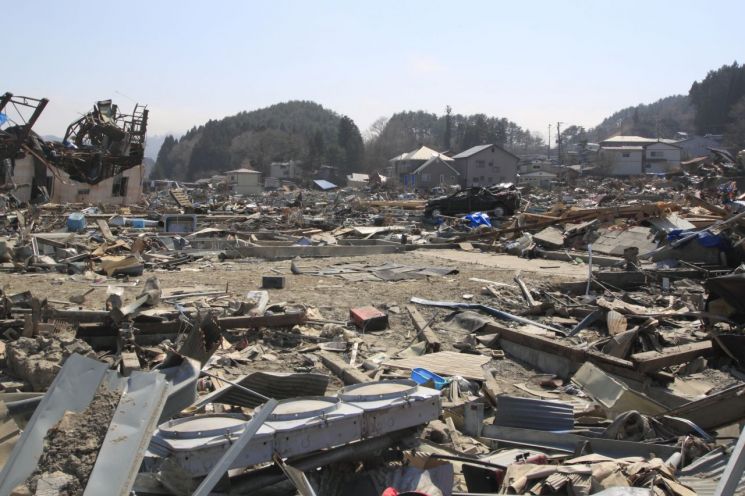 Debris of buildings destroyed by the earthquake during the Great East Japan Earthquake. Getty Images
On July 3, Hong Taekyung, a professor in the Department of Earth System Sciences at Yonsei University, stated on CBS Radio's "Park Jaehong's Hanpan Seungbu" that "the southern part of the Korean Peninsula is within 500 kilometers of the Nankai Trough," and explained, "If a major earthquake is expected there and its magnitude is large, a significant amount of low-frequency energy will be released, which could affect high-rise buildings along Korea's southern coast and, more broadly, throughout the entire peninsula." He added, "An earthquake in Japan's Nankai Trough may not be just someone else's problem."
In particular, in Korea, there are not as many buildings with seismic design as in Japan, so the damage could be greater. Professor Hong said, "In fact, we have little experience with major earthquakes," and continued, "Although our buildings are equipped with seismic performance, we have never actually tested them against earthquakes. During the last Nankai Trough earthquakes in 1944 and 1946, there were no high-rise buildings in Korea."
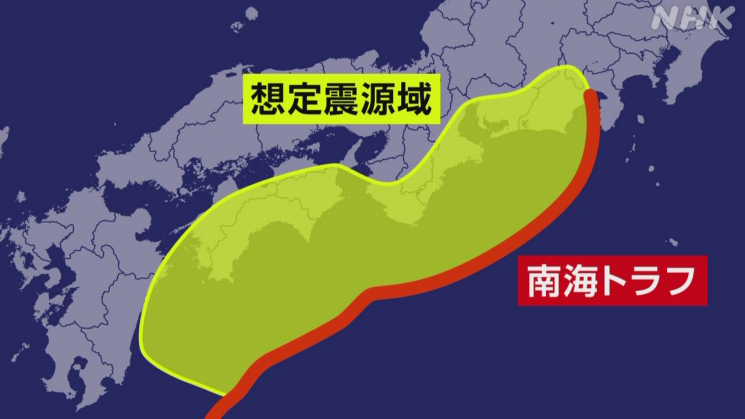 The Nankai Trough, known as 'Nankai Teropeu,' is a region with a high likelihood of a major earthquake caused by the Nankai submarine trench. Japan NHK
He went on to say, "The magnitude 7.1 earthquake that occurred on August 8, 2024, was clearly recorded along Korea's southern coast, and at that time, the area moved up and down by about 1 centimeter. If a magnitude 9.0 earthquake, which is 1,000 times stronger than a magnitude 7.1, were to occur, the Korean Peninsula would shake by more than 30 centimeters."
Regarding the heightened anxiety caused by more than 1,000 earthquakes occurring near the Tokara Islands since late June, he commented, "The so-called Tokara theory has not been scientifically verified much, and it seems to be a topic mainly discussed among the public." He added, "Since June 20, there have been about 60 earthquakes of magnitude 4.0 or higher, all within a 25-kilometer radius, and among them, 17 were magnitude 5.0. Yesterday, there was also a magnitude 5.6 earthquake."
Professor Hong said, "Even though this is a plate boundary, it is extremely unusual for so many earthquakes of magnitude 4 or higher to occur in such a concentrated manner in one place over a short period. Usually, this kind of phenomenon is observed after a major earthquake of magnitude 9.0 or 8.0, when aftershocks occur. The occurrence of these earthquakes indicates that a great deal of stress has accumulated at this location and has not yet been released."
© The Asia Business Daily(www.asiae.co.kr). All rights reserved.


















