Research Collaboration to Strengthen Global Infectious Disease Response Capabilities
The "National Infectious Disease Response Infrastructure Project," made possible by a donation from the family of the late Lee Kunhee, former chairman of Samsung Group, is now entering full-scale implementation.
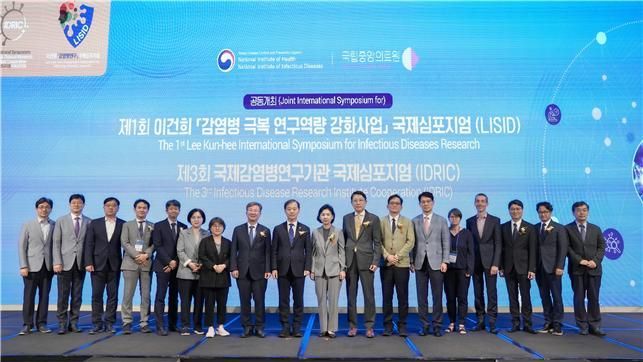 On the 3rd, attendees are taking a commemorative photo at the "1st Lee Kunhee Infectious Disease Overcoming Research Capacity Enhancement Project International Symposium" held at Dragon City Hotel in Yongsan-gu, Seoul. Korea Disease Control and Prevention Agency
The National Institute of Infectious Diseases at the Korea National Institute of Health, under the Korea Disease Control and Prevention Agency, announced on the 4th that it held the "1st Lee Kunhee Infectious Disease Overcoming Research Capacity Enhancement Project International Symposium" together with the National Medical Center at Dragon City Hotel in Yongsan-gu, Seoul, on the 3rd.
This symposium was organized to share the direction and research achievements of the research capacity enhancement project, which is being launched in earnest this year, and to promote cooperation between institutions. The National Institute of Infectious Diseases and the National Medical Center are co-hosting the event, with the International Vaccine Institute (IVI) participating as a partner organization.
Previously, in 2021, the family of Chairman Lee donated 700 billion won to establish infrastructure to respond to and overcome infectious diseases, which pose a threat to humanity.
Taking into account the intent of the donation, the Korea Disease Control and Prevention Agency decided to promote six key research areas that meet the criteria of public interest, urgency, and innovation, by linking the public healthcare system for infectious disease response with infectious disease research and clinical practice. Specifically, 18 detailed projects have been selected to advance clinical collaboration and data infrastructure for the rapid development of vaccines and therapeutics in the event of an infectious disease crisis, and to pursue the development of new-concept antimicrobial agents to overcome antibiotic resistance. In addition, the agency plans to build infrastructure such as an Infectious Disease Clinical Research Center in the future, and to expand cooperation with domestic and international research institutes and companies.
At the symposium, Jang Heechang, Director of the National Institute of Infectious Diseases, delivered a keynote speech on the theme "Overview of the Lee Kunhee Infectious Disease Overcoming Research Capacity Enhancement Project: The Legacy of Giving and the Future of Infectious Disease Response." The first session introduced the establishment of a national clinical trial network and research infrastructure for overcoming antibiotic resistance, while the second session featured presentations by domestic and international experts on research projects such as strengthening medical response capabilities for pandemic preparedness based on infectious disease hospitals.
At the "3rd Infectious Disease Research Institutions International Symposium (IDRIC)" held on the 4th, presentations and discussions will take place under the theme "Strengthening Vaccine and Therapeutic Development and Research Collaboration for Future Pandemic Preparedness and Response," in line with the pan-government "Mid- to Long-Term Plan for New Infectious Disease Pandemic Preparedness," to enable the rapid development of vaccines and therapeutics.
Lee Hyunhoon, Second Vice Minister of Health and Welfare, stated, "It is highly significant that we have established a framework for international cooperation at the national level by building a collaborative system among domestic and international research institutions, centered on the National Institute of Infectious Diseases and the National Medical Center, to strengthen our capabilities for future pandemic preparedness and response." He added, "In particular, the meaningful donation from the family of the late Chairman Lee Kunhee has served as a catalyst for expanding the national infrastructure needed for infectious disease treatment and research, laying the foundation for conducting research on comprehensive preparedness and response throughout the entire cycle of infectious diseases, and providing an opportunity to further advance our infectious disease management system."
Ji Youngmi, Commissioner of the Korea Disease Control and Prevention Agency, said, "Through the successful implementation of this project, we will strive together with the Ministry of Health and Welfare and the National Medical Center to support the rapid development of vaccines and therapeutics, and to ensure that the donation is used in line with the goal of building global infectious disease crisis response capabilities."
© The Asia Business Daily(www.asiae.co.kr). All rights reserved.

















