Manufacturing CEO Issues Unprecedented Warning on AI Unemployment
Amazon Also Signals Job Cuts
Calls Grow for Employment Restructuring and Social Safety Nets
Jim Farley, CEO of Ford, has issued a warning about the possibility of mass unemployment among office workers due to the spread of artificial intelligence (AI). It is unusual for the CEO of a major U.S. manufacturing company, rather than a Silicon Valley executive, to publicly address the employment shock that may result from AI.
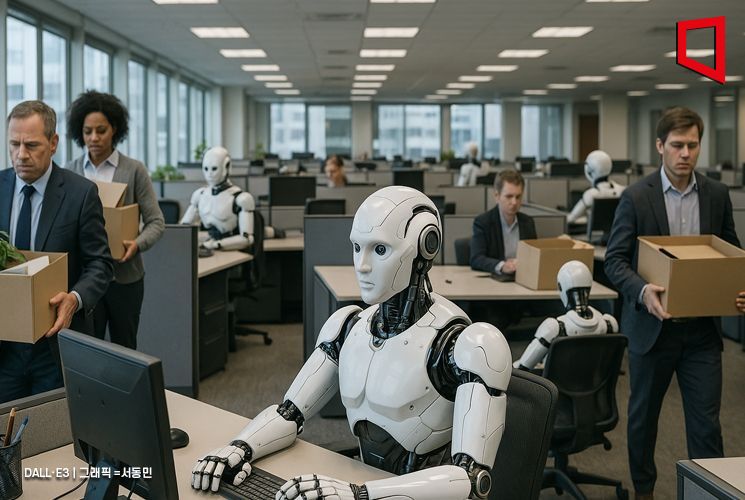
In an interview with The Wall Street Journal (WSJ) on July 2 (local time), CEO Farley stated, "AI will literally replace half of America's office workers," adding, "Many office workers could be left behind." He expressed particular concern that non-productive roles and mid-level management positions could be directly impacted by AI.
The WSJ described Farley's remarks as "among the sharpest from U.S. corporate CEOs outside Silicon Valley," and assessed that corporate leaders are only now beginning to seriously confront the employment risks posed by AI.
Farley's warning is already becoming a reality. Amazon now operates more than 1 million robots across its global logistics facilities, and approximately 75% of all deliveries are now handled by robots. While Amazon remains one of the largest employers in the United States, the average number of employees per logistics facility was about 670 as of last year, the lowest level since 2015.
Andy Jassy, CEO of Amazon, remarked last month that "generative AI and AI-based software agents are fundamentally changing the way work is performed," and predicted that the number of office workers will decrease in the coming years.

Duolingo, a foreign language learning service provider, announced that it will gradually stop hiring contract workers for tasks that can be handled by AI. E-commerce company Shopify now requires managers to justify why a new hire cannot be replaced by AI when making hiring requests, and Moderna has instructed its teams to launch new products without adding staff.
Concerns about AI-related unemployment risks are spreading not only in Silicon Valley but also in the financial sector. Marianne Lake, CEO of Community Business Banking at JPMorgan Chase, recently predicted that the adoption of AI could result in a 10% reduction in operations staff over the next few years.
Dario Amodei, CEO of Anthropic, an OpenAI competitor, warned that "within the next five years, half of all entry-level office jobs could disappear, and the unemployment rate could soar to as high as 20%." He criticized, "Political and economic leaders must stop sugarcoating the realities of the labor market."
There is a growing call for discussions on restructuring employment and establishing social safety nets. David Autor, a professor at the Massachusetts Institute of Technology (MIT), emphasized that "AI could render existing workers' skills obsolete or diminish their value," and stressed the need for well-designed safety nets and policies.
The International Monetary Fund (IMF) has also argued that about 40% of jobs could be affected by AI, and that building social safety nets to mitigate this impact is urgently needed.
© The Asia Business Daily(www.asiae.co.kr). All rights reserved.


















