1,536 Units in Pyeonbaek Village, 200 Sinsa-dong Area
1,360 Units in Sanse Village, 237 Sinsa-dong Area
Creation of Walkways, Resident Rest Areas, and Sports Facilities in Bongsan Neighborhood Park
A total of 2,896 apartment units, with buildings up to 33 stories high, will be supplied in the Sanse·Pyeonbaek Village area of Sinsa-dong, Eunpyeong-gu.
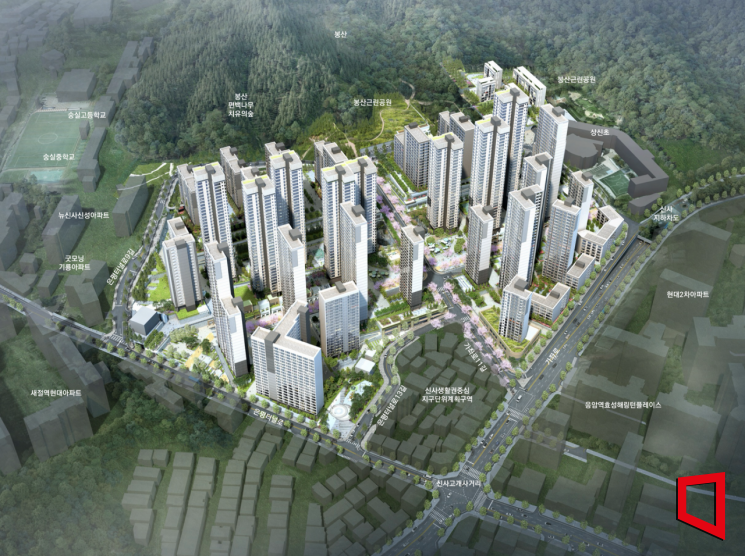 Aerial view of Sintong Planning in the area of 200 and 237 Sinsa-dong, Eunpyeong-gu. Provided by Seoul City
On July 4, the Seoul Metropolitan Government announced that the 6th Urban Planning Committee’s Subcommittee for Rapid Integrated Planning and Maintenance Projects had approved, with amendments, the 'Housing Redevelopment Maintenance Plan Decision, Maintenance Zone Designation, and Landscape Review (draft)' for the redevelopment project in the area of 200 Sinsa-dong (Pyeonbaek Village) and 237 Sinsa-dong (Sanse Village).
The target site, a steep slope near Bongsan Neighborhood Park, was not selected in the August 2022 public redevelopment candidate site contest. However, in December of the same year, it was chosen as a private redevelopment candidate site on the condition of establishing an integrated plan linking Sanse and Pyeonbaek Villages. As a result, a maintenance plan (draft) was prepared through Sintong Planning. Pyeonbaek Village will have a total of 1,536 units, while Sanse Village will have 1,360 units.
This maintenance plan features an upgrade of the Type 1 and Type 2 (up to 7 stories) General Residential Areas to Type 2 General Residential Area, and applies a business feasibility adjustment coefficient to enhance profitability. In addition to the base floor area ratio (FAR), a 20% FAR relaxation is granted for supplying small-sized housing, and a business feasibility adjustment coefficient of 2.0 is applied, expanding the allowable FAR by 40%. The legal maximum FAR is also relaxed, thereby securing business feasibility.
Reflecting the hilly terrain adjacent to Bongsan, mid- to low-rise buildings of 6 to 10 stories and 12 to 17 stories will be arranged near Bongsan to secure views. A landscape that opens up sightlines to Bongsan along Gajwa-ro 11-gil will be created, and a three-dimensional architectural plan utilizing site elevation differences will be established.
In Pyeonbaek Village (around 200 Sinsa-dong), up to 33 stories and 1,536 units (including 209 rental units) will be built. The existing Bongsan Neighborhood Park will be expanded by 1,381 square meters, and a small park of 1,678 square meters is planned at the entrance to the hiking trail.
The width of Gajwa-ro 11-gil will be widened from the current 6 meters to 12 to 15 meters, and a new ring road (6 to 8 meters wide) will be constructed along the boundary of Bongsan Neighborhood Park. Eunpyeong Tunnel-ro 13-gil (9 to 15 meters wide) will be newly established, and infrastructure such as a park (4,608 square meters) and a social welfare facility (347 square meters) will be greatly expanded.
In Sanse Village (around 237 Sinsa-dong), a floor area ratio of 257% will be applied, and up to 33 stories and 1,360 units (including 193 rental units) will be constructed. In the western neighborhood park, sports facilities with a total floor area of 3,167 square meters?including a swimming pool, gym, and GX room?will be installed to provide residents with spaces for exercise and relaxation. Additional infrastructure such as a neighborhood park (4,512 square meters) and public open space (294 square meters) will also be expanded.
Going forward, through integrated review and project implementation plan approval, the city aims to complete the move-in of all 2,896 units by 2037. The Seoul Metropolitan Government stated that, including the redevelopment of 200 and 237 Sinsa-dong, a total of 194,000 units will be supplied through Rapid Integrated Planning.
Choi Jinseok, Director of Housing at the Seoul Metropolitan Government, stated, "Through the redevelopment of 200 and 237 Sinsa-dong, a sustainable residential area where the city and nature coexist will be reborn," adding, "We will continue to expand high-quality residential environments in the city center through citizen-centered public services and regionally tailored development."
© The Asia Business Daily(www.asiae.co.kr). All rights reserved.

















