The Realistic Tariff Target Is 10%
Trump Remains Skeptical About an Agreement With Japan
Negotiations With India Are in the Final Stages
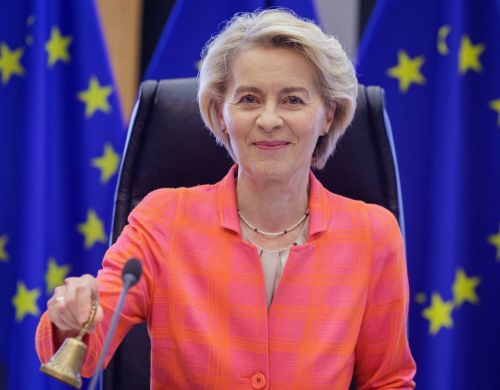 Ursula von der Leyen, President of the European Commission, is speaking at a meeting held in Brussels, Belgium on the 2nd (local time). Photo by EPA Yonhap News
Ursula von der Leyen, President of the European Commission, announced on the 3rd (local time) that she is aiming for an "agreement in principle" rather than a "final agreement" by the 8th, which is the tariff negotiation deadline set by U.S. President Donald Trump.
At a press conference held before talks with the United States on the same day, President von der Leyen said, "The EU and the United States have the largest trade volume in the world, amounting to 1.5 trillion euros (approximately 2,405 trillion won) annually, which is a tremendous challenge." She added, "What we are seeking is an agreement in principle, as it is impossible to reach a detailed agreement within the given 90 days."
Previously, on April 2, President Trump announced reciprocal tariffs on a country-by-country basis for the entire world, but then postponed their implementation for 90 days and entered into negotiations with each country individually.
With five days remaining until the negotiation deadline, the United States has already concluded trade agreements with three countries: the United Kingdom, Vietnam, and China. The United States signed a trade agreement with the United Kingdom on the 8th of last month, applying a 10% tariff rate, making it the first country in the world to do so. With Vietnam, the United States reached an agreement the previous day to apply a 20% tariff rate. With China, which had the most confrontational relationship, the two countries reached a partial agreement focusing on rare earth and semiconductor sanctions.
The realistic goal that the EU is seeking is known to be a 10% tariff rate. EU diplomats told the Financial Times (FT) that "the EU is willing to accept a comprehensive 10% tariff," but also pointed out that further discussions are needed for additional reductions on steel (50%) and automobiles and related parts (25%).
Japan, which was considered one of the United States' priority negotiation partners, is unexpectedly facing difficulties in its negotiations with the United States. In particular, Japan's passive stance on opening its rice market has angered President Trump. On the 1st, President Trump expressed skepticism about the possibility of a U.S.-Japan trade agreement, calling Japan a "spoiled country" and warning that Japan's reciprocal tariff rate could be raised from the current 24% to as high as 30-35%.
The South Korean government has also acknowledged that its negotiations with the United States are facing difficulties. Jeremy Chan, a senior analyst at Eurasia Group and a 'Korean Peninsula expert,' said in an interview with CNBC in the United States the previous day, "President Lee Jaemyung's reference to a 'mutually beneficial outcome' means that South Korea expects reciprocal concessions from the United States, not just one-sided proposals from Korea."
Negotiations between India and the United States are believed to be in their final stages. The Financial Times reported this on the 1st. Previously, White House spokesperson Karoline Leavitt also stated at a regular briefing on the 30th of last month, "You will soon hear from the President and the trade team as the agreement is in its finalization stage."
Meanwhile, although Vietnam became the first country in the Indo-Pacific region to negotiate with the United States, there are concerns that it may have to pay the price for accepting unfavorable terms. Vietnam is subject to a 20% U.S. tariff rate, which is higher than the 10% applied to the United Kingdom, but the United States receives duty-free treatment when exporting to Vietnam. In particular, since Vietnam agreed to a 40% tariff rate on transshipped products, there is a high possibility that China may retaliate in the future.
© The Asia Business Daily(www.asiae.co.kr). All rights reserved.

















